FrankyLttrs
Active Member
I've owned this Yamaha RX-300U since new. It's been sitting in a cabinet for 20 years and I thought I might resurrect it. It's a model no one cares about, but it is dear to me because it is the first piece of non-essential electronics my wife and I bought when we were starting out. On powerup the left channel would take a long time to come in, and then if you turned the volume up beyond 50% it would go into protect mode.
Popped the hood and I actually was happy to see it had discrete finals, I assumed being late '80s it would be STKUnobtaniums. Given the discrete finals, I thought I might expend some effort on it.
![IMG_0790[1].JPG](/forums/data/attachments/2685/2685098-e55a469a4f737934d1b1b24ab275090f.jpg?hash=5VpGmk9zeT "IMG_0790[1].JPG")
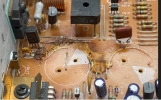
On closer look, uh oh, corrosive glue around the power caps.
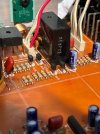
Not only corrosive glue, but someone missed with the glue gun and nailed a driver. I don't have a schematic, but I'm guessing that's the left channel.
![IMG_0792[1].JPG](/forums/data/attachments/2685/2685104-23015a5ff1da7a56bad5e9dce37cbb39.jpg?hash=IwFaX_Hael "IMG_0792[1].JPG")
An even more gruesome shot. The stuff was all over a bunch of bare jumpers and got so hot in some places it discolored the board. I guess the glue had enough conductivity that it was working as a heating element.
![IMG_0803[1].JPG](/forums/data/attachments/2685/2685108-cc4617a29d2fc08c784a2b834fc14bed.jpg?hash=zEYXop0vwI "IMG_0803[1].JPG")
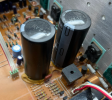
Removed the power caps and cleaned it up as best I could. Fun fact, there was NO glue under the power caps, it was just glopped on the side. 34 years ago, whoever was running the glue gun had one job...
![IMG_0808[1].JPG](/forums/data/attachments/2685/2685336-265a0dc463a198fcc4d86476d0745efd.jpg?hash=JloNxGOhmP "IMG_0808[1].JPG")
So on reboot, it comes on properly and will run at full power...but the left channel is weak and distorted. Two out of three ain't bad! Given the amount of corrosion on the driver transistor, I'm not surprised. I don't have any spares for the transistors so maybe I'll get some and give it another go, or maybe not, RX-300Us go for like $50 on eBay.
I learned a lot (they were still using the corrosive glue in the late '80s), developed some new skills (dental tools work great to clean the glue off), and I got to try out my new desoldering gun (sweet!!).
Final note, what is up with Yamaha and their signal routing? This thing has terrible crosstalk between the receiver stage and the other inputs. It's at the board level. The receiver stage is in the back next to the AUX inputs, they run both signals in parallel traces from front to back, and the receiver is never off, so at maximum amplification on the AUX and no AUX signal, you hear the radio. Been that way since day one and is part of the reason it's been in the cabinet for 20 years. And what about routing the un-rectified output from the transformer in parallel with the output signals (first picture)? Isn't that like, rule #1 to not run unshielded DC signals in parallel with AC power lines? A CA-610II I'm working on does the same thing.
Popped the hood and I actually was happy to see it had discrete finals, I assumed being late '80s it would be STKUnobtaniums. Given the discrete finals, I thought I might expend some effort on it.
On closer look, uh oh, corrosive glue around the power caps.
Not only corrosive glue, but someone missed with the glue gun and nailed a driver. I don't have a schematic, but I'm guessing that's the left channel.
An even more gruesome shot. The stuff was all over a bunch of bare jumpers and got so hot in some places it discolored the board. I guess the glue had enough conductivity that it was working as a heating element.
Removed the power caps and cleaned it up as best I could. Fun fact, there was NO glue under the power caps, it was just glopped on the side. 34 years ago, whoever was running the glue gun had one job...
So on reboot, it comes on properly and will run at full power...but the left channel is weak and distorted. Two out of three ain't bad! Given the amount of corrosion on the driver transistor, I'm not surprised. I don't have any spares for the transistors so maybe I'll get some and give it another go, or maybe not, RX-300Us go for like $50 on eBay.
I learned a lot (they were still using the corrosive glue in the late '80s), developed some new skills (dental tools work great to clean the glue off), and I got to try out my new desoldering gun (sweet!!).
Final note, what is up with Yamaha and their signal routing? This thing has terrible crosstalk between the receiver stage and the other inputs. It's at the board level. The receiver stage is in the back next to the AUX inputs, they run both signals in parallel traces from front to back, and the receiver is never off, so at maximum amplification on the AUX and no AUX signal, you hear the radio. Been that way since day one and is part of the reason it's been in the cabinet for 20 years. And what about routing the un-rectified output from the transformer in parallel with the output signals (first picture)? Isn't that like, rule #1 to not run unshielded DC signals in parallel with AC power lines? A CA-610II I'm working on does the same thing.