• The move to the new server is done. There are some software and database maintenance updates in process. This has us passing the hat around to help out. We appreciate any donations. Seriously, even a dollar helps. The payment page may be found here - https://www.audiokarma.org/support.html

MOJO AMT3 Next Gen V.1

automojo

OurBandCouldBeYourLife
Subscriber
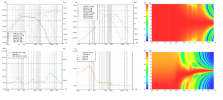
Here is a revised crossover for those wishing to upgrade their AMT3's. The crossover point are 550hz and 19.9khz.
The design also takes into account the driver location and baffle shape of the stock cabinet.
PLEASE NOTE-THIS IS A SEALED CABINET-YOU WILL HAVE TO PLUG ANY PORTS.
SOME AMT3'S WERE SEALED FROM THE FACTORY.
As well as these specific driver parameters.
So no patching in random drivers.
Mid-driver: Eminence Alpha 6a
Woofers(x2 )Dayton Audio DA270-8
The new production model will work the same DS270-8
Use 20 watt or greater on LF
L1 l3 L4 L5 15-18 gauge l2 20-21 gauge is fine.
Bipolar are fine for LF Caps.
The Dayton woofers were selected for 2 main reasons.
They have clean low distortion response, and their ability to work well in a 2x configuration with the stock AMT3 cabinet in a sealed bass box.
And don't cost a arm and a leg.
A sealed box eliminates for the most part group delay.
The Alpha 6a is a extremely clean and uncolored mid/midwoofer driver.
It's longevity speakers for itself.
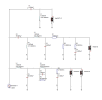

Automojo Final AMT3.PNG
 
Last edited:
Register to hide this ad
This should qualm those that don't like the crossover point so low for power handling, sound of the stock crossover.
Plus it's taking into account the same cabinet and driver perimeters as a production speaker-so much less DIY, and real 'science' (sic) behind the design.
As far as the driver-the Alpha 6a is one of the best drivers in it's class-STILL.
The Dayton Al cone woofers are really under rated, esp for the $.
Again-these are SEALED cabinets.

The good news is you can finally make your AMT3's into a well-designed modern speaker-that still has the vintage flair and sound (i.e musicality).
The real drawback to the 3 was the power handling.
Ess proved the Heil could go low-but if you have a good/great midrange-their is really no need if they are well integrated.
The Dayton woofers are one of the few that works well in this cabinet x2, and sealed.
No need for a subwoofer, I will Guarantee you that.
Totally different animal then stock AMT3's-the bass is clean forceful and deep when called for.
No whimpy Alnico tin pan alley woofer bass.
But to get the most out of it-use some baffle bracing
 
Last edited:
Automojo: I understand the LF xover point of 550hz. The twin woofers handle more bass and more power. Looks like the Alpha 6 connects out of phase like in the original xover. I don't understand the xover point to the Heil. You wrote 19.9khz. I can't hear that high. Is that what you meant?
 
Automojo: I understand the LF xover point of 550hz. The twin woofers handle more bass and more power. Looks like the Alpha 6 connects out of phase like in the original xover. I don't understand the xover point to the Heil. You wrote 19.9khz. I can't hear that high. Is that what you meant?
Opps!
Sharp eye-forgot the decimal point!
1.9khz
 
When I had my original pair of 4 coil crossover AMT3's-they had 4 ohm woofers and Peerless mids.
Those were much better sounding then the 3 coils-
But they still had a imbalance.
AS they sit-before implementing this-I have the Heil l-pad barely on-the Alpha 1/2 on.
I was experimenting with a Rogue Medusa class D hybrid.
And managed to get the Heil to start buzzing.
I picked of a set of OG Tekton Lores last year and have been playing with this combo, along with a Rogue Atlas.
I have to say the AMT3's as they sit hold up darn well.
But with the combination I have of new drivers-they should be able to play cleaner.
But they are, for better or worse hamstrung by the low crossover point.
So making them a traditional 3-way, with a great clean sounding, (still) affordable midrange was my goal.
And optimize the cabinet, driver layout, and driver parameters.
Especially those looking at empty cabinet w/only Heils or a mix/match of drivers.
 
Some design notes:
Measurements of Great Heil assumes Joeseph Crowe measurements.
Filters are based around offset and slightly modified 2nd order Butterworth which gives a reasonable power response.
RC Zobels on midrange and LF drivers; fixed damping on the midrange which is helping shape to the target/intended transfer function
Small parallel notch on woofers to help suppress their stopband resonance.
A rising response on the Heil was left to give some flexibility with a adjustable (4ohm) L-pad-so highly recommended, unless compensated.
Myself am a fan of l-pads on mids and tweets.
FIY-the l-pad will shift the crossover frequency slightly upward a little-depending on what's dialed in.
Nominal crossover frequencies:550z & 1.9khz
Line interior with foam, and 1 or 2 sheets of 1-1/2" foam behind woofers.
If able highly recommend a brace in between the woofer openings.
 
Last edited:
As for caps-on this project I'm going with Jantzen Standard Z Caps for the mid and Heil. And some spare Solen/Jatzen Cross-Caps and Dayton's for the LF.
You can simply use Dayton electrolytic caps here and save a ton. I would have if not for the unused poly caps.
Coils 18 gauge Dayton inductor coils for mid and HF. 15 gauge Jantzen for LF 3.0mh coil. Parts Express
LF resistors I'm using 50 watt wirewound. 25 watt wirewound power resistors for the rest.
You can find them on Amazon.
You could piggy back 2x10 watt resistors on the LF as well.
The standard Z's as I'm finding are a excellent cap for the money. Very neutral and quiet, and let the signal come through with little alteration.
IMHO-if you can swing it-use these in the mid and tweeter circuits.
My fav are Superior Z's, but in this project, I wanted to use more affordable caps, as the inductors add up in price.
With this crossover design, and the Alpha 6a taking on a bigger role, and the crossover design taking into account all the same design parameters that reputable loudspeaker manufactures take into account-a neutral well rendering capacitor is all you need!
 
Last edited:
IMG_3205.jpeg
Partial parts list. As mentioned, I purchased the AL cased power resistors from Amazon Used to get them from Meniscus-but they went out of business.
 
A FIY-with this you could easily leave the cabs stock-and simply remove all the stock components except the Great Heil.
I would recommend at least a HF L-pad.
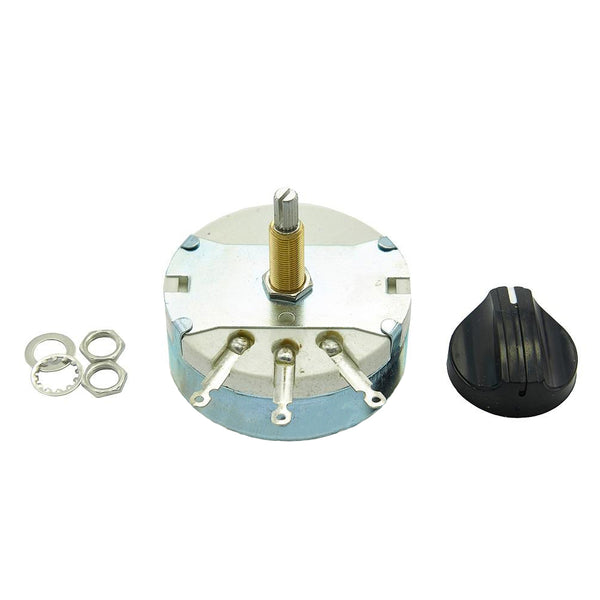
They need to be 4 ohms.
They can be purchased here.
I used this for a crossover board
And Dayton Audio # BPA-38AG binding post.
Myself, I would also add one to the midrange.
Nice thing about l-pads @ zero attenuation, they are effectively out of the circuit.
 
Last edited:
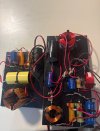
I finally got around to getting one crossover finished
I ended up using two boards. The board on the left is the woofer circuit I’ll mount that on the bottom of the cabinet. The board on the right with the speaker inputs will go in the same place as the stock crossover.
Only two wires are needed to connect it to the inputsIMG_3381.jpeg
I’m not using the three-way switch on this just the L pads that are already installed on the speaker cabinet for both the mid range and tweeter.
 
Last edited:
Ok!
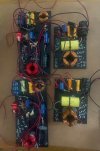
Finally managed to get the second crossover done, so we’ll be trying to install this weekend!
IMG_3414.jpeg
 
Just as a question... Those look like the Chinese resistors from eBay. Have you ever checked their inductance?
 
Just as a question... Those look like the Chinese resistors from eBay. Have you ever checked their inductance?
I got these Meniiscus audio a year or two ago before they went out of business
The exception is the 7.2 which is a Vishay
They called them twisted Zistors and they were made for Audio
Usually, they were blue, but not all of them.
No, I didn’t bother measuring the inductance because there was no need. I’ve used them before. for a number of different projects and they sound just fine.
I did check each for resistance in spec
All wire wound resistors are going to have inductance by the very nature of their construction.
 
Last edited:
I got these Meniiscus audio a year or two ago before they went out of business
The exception is the 7.2 which is a Vishay
They called them twisted Zistors and they were made for Audio
No, I didn’t bother measuring the inductance because there was no need. I’ve used them before. for a number of different projects and they sound just fine.
Are you aware that, at least for the Dales I've tested, the higher wattage values have lower inductance (e.g., 50 watt vs 25 watt)? And, they are even lower than the Mills.
 
Actually, I take that back.
I was thinking of a different project. The ones from meniscus are all blue.
These ones I got off Amazon
The spec on the crossover for at least 15 or 20 W resistors
Esp in the woofer section
The 7.2 was a pain in the ass to find I did get that one off eBay
Sorry for the confusion

Nice thing about this particular crossover design is it not only takes into account the electrical characteristics of each driver, but the physical characteristics of the cabinet.
Edge, defraction , baffle step loss acoustic offsets
So it’s obviously a step or two above a DY trial and error
The alpha and the Dayton woofers aren’t world class drivers but very good.
Clean sounding and low distortion.
Sealed bass box in my experience makes a huge difference integrating with the Heil.

You can have the best drivers in the world world class drivers but a poorly designed crossover not taking into the above factors you’re not getting the best out of them that’s for sure.
And for myself in this particular speaker, this is the final version
These particular drivers are well matched to the stock cabinet, so why not get the best out of them with a real professional crossover design?
That’s the whole point here
The stock ESS crossover when you look back on, it was a compromise from day one.
As we’re a lot of designs back then.
Better measurement, techniques, knowledge simulations etc account for a lot of speakers sound systems, etc. these days sounding very good given the sum of their parts.
And thirdly, my thought was the guy sitting there with AMT 3 cabinet with just the Heil.
Now you have some options
Instead of merely DYI, test error…
And frankly, even if you have a mint one, you can put all those drivers in a box and have a much better sounding speaker, but just substituting, plug in the port tube if you have it and go from there, you don’t need to do all the bracing and stuff I did unless you want to.
It’s still gonna sound worlds better than what came out of ESS!
 
Last edited:
Are you aware that, at least for the Dales I've tested, the higher wattage values have lower inductance (e.g., 50 watt vs 25 watt)? And, they are even lower than the Mills.
I didn't ask-but besides power handling-the reason why higher power resistors where speced.(i.e. 20watt) could have been the lower inductance.
So all are 50 watt-except the Vishay-25 watt.
18 gauge min for inductors. Large bass coil is 15. Wiring is all 14 gauge.
With this crossover-I figured the least coloration it would add the better.
Why I used standard Z's, except for the large value caps.
As far as electrolytics in the bass circuit-I might be imagining it-but bass seems less colored and livelier with poly caps.
Looking at Gee's cap review-it seems the larger wattage caps in the same model line seem to usually get the better reviews.
 
OK, I finally got one installed, unfortunately I forgot to take pictures. I will on this next one. Hopefully I can possibly get it done this evening. We’ll see.
Anyhow, the good news it sounds very good
The sound stage is more forward now, and a bit wider.
I’m assuming it’s because the alpha 6a is playing a much bigger role, which incidentally it’s an excellent sounding driver.
And clarity definitely has taken a few major steps up.
And comparing the two it’s easy to tell how much more integrated the new version songs versus the old.
As far as the L pads go, I have them about 1/3 between 10 and 11 o’clock.
And just a note, this particular crossover was designed with the L pad in mind on the tweet,
As a bit of arising response was left that could be tamed by the L pad if needed.
It certainly could be tweaked to be flatter.
All in all worthwhile exercise, I can’t see me going any further with this
When I get a chance, I’ll add up the cost of the components, but it’s roughly about $300 as I recall.
How was the sidenote I’m powering this with a Rogue Audio Medusa : Van Alstine tube preamp.
They need a little bit more juice than the Teton OG Lores.
 
Just a update on the sound.
Well they sound great!
Bass is very powerful; as before-no subs are needed. They can rattle the walls when called upon.
But the overall sound is much more integrated, musical.
Mush wider and taller soundstage.
They really remind me of my old PS1220-with way more forceful bass.
But clear, musical and can through a super deep soundstage.
Very clear and concise.
I turn them up, and enjoy the detailed sound upstairs in my office.
It's like a life show a couple rooms down.
Very cool.
I just had a buddy bring over his newly acquired Cornwall's to try on the Medusa.
I have to say, and even he agreed-these current 3's are away better sounding top to bottom. The Cornwall's are a bright speaker, and they still overpower the bass.
Like every Klipsch speaker I have encounter-it's really difficult to get them to sound good, because of the tilted up response they all seem to have.
 
Back
Top Bottom