• The move to the new server is done. There are some software and database maintenance updates in process. This has us passing the hat around to help out. We appreciate any donations. Seriously, even a dollar helps. The payment page may be found here - https://www.audiokarma.org/support.html

My first idler TT and restoration. Building a plinth, damping, tonearm board etc. starting with mint

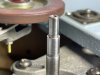
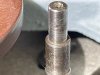
Yikes! My spindles, are they supposed to look like this, for traction? Or do these need a little light cleaning with a scotch brite pad or chemical cleaning?
5079 spindle.JPG

5080 Spindle.JPG
 
Yea they look a bit rough but if you remove metal that will effect the speed. I'd just give them a quick polish with a piece of Scotchbrite and let them be.
So far we haven't had any of that white stuff, weird year weather wise but it's not over yet.
I spent the day at two clean up events, multiple trash bags full of bottles, cans and garbage. At least when I walk those trails they will look much nicer now. Did my civic duty!

BillWojo
 
Yikes! My spindles, are they supposed to look like this, for traction? Or do these need a little light cleaning with a scotch brite pad or chemical cleaning?

View attachment 2831932

View attachment 2831933
My concern is with those ridges, they have cut patterns, grooves, into the idler soft face, this might keep the idlers from “floating vertically” when moving with the motor shaft? I’d use some 2000 grit on a small flat piece of steel (hard flat surface) followed by 3000 & 5000 or higher. Using caution as Bill states, not to remove too much material, but I’d want those ridges smoothed out, but hey, that’s me;)

Andy
 
My concern is with those ridges, they have cut patterns, grooves, into the idler soft face, this might keep the idlers from “floating vertically” when moving with the motor shaft? I’d use some 2000 grit on a small flat piece of steel (hard flat surface) followed by 3000 & 5000 or higher. Using caution as Bill states, not to remove too much material, but I’d want those ridges smoothed out, but hey, that’s me;)

Andy

Okay, I can certainly do that, I'll use one of my HSS lathe tool blanks and from the body shop side of my shop I have 1000, 2000 and 3000 W&D paper. Watching the F1 race this morning then I'll be on to the table work.

Thanks!
 
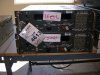
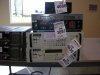
And I just remembered, I am going to locate my AC power supplies today which I bought years ago and have never used but I can't imagine a better use for them than to drive a turntable motor. They are commercial rack mount AC amplifiers, 45Hz-4KHz, 0-135VAC, 500-1500W out., .001% frequency stability. They are a bit big and clunky but I have a 7' equipment rack in my living room which will hold one nicely. I will post some better pics later, these are from the day they arrived here from California.

More later...

DSCN0437.JPG DSCN0438.JPG DSCN0439.JPG
 
At the radio station I worked for in the 60's while going to HS and Univ, we used Runco TT in the new studios and the Gates tables in the older studios. When we added a FM studio and redid the production studio the we used SL 10 turntables and tried SME arms, but that didn't work in the FM studio as the DJ's were to clumsy, use to working with older damped broadcast tone arms. The young DJ's had no problems. In the early 70's I was also working for a professional sound company and we tried to use new Runco Tables for discos but they were had to much rumble even then. So they had to replaced with Technics DD tables. Eventually the SL 1200 became the Disco system table of choice. At the radio Station we used 50 HZ filters to keep the noise from getting into the broadcast on air signal and in the production rooms. That wouldn't work for discos. By the 80's the CD had come along so except for playing records for the occasional oldies broadcast where listeners expected to hear the noise from real records. Some of the DJ's left the volumes up when placing and removing the stylus from the record groove.

One year we tried using Shure cartridges instead of Stantons because the Shures were significantly cheaper. That didn't work out so well as the Shure cantilevers were always getting bent or the stylus tips were damaged to frequently. When you have to start replacing a stylus assemble after two or three 24 hour broadcast cycles management starts frowning. Especially when they were the ones that recommended the change. Those of us in engineering were against it. But money talks.
 
Last edited:
And I just remembered, I am going to locate my AC power supplies today which I bought years ago and have never used but I can't imagine a better use for them than to drive a turntable motor. They are commercial rack mount AC amplifiers, 45Hz-4KHz, 0-135VAC, 500-1500W out., .001% frequency stability. They are a bit big and clunky but I have a 7' equipment rack in my living room which will hold one nicely. I will post some better pics later, these are from the day they arrived here from California.

More later...

View attachment 2832656 View attachment 2832657 View attachment 2832658
Wow! My feeble experiments with turntable power supply have been related to shielding, voltage reduction and such, don’t have things that “clean up” sine waves or stabilize output….

Started collecting parts a couple of years ago to build “Nigel’s” power supply fro Lencoheaven and I’m almost ready to start the build, there are probably much better options and @hirscwi (another Bill) is the guy to guide you down that path, his skills far exceeds mine:cool:

Andy

Forgot the links for Nigel’s stuff

https://www.lencoheaven.net/forum/index.php?topic=13981.0


https://www.lencoheaven.net/forum/index.php?topic=14824.0
 
Last edited:
As well as digging out the the AC supplies today, I decided to try to get to the birch wood, I needed some heavy iron to get there. I found it, it's still pristine, just needs to be thickness planed down to right dimensions. Still looking for the mahogany..it's in a different building I think.

Later today I'm going to try the fine paper and scotchbrite pad on the spindle, I'll let you know how it turns out.

Cheers

Snow shed birch wood.jpeg
 
Last edited:
I now realize my brain thinks I am 25, my body thinks it's 85, somewhere in between lies reality. I spent 3 hours on the weekend trudging thru snow up to my knees to get the variable AC supplies out, I forgot they weighed 80-100lbs each, monsters, thankfully they slid well on the snow and I got them to the shop to warm up. I now am thinking I am nuts to use these as they are WAY overkill for a 5W TT motor, all three are good for 1500W out. I am going to investigate Nigel's offering and maybe come up with something similar on my own. I haven't read the thread, I just glanced at the schematics but I didn't see a power stage, only low level stuff, I need to read the whole thread to grasp his concept.

And now I am back to work full time so hobby time is relegated to evenings and weekends only and about all I could muster today is to clean the spindles. Here are the after pictures. I used a lathe tool steel blank as backing for 400 W&D paper (used wet) then 800 W&D then a buff with scotch brite. I didn't see a need to go to 3000 grit and then polish it, if I am wrong please correct me and I will continue with the finer paper. I thought the spindle would need a little bit of traction, and even 800 is pretty damn smooth.

Cheers

Spindle cleaned 5080.JPG


Spindle cleaned 5079.JPG
 
Last edited:
  • Like
Reactions: T68
I now realize my brain thinks I am 25, my body thinks it's 85, somewhere in between is reality. I spent 3 hours on the weekend trudging thru snow up to my knees to get the variable AC supplies out, I forgot they weighed 80-100lbs each, monsters, thankfully they slid well on the snow and I got them to the shop to warm up. I now am thinking I am nuts to use these as they are WAY overkill for a 5W TT motor, all three are good for 1500W out. I am going to investigate Nigel's offering and maybe come up with something similar on my own. I haven't read the thread, I just glanced at the schematics but I didn't see a power stage, only low level stuff, I need to read the whole thread to grasp his concept.

And now I am back to work full time so hobby time is relegated to evenings and weekends only and about all I could muster today is to clean the spindles. Here are the after pictures. I used a lathe tool steel blank as backing for 400 W&D paper (used wet) then 800 W&D then a buff with scotch brite. I didn't see a need to go to 3000 grit and then polish it, if I am wrong please correct me and I will continue with the finer paper. I thought the spindle would need a little bit of traction, and even 800 is pretty damn smooth.

Cheers

View attachment 2834135


View attachment 2834130


Thaat looks much better :thumbsup::thumbsup::thumbsup:
 
I'm now working on the Delrin bearing and platter spindle. Since my version has the captive ball on the grub screw I have a question. Has anyone tried to remove the ball and replace it with a Delrin ball? It seems like a great way to go. There are numerous ball sizes available on the net. As much as I enjoy machining new parts, this just seems simpler.

Thoughts?

Cheers
 
I’m typing this on my phone so I don’t know how well it will work and I’m not sure how to post pictures but I went out at lunchtime and found what’s called UHMW plastic, a nice 1.25” rod length of about 3”, enough to chuck in the lathe. I did a quick look around the web and it’s comparable to Delrin, has better wear characteristics but it’s not as temperature stable, which I don’t think will be a problem in this application. I am going machine a flat disk to glue on the bottom of the spindle platter to ride on the existing ball.

more later.
 
Well here is the issue using the ball, any ball in the grub screw. How confident are you that the ball will contact the exact center line of the spindle shaft? It might wind up tracing a circle on the bottom of the spindle. It's one of the reasons I gave Andy one of my special Delrin setscrews with the flat Pad. Looking at several of the Russco TT that passed through my hands I saw evidence that the ball wasn't perfectly on center. The wear mark should be just a point contact, no more.
Just something to think about.

BillWojo
 
Ok that's cool, but I just read your comments on Werners thread (Lenco heaven, see below) and you had 2 balls stacked, and I think you only replaced one with the pad, still had a ball on the bottom of the platter spindle? Do you think just the flat spindle riding on the pad will be okay, no balls at all?

Thx Bill

From your post on Lenco heaven May 13, 2021.

https://www.lencoheaven.net/forum/index.php?topic=36927.180

"A buddy and I are buying 3pc of Russco Studio Pro Model B turntables from a guy on the other side of the country...Anyway, I'm not sure what spindles will be in these, flat bottom or with a ball on the bottom. I want to be prepared for either possibility. If it has a ball on the bottom, I can use my brass setscrew with either a Delrin, Teflon or Peek bearing pad.
If it's a flat bottom, I need to glue a bearing pad to the spindle."
 
Last edited:
Bill can clear this up but don’t think he was talking about 2 balls stacked, believe he’s just explaining that Russco had several different versions….
 
Yea, plus my thinking along the way changed a bit as I analized the designs more.
Steel ball on steel ball is very bad. Steel ball on flat steel is very bad. Flat steel on flat Delrin (Andy's setup) is very quiet as is a steel ball (in spindle) on flat Delrin.
Not 100% sure how they made the spindles on the Russco tables, suspect they are pressed into the platter after machining. I also suspect the shaft is ground after the recess for the ball is machined and the cone at the bottom of the pocket is used to support the shaft for grinding. This would make the ball concentric with the OD of the spindle.
If I ever get access to a surface plate and some inspection equiptment I will verify that the ball is indeed concentric with the OD.

BillWojo
 
Awesome Bill, thank you for clarifying. Now we have all the scenarios explained.

Ok so now I will machine a grub screw to replicate Andy's setup. Have you tried steel thread or have you just used brass? I have loads of steel bolts here I could machine, brass would have to be internet ordered. Other than ease of machining, do you feel brass has any acoustic benefit? I think the original grub is steel?

Thanks!
 
Back
Top Bottom