• The move to the new server is done. There are some software and database maintenance updates in process. This has us passing the hat around to help out. We appreciate any donations. Seriously, even a dollar helps. The payment page may be found here - https://www.audiokarma.org/support.html

My soldering skills pay off...

When you think you've got it mastered, try working with 5% silver solder. Very humbling. ;)
When I bought my Elekit amp, Victor sent me a roll of WBT lead-free silver solder. Being a dumbass that didn't know better, I went ahead and used it for the build. To say it was challenging is an understatement. I soldiered (soldered?) on and completed the amp with it. One thing I will say is that my soldering skills improved dramatically on that build!

The only reason for using lead-free is to prove to yourself that you can. Once you do, you can pat yourself on the back and then forget about it.
Life's too short to deliberately make it more difficult than it needs to be.

'Zactly!
 
Before you get a new one install a rough service incandescent bulb and make sure you still have an issue.
Rough service incandescent bulbs are readily available.
Or just remove the bulb altogether if you don’t need it.
 
Last edited:
Possibly because the grease on the rollers has dried up over time and now you have more friction. If I don't lube the rollers on mine on occasion, it stops mid-track.
reasonable guess, and easy enough to fix if so. The question was more rhetorical in nature though, prompting a consideration of all of the things attached to the door that are not the actual door opener that could cause problems. Broken spring, jammed rollers, bent track, etc.
 
I assume it is a screw drive. Lube the screw the truck rides on, I've seen them reverse because of it, and looked but saw no reason but lubrication made it work. I still think you have another bad connection on the board, maybe a cracked trace but I'd bet on a bad solder joint. Use an incandescent bulb, just because. If you fix it imagine the satisfaction every time you use it.
 
It's a constant battle around here with mechanical and electro-mechanical stuff. I give each piece an hour or so each day. I've had something somewhat similar going on recently.

My mind was instantly wanting to condemn the board and/or battery on a remote gate operator. Both parts are reportedly common problems. Turns out that it was neither, but it had three different issues.

There was bad connections first off. Cleaned those up with mild abrasives and Deoxit. Re-tensioned the board spring connectors with a pick.
The next problem was actually a factory defect. It had a micro switch wasn't positioned correctly and the switch eventually caved. I had a replacement switch on the shelf and these are inexpensive.
The final problem is that the solar panel had the correct voltage, but not providing enough amperage through the day. The fix is tree trimming or relocating the panel with a few more bucks in a longer copper run.
 
It feels great to do these types of fixes. The trick I use to find circuit board problems is to take a photo of it. It's better if you use the magnifier app like on the iPhone to take the photo because it isn't always easy to get perfect focus on close-up shots with the normal camera app. Then I blow the photo up on a computer screen and navigate around the boar -- you can see every flaw easily with that approach, even if it can't be seen by eye at all.
 
Alright I will make one last post for a while and then I am just going to deal with it as is for a bit. It's quite possible that when the weather turns colder it may work fine until Spring rolls around...

As far as the bulb goes... I don't see how that can be an issue. From what I understand the only symptoms you would get, if there were interference between the bulb and the remote sensor, is that the remote would just not work sometimes. And that is not a symptom that I am having at all. Not to mention that I am using a bulb that is specifically designed for garage door opener use, so it should not produce any interference at all. The symptoms that I get sometimes are while using the wall switch as well. And the symptom is a total loss of power to the unit. Sometimes it comes back on, sometimes it doesn't and sometimes it comes back on after I give it a good whack... Also I can almost predict when the thing is going to fault because the bulb starts to flicker just a bit. Once again all these symptoms would point to a loss of power somewhere in the chain. I don't know if a motor being on its way out would give these symptoms either, but if that were the case why would the bulb flicker like that?

The sensors are clean and aligned properly. Both lights (sending and receiving) are green and when you step into the beam the receiving sensor goes red and you can hear a small click in the unit itself. So no issue there.

I put the door up this morning and left it that way. No reason to tempt fate as I go to work in an hour or so. I will run it down at that time. Sometimes if it doesn't go down by itself I will hold the wall button down and that usually works, but not always...

Also it was over 80 degrees here today and that generally means that it is going to mess up. It messed up during the day yesterday but then worked fine later in the evening when the temperature cooled down. The guy at the dealer even told me about a woman would had the exact same symptoms. It wouldn't work properly on hot days.

All signs point to it needing to be replaced. Because even if I do get it going how long is it going to last when it is already over 30 years old?

And by the way, it is a chain drive and not a screw drive. A Raynor R170 unit manufactured in 1995... The Raynor units are quite good and well respected but I doubt they were designed to last more than 30 years.

 
I already watched all the videos on YouTube. Some seemed relavant and some did not. Went to Home Depot and got some lube and lubed the rollers. Made sure sensors were aligned and working and even put a piece of cardboard next to one of them just so the sun would not shine into it. I also believe I tried it with the bulb unscrewed but had the same symptoms. The funny thing is that when we moved in the weather was colder. And then over the course of the summer as it got really hot the symptoms started to show up. Was in the low 60s this morning and it worked fine...

Checked the tracks and they appear to be OK. I don't know if it would be a good idea to lube the chain drive. I suppose it would be OK as long as I used something that wouldn't attract dust and dirt. It seems OK as well.

But so far the underlying factor that is the biggest predictor of failure is hot temperatures. Go figure...
 
Is there a motor run capacitor? These can go bad and if it did, it could even explain the flickering light as the motor draws amperage.
There is a capacitor that is there to supply current when the motor turns on. I'm just not sure that it is needed once the motor is running? Am I wrong about?

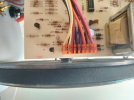
Here is the connector that I touch and it will then turn back on if it has lost power...
IMG20261008134129.jpg

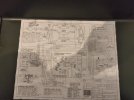
And here is the diagram that is on the inside of the case...
IMG20261008142215.jpg
 
The other day I reflowed the solder where that connector attaches to the board and also added a small amount of new solder as well. That obviously did not fix it like I thought. Today when it was shutting down I touched that connector in the center where the blue and purple wires are and it would come back on. But there is a whole lot of vibration when it is running. Makes me wonder if somehow that connector is just not making good contact. Basically it just slides onto the pins on the board. Could it be loose?

Going to leave the cover off for now for easier access and that way I can just touch the connector instead of giving the unit a good whack.
 
Replacement certainly isn't necessary if it works at low temperatures; I’d bet on a poor contact—possibly at that connector pin or some other bad solder joint.
You can spray freeze spray on that connector when the interruption occurs; it should start working when the female connector contracts.
 
Replacement certainly isn't necessary if it works at low temperatures; I’d bet on a poor contact—possibly at that connector pin or some other bad solder joint.
You can spray freeze spray on that connector when the interruption occurs; it should start working when the female connector contracts.
Freeze spray is a good idea. Can I just use a can of compressed air and flip it upside down?
 
Dang, no schematic. I was hoping to find a relay that might be the cause. It would be hard for me to quit working on it when hitting it makes it work.
In that photo, what do you think those white boxy looking things are? They sure look a lot like relays and there are four of them...
 
Freeze spray is a good idea. Can I just use a can of compressed air and flip it upside down?
I would remove the female connector and slightly tighten each terminal. However, it wouldn't hurt to test it first using freeze spray or compressed air.
 
I would remove the female connector and slightly tighten each terminal. However, it wouldn't hurt to test it first using freeze spray or compressed air.
I thought about that but I'm not sure how I would go about that. They are inside that plastic part.
 
Back
Top Bottom