• The move to the new server is done. There are some software and database maintenance updates in process. This has us passing the hat around to help out. We appreciate any donations. Seriously, even a dollar helps. The payment page may be found here - https://www.audiokarma.org/support.html

NAD 1020 recap questions?!?

sunking9

New Member
I just got an NAD 1020 off the bay with all original purple caps. Everything is in really good shape, but the preamp sounds very plain right now, nothing special. I am hoping to help it out with a recap.

I have gone over the thousands of posts on recapping NAD 3020/1020s here, but I still have a few questions before ordering caps. I really hope these questions don't sound too dumb.

1. In the NAD 1020 Service pdf, it shows C519/520 as 100uF 10v. The 1020 that I have has original 47uF 10v caps. So, should I get the 100uF or 47uF?

2. I have read when using Nichicon KL in the signal path, a small bypass film cap can be used to smooth higher frequencies. How do you install a bypass cap? And do you install them on each one of the Nichicon KLs?

3. And which caps are in the signal path? I figure the C9xx caps are the power supply caps. Are all of the C4xx and C5xx caps in the signal path?

Thanks
 
Register to hide this ad
I would go with what is physically installed and not what the SM says. There are way too many examples of misprints and/or changes to components by the manufacturer that never got put back into an updated SM. Nichicon KL's are what i use to replace any 'orange' colored electrolytic or for any tantalums. By pass caps are ok, but i am not sure how much benefit you are going to get by using them. By means of comparison, a KL is going to be a better overal cap compared to what they used back when this unit was made due to progress in engineering, materials and manufacturing process. But to answer your question, a bypass film cap simply goes in parallel with the electrolytic. The problem with trying to use bypass caps on PCB is that you are going to have a challenge on where to put them. I have seem the mounted on the underside of the PCB....but to me, it looks like @#$%!. I would not worry about the bypass cap. Just use the KL and see how it sounds. If you like it, crack a cold one and call it a day.

For you last question, Not all C4/C5 would be signal path. Look to see which ones tie to the voltage rails. These are more than likely down stream DC smoothing caps. For instance, C401/402 and 421/422 are in the signal path, C407/408 is not.
 
Glad to read that your upgrading the caps in the NAD, I just purchased a NAD 602
cassette deck (sorry not a amp) and found it like you said "sounding very plain" so
I started changing out the electrolytic's (Tempo's who's that) and little by little it's sounding
better, the high's are back in the recording's. I sticking pretty much to the values that are
in there as well, not going crazy with upping them to much.
 
A warning about lifting those soldering pads! When desoldering be careful because the pads and traces will come off very easley. That was my experience when I recapped my brothers 1020.
 
By way of comparison, the UKL's are clean, detailed, sterile and cold- especially when compared to something like an Elna ROB Tonerex or even RFS Silmic. They're a great "modern-sounding" cap. I use them in the larger values, not as much in the smaller, signal path values unless low-leakage is called for, or it's feeding an IC. It just depends what you want it to sound like. Some prefer the sonic signature, others don't.
 
Last edited:
Awesome, this was just the info that I needed to figure out the mouser order. Now I am patiently waiting for UPS. :>P

I decided to stick with leesonic mods as best as I can. Wima MK2/Nichicon UKL in the phono/preamp sections and Nichicon UKW in power.

I'll let you know how it comes out. Thanks to all.
 
Last edited:
I am still waiting for the caps to arrive, but I had time today to carefully remove the old caps. All 26 caps came out pretty easily with NO pads lifting.

I took lots of pictures before pulling the old caps, so putting the new caps back should be a breeze, as soon as they get here.
 
Okay... I've got all of the caps in and the preamp fired up. No smoke, no issues. Great.

But how does it sound? Way, way better than it did.

I haven't had a chance to sit down and really listen to it for a prolong period. I have tested the AUX and TUNER inputs. They work and sound really good.

I tested the PHONO input and I think this is the real star here. It sounds really nice.

I have gone through a number of phono preamp/stages since getting back into vinyl. All devices that I tried had an issue or two. Nothing really seemed to sound wide open and detailed.

I've only had time to play a couple of album sides with NAD, but this preamp has a beautiful phono stage.

I am going to compare it to the three external phono preamps laying around and my (recapped) Hafler DH-110 and my old (not recapped) Marantz 2230. I am going to have to find time to really sit down and go through some albums. I am guessing that it will beat everything that I have in house. :>)
 
Sounds really nice the way it worked out. Hope it sounds better as it burns in. Love the way NAD units sound. Have a 3140.
 
Tonight, I tested out the NAD 1020 phono section with 4 of my favorite albums...
Donald Fagen - The Nightfly
Elton John - Tumbleweed Connection
The Doobie Brothers - Toulouse Street
Pink Floyd - The Dark Side of the Moon

The setup is: Technics SL-1800 (MK I) with a Shure M91ED cart -> NAD 1020 (recapped) -> Hafler DH200 -> home-built Indignia speakers.

The best word to describe the music tonight is WOW!

EDIT: The next night I found that the right channel was 'looping' low frequency. With the bass turned all the way up, dropping the needle on a record would start a bump which looped in the right speaker. The woofer in the right speaker was moving quite a bit more than is usual.

So although the preamp does sound much better, this post was total crap and I deleted all the blah, blah, blah. I will check my soldering and report back.
 
Last edited:
Sorry to resurrect an old thread but I’m embarking in a recap on a series 20 1020.

couple questions for the OP or whoever can offer advice:

1. looking at the SM I’m only seeing 10, potentially twelve caps in the signal path (C401/2, C421/2, C505/6, C507/8, & C519/20 - other threads mention C305/6 though i dont see that one falling on the bold line of the signal path). Where are people getting to 26 or even 34 caps I see mentioned?
2. if I’m only really using this 1020 as my phono stage and utilizing the tone controls, volume, and balance knobs is it essential that I address any additional caps than the ones mentioned above?
3. most often mentioned are the Nichicon models - any tips for what models I should aim for? Still digging and researching and trying to figure out high quality without going too wild.

thank you!
 
You're asking which caps are in a direct (logical) signal path? That can be a hard question to answer with accuracy. Some caps not in a signal path effect sound. I've found that to be a very hard question to know beforehand. Some caps in the power supply (for instance) will most definitely effect sound with their 'impact'; but some cap positions are certainly more obvious than others. UES is my recommendation for as much as possible.

Imagine everything is audible or that it "mattered" -even when you're pretty sure it doesn't. That way, no matter what, you won't regret the decisions you made or question the results, or be tempted to go back in and change anything.
 
Last edited:
I’ve rebuilt at least a dozen of the 1020, and while very simple in circuitry it sounds fantastic. I find that the unit either has mostly good purple Matsushitas or they’re mostly bad. Regardless I replace them because I see a lot like this which I pulled from a Technics recently.
IMG_7309.jpeg
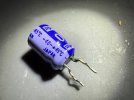
Being mounted to the board it’s hard to see that they’ve been leaking.

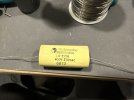
Yes, the phono input sounds really great. The last one I did we decided to put in the best output coupling caps I have on hand. These are Electrocube 950 series, a polypropylene and foil capacitor (not metallized like most you see.
IMG_6632.jpeg

They are very large being 1 uF. I got into touch with Electrocube as I bought a very large lot of these 1 uF and wanted to buy more values, but it’s absolutely insane what these are selling for now. These 1 uF caps are $97 each! Though you get a price break once you hit 25 caps lol. Anyways, that’s why I say they’re the best I had on hand, because they’re expensive lol.

IMG_6585.jpeg
I really enjoyed this preamp, listened to it for about a week and my goodness, I bet it could run with the big boys!

Dan
 
Sorry to resurrect an old thread but I’m embarking in a recap on a series 20 1020.

couple questions for the OP or whoever can offer advice:

1. looking at the SM I’m only seeing 10, potentially twelve caps in the signal path (C401/2, C421/2, C505/6, C507/8, & C519/20 - other threads mention C305/6 though i dont see that one falling on the bold line of the signal path). Where are people getting to 26 or even 34 caps I see mentioned?
2. if I’m only really using this 1020 as my phono stage and utilizing the tone controls, volume, and balance knobs is it essential that I address any additional caps than the ones mentioned above?
3. most often mentioned are the Nichicon models - any tips for what models I should aim for? Still digging and researching and trying to figure out high quality without going too wild.

thank you!
I believe there are some in the feedback circuit which is why they aren’t in the bold path. There aren’t many, I personally wouldn’t cheap out, replace all of the electrolytics. It truly doesn’t cost that much.

For anything in the signal path I personally go non-polar. The Nichicon UES are great if you can still get them. If the values are low enough go film, Wima PET or better yet polypropylene. Say 4.7 uF and lower. Some go all the way up to 10 uF, but for 10 I use the Nichicon UES. For the other caps it depends where they are in the circuit. I like Nichicon UKL where low leakage is wanted, UPW or Panasonic FR/FM/FC are great. Maybe splurge a little on the coupling caps in the audio path???

By the way, I have found that this model is prone for power switch failure. Oddly I’ve had 3 come in with open power switches. They aren’t too much, you can go to EastPoint here (affinity for artifacts on eBay) for the proper power switch. Extremely reasonable.

Dan
 
You're asking which caps are in a direct (logical) signal path? That can be a hard question to answer with accuracy. Some caps not in a signal path effect sound. I've found that to be a very hard question to know beforehand. Some caps in the power supply (for instance) will most definitely effect sound with their 'impact'; but some cap positions are certainly more obvious than others. UES is my recommendation for as much as possible.

Imagine everything is audible or that it "mattered" -even when you're pretty sure it doesn't. That way, no matter what, you won't regret the decisions you made or question the results, or be tempted to go back in and change anything.
Well I’m still learning - I’ve been going through tutorials at sparkfun so I feel more confident reading circuit diagrams from the SM. I feel confident I know which ones are in the signal path from the SM, my question is more that it seems most of the reading I’ve done folks are replacing ~25-40 caps total whereas by my math there are only 10-12 shown in the signal path in the diagram. Additionally the parts list lists 84 total caps. I’m not worried about more work or money just only want to address what is logical. I’m not looking to make radical or experimental changes as i dont feel confident enough that I know enough to be at that point. It’s a project as a learning experience that will hopefully have some nice perks at the end too.
 
I believe there are some in the feedback circuit which is why they aren’t in the bold path. There aren’t many, I personally wouldn’t cheap out, replace all of the electrolytics. It truly doesn’t cost that much.

For anything in the signal path I personally go non-polar. The Nichicon UES are great if you can still get them. If the values are low enough go film, Wima PET or better yet polypropylene. Say 4.7 uF and lower. Some go all the way up to 10 uF, but for 10 I use the Nichicon UES. For the other caps it depends where they are in the circuit. I like Nichicon UKL where low leakage is wanted, UPW or Panasonic FR/FM/FC are great. Maybe splurge a little on the coupling caps in the audio path???

thanks for this! I’m gonna dive in today and start to learn more. I kinda understand what you’re talking about but not fully. Any chance you have a list of your preferred or standard caps for the 1020? I considered just buying a kit from a reliable seller on eBay or through this German website that offers one specifically for the 1020. I just want to make sure I’m getting a quality setup. Not an audiophile just someone who likes to take on projects and has what I consider to be a very pleasant setup for listing to LPs. I have a modern phono pre-amp as well (JDS Labs Atom phono) that’s really nice but I kinda prefer to meatiness of the 1020 more for most vinyl recordings I own. When I want something different sound Wise I find myself most content streaming hi res digital.

The 1020 is a nice fit aesthetically and while a small detail I really love the horizontal back tray. The simplicity of the unit and having something that pairs so well with a modern class d power amp with east digital connectivity is important to me.
 
I guess the bottom line is I’m interested in replacing everything that needs replacement or would be wise to replace and have a unit that is a keeper for a good long while. A project and learning experience is a side benefit. I’m interested in using good quality parts and Maybe that will result in better performance but I’m not interested in modding it, etc.
 
Back
Top Bottom