• The move to the new server is done. There are some software and database maintenance updates in process. This has us passing the hat around to help out. We appreciate any donations. Seriously, even a dollar helps. The payment page may be found here - https://www.audiokarma.org/support.html

New Custom PhonoCartridges

Interesting JP, can you remember which cartridge or manufacturer used boron tubes?
I think Matsushita/Panasonic, for one.

Also, it was beryllium that was highly toxic particulated, I dunno about boron. Afaik, boron was adopted as nontoxic alternative for beryllium. Crystalline alumina is very rigid but very brittle, again, dunno about boron.
 
Last edited:
Out of curiosity, could these cantilevers be retipped? Or are they too fragile to withstand the process? What did the factory do in the hey day for owners? Exchange when a cartridge is worn out? I know what you went through with trying to find suspension/damper work done with yours, is the diamond replacement process going to be easier or harder?

Probably not an issue I'll face, as the suspensions will go long before the styli wear. Most of the ones with replaced styli that I've seen decent close-up pictures of show a glob of glue which throws the effective mass spec out the window, which, IMO, is a major ingredient in their performance. It'd be nice if someone did a reasonable job of it, as I've a beautiful 100CMK3 with a sheared stylus.

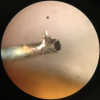
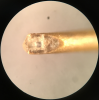
Coincidentally, I pulled the one styli Andy sent back to take the pictures below, and discovered a crystalline growth on the cantilever and parts of the tube that wasn't there when I first got it back. As I know he didn't disassemble it to change the bushing like he claims, I now believe he attempted some kind of chemical treatment. Amazingly dishonest, that guy.

Anyway, this is a P100CMK4. This one actually has quite a large amount of glue on it compared to others I have.

p100cmk4.png

And this is an AT ML170.

ML170.png
 
Probably not an issue I'll face, as the suspensions will go long before the styli wear. Most of the ones with replaced styli that I've seen decent close-up pictures of show a glob of glue which throws the effective mass spec out the window, which, IMO, is a major ingredient in their performance. It'd be nice if someone did a reasonable job of it, as I've a beautiful 100CMK3 with a sheared stylus.

Coincidentally, I pulled the one styli Andy sent back to take the pictures below, and discovered a crystalline growth on the cantilever and parts of the tube that wasn't there when I first got it back. As I know he didn't disassemble it to change the bushing like he claims, I now believe he attempted some kind of chemical treatment. Amazingly dishonest, that guy.

Anyway, this is a P100CMK4. This one actually has quite a large amount of glue on it compared to others I have.

View attachment 654876

And this is an AT ML170.

View attachment 654877

Stylus wear is often considered to be a minimum of 1000 hours, perhaps up to 2000 hours before pthe more advanced profiles show signs of wear. Do you think you will get more hours out of them then that? Or how long do you think the suspension will survive?

Regards
Mister Pig
 
The Technics are all elliptical, so 1000 hours would be at the maximum end of the scale. Only time will tell, but of the trustworthy sources I know, which are few, maybe 300-500 hours. One of the reasons I only use these styli for recording stuff that doesn't already exist in a good digital format.
 
I certainly appreciate the conversation going on here. Many thanks on all of your perspectives.

A few comments from my perspective and experience:

I used the new sapphire cantilever in the Astrion design (correctly identified as a new offering from Namiki Jewel) instead of a Boron cantilever because corporate legal was seriously concerned about the toxicity of Boron and potential product liability. Today, there are a number of products with Boron cantilevers and just as we technically argued with the legals back then, there have been no issues with the material. Boron, indeed, is very toxic when machined, the dust of the machining process can be inhaled and is quite dangerous. But solid pieces, even as small as little cantilever rods do not present a rational hazard. Technically, the stiffness of the two materials, Boron and Sapphire, are substantially similar. Stiffness for translation of the motion from the driven diamond tip to the pivot in the cartridge without some bending inducing loss of motion or phase effects in the motional translation are indistinguishable. And at least at that time, the price differential was negligible as well. Industrial sapphire is a very mature technology and well down its price curve. If a design accommodated replaceable styli, then it would be interesting to make the same design available with both cantilever materials and let users try and select one or the other if they could discern an acoustic difference or preference.

Market volume and pricing is a very different trade space today than it was back in the early 80s. While I was at ADC, we manufactured ~ 11,000 phonograph cartridges PER DAY. And we were the third largest behind Shure and Audio Technica. The total industry output at the peak was ~ 40,000/day. I never figured out where they were all going. Eventually assumed they were being shoveled off the back of ships to feed north sea whales. Today, there really isn't the volume to support the investment in capital equipment and tooling like there was then. Those companies which have survived to today from that era are undoubtedly surviving on old tooling designs. Or, like Ortofon, are trying to transition to next gen manufacturing approaches similar to 3D printing. Without question, any design I would do today would have to account for low tooling investment in the traditional sense. This argues for the more custom, hand-built and therefore more expensive end of the market. And of course, that reduces the volume further pushing the ROI equation ever further into higher pricing regimes. It will take some real creativity to keep pricing in that $250-500 range while minimizing tooling investment. Ahhh, the age old question of market price elasticity! The more things change, the more the fundamentals stay the same.

Thanks guys, the conversation is indeed most stimulating. I hesitate to say how my thoughts on doing this are progressing but I will say that the effort continues in both design and market analysis.

I'm not a scientist :) But I am pretty decent at marketing. It's also a vastly different world out there in that regard. Your business is literally world-wide as soon as you 'open the door'. You'll probably save on the 'brick and mortar' aspect of it all if you can do it out of your home. Even with packaging - you could even 'brown bag it' (generic boxes rather than fancy printed containers with plastic inserts and such which could cut costs down further. Lots of things like that can help the overhead costs.

But I'm not saying how - unless you promise to make p-mount versions too (hey! Someone had to say it, right?? ;)
 
Narrowing the target further to a high performance stylus assembly for an existing generally available worthy carcass?
 
See: "ambergris".
Fascinating Wiki on this. Like I said, I learn something every day. Fact is, the more I know, the less I know. My view just gets broader and therefore I comprehend the extensive scope of my ignorance ever better!!
 
I'm not a scientist :) But I am pretty decent at marketing. It's also a vastly different world out there in that regard. Your business is literally world-wide as soon as you 'open the door'. You'll probably save on the 'brick and mortar' aspect of it all if you can do it out of your home. Even with packaging - you could even 'brown bag it' (generic boxes rather than fancy printed containers with plastic inserts and such which could cut costs down further. Lots of things like that can help the overhead costs.

But I'm not saying how - unless you promise to make p-mount versions too (hey! Someone had to say it, right?? ;)


What's a P-mount? hahahaha
 
Narrowing the target further to a high performance stylus assembly for an existing generally available worthy carcass?

Well, the more I cogitate on this, and listen to what you guys seem to want, there isn't a "generally available worthy carcass" that could be the platform. Two primary reasons: 1) replaceable stylus design is deeply integral to the body/magnetics design or all you are doing is putting different cantilevers/diamonds on the same design. Other features cannot all be balanced and compensatory to your stylus choice in existing designs. I'm not sure it can be done on an ideal basis on a design from scratch. You make some of these critical design decisions as you go along. Everything is a compromise and a balance. Otherwise all cartridges should sound exactly alike. 2) Other manufacturers are likely to take umbrage with someone trafficking off of their proprietary designs, even if it is only the body. Lawyers and cease/desist letters are soon to arrive!!
 
Even common ADC/ Sonus carts?

I have no more rights to them than I would to Shure/AT/Stanton-Pickering bodies. Add to that, I surely know their limitations!! Ha!

In all seriousness, the old ADC design used AlNiCo magnets. Keep the same design and change to modern NdFeB magnets and the flux in the pole pieces would be in saturation without a doubt. All these things play together in the design process. Materials change. Designs are always an expression of the materials available.
 
I have no more rights to them than I would to Shure/AT/Stanton-Pickering bodies. Add to that, I surely know their limitations!! Ha!

In all seriousness, the old ADC design used AlNiCo magnets. Keep the same design and change to modern NdFeB magnets and the flux in the pole pieces would be in saturation without a doubt. All these things play together in the design process. Materials change. Designs are always an expression of the materials available.
A recipe of course, it was a random thought for a premium aftermarket upgrade.
 
NOOOOOOOOOOOOOOOOO!!!!!!!!!!!!!!!!!!!!! ;)
"P-Mounts - the lost design" <sigh.....>
Speaking of which, though it's off-topic for this thread-- if Eric knows anything about the [apparently] ill-fated ADC Integra XT p-mount line, I'd love to hear it.
But speaking of that, I don't see a problem, as I think someone already pointed out, with Eric starting off by making high-performance aftermarket styli for the fleet of extant top-end ADC bodies. He wouldn't even need to make the grips-- people could send in their old XLM and ZLM styli and have them rebuilt. New suspensions, advanced new cantilevers. Toss out the old magnet and put a tiny chip of NdFeB in the cantilever's tail. This would require minimum initial outlay, would let him parlay his well-known expertise in things ADC into bigger things, satisfy a crying need, etc etc. This would be noncheap, aimed at the diehard ADC fan. Perhaps not the business he'd want to stay in, but once it got going, he could capitalize the next business and the one after that, until he found his niche, like a well-planned game of chess. Well, it could happen..
 
....Eric starting off by making high-performance aftermarket styli for the fleet of extant top-end ADC bodies. He wouldn't even need to make the grips-- people could send in their old XLM and ZLM styli and have them rebuilt. New suspensions, advanced new cantilevers. Toss out the old magnet and put a tiny chip of NdFeB in the cantilever's tail.....
I thought the ADC were 'induced magnet' aka MI?

Still, having the old master at the helm rebuilding these would be a huge plus for the lovers of these old gems, though I do think we be seeing tunable suspensions involved somewhere along the way....
 
I thought the ADC were 'induced magnet' aka MI?
They were. But as he said, magnet tech has moved on. Just as Stanton/Pickering went with moving-magnet back in the mid-'70s, there's no real need I can see for keeping the permalloy sleeve when a magnet weighs less, although I wonder if the sleeve could be lightened by using a high-permeability high-saturation alloy like permendur, permendur 2V or supermendur. With a high-cobalt content, these would certainly be more expensive than permalloy, but if less of it was needed... dunno. Might make sense someday.
 
Last edited:
Well just a thought. Peter Lederman did revive the B&O cartridge design and modernize it. While he is not a major player in the new cartridge market, he has created a sustainable niche I believe. So there is a precedent for this kind of idea.

But I still believe that you should start with a fresh sheet, build the best cartridge you know how to build for a given price point, and see what the market place thinks. Non traditional methods of distribution and marketing( getting the word out) could be brought into play as a way to give the product line a jump start. Now the market place could use a high performance cartridge in the $200 to $300 range, and at the sub $500 range, as there are choices, but not a huge amount of them.

Regards
Mister Pig
 
I have an old Sony cart that I like and I think Sony was on to something but due to the CD's takeover it closed shop. I wonder if this design would be a worth while one.


Sony used a Figure 8 coil to address the recurrent problems of moving-coil : low output, field-disturbing iron core, and increase of coil turns to increase output.

By giving one part of the armature a 90° twist, the two halves of the coil do not cancel each other out but produce voltage with both inward and outward movements.
No need to use a stronger iron core or increase the number of coil turns : linearity is improved, the cantilever isn't burdened by a heavier coil and output is doubled - simple.

They are a LOMC but they were designed with replaceable stylus assemblies, which is something that I think the market is missing When you damage or wear out a MC cart its either trash or you have to send it off for a retip. Having one where you can order a new tip, would be something that might be an advantage over competitors.
 
Back
Top Bottom