• Please note that Audiokarma will be offline briefly for updates early on Monday morning, September 28th.

New Project Very Early TD 124

If this was my bicycle wheel - with the dial indicator against the edge as pictured I'd say you were measuring the rim's "hop".

Using the bicycle wheel analogy- did you check the rotating platter for any "up and down" movement? (Analogous to truing a vertical rim's "side to side" movement).

the little I know of this process, the info I gathered online is that centering is to address lateral runout. I saw no discussion of vertical runout.

This made sense to me as a lot of vinyl can have a little warping, so chasing 0.001” would be moot.

additionally, there is very little I can do to adjust it given the nature of the assembly and bolt configuration.

and lastly, phono cartridge is most sensitive to side to side movement, which affected greatly by lateral runout. I feel that on even a blank groove, a platter with a big runout would produce noise.

now that it was mentioned to check for , I will check as Im now curious. Im not arguing for any position. Im just pursuing assembly in a way that makes sense to me.
 
Thanks @heyraz - so that would be the space between the platters edge and the rim of the plinth?
Yes...exactly.
What's important to the disc is that it spins true and concentrically so the tone arm doesn't move side to side.
The way the platter is attached to the spindle can't affect that because the disc is positioned by the spindle. What he was measuring only matters for the way the idler tire rides against the inner rim of the platter.

More important I think is to check how flat the platter spins relative to the tonearm. Don't want the tonearm moving up and down.
 
The way the platter is attached to the spindle can't affect that because the disc is positioned by the spindle. What he was measuring only matters for the way the idler tire rides against the inner rim of the platter.

Interesting point on the spindle holding the record despite possible runout on the main platter. I do not think it is true that in remounting the platter to the spindle that the it only affects the idler wheel.

There is sufficient wiggle room in the platter bolts and their bolt holes to mount the platter off center. An off center platter will coz the record and the upper platter to fight against the centering force of the spindle. it cant be good.

An off center platter will be basically a wobbly flywheel, a veritable low frequency vibrator.

you correctly referred to it as similar to a bicycle wheel hop. how much of that is transferred to the tonearm, I am not sure, but it will definitely be a cause for vibration and likely noise.

dirt on the mechanisms faces (idler wheel) in the turntable is said to cause rumble. an off center platter would be a more significant issue with tolerances.

I could attempt to address vertical runout, but looking at the machined faces, it didnt seem necessary. I will measurement it anyway this afternoon.
 
Last edited:
Thank you so much. There's play alright and that's exactly how I thought it works. The TD-124 was their hi-end, expensive flagship at the time. It was a broadcast turntable. Unlike home consumer level products, it was made in smaller numbers. Probably much smaller numbers. I suspect they were way more meticulous about it with QC resource allocation. Sadly... they did go bankrupt eventually, though I'm not sure if the TD-124 had direct influence on that.

It was sort of a broadcast turntable. The TD 124 was used in the USA on air for FM Stereo. Because of the fact that then none of the USA idler drive broadcast turntables had low enough vertical rumble for satisfactory FM Stereo. Big limitation, not as fast to cue as a Gates, Russco, QRK, or RCA broadcast turntable.

Back in that era, USA FM Stereo stations were mainly easy listening, jazz, and classical music and less frenetic and not as fast paced in terms of cueing. Which is why the Empires and TD-124 worked well for these stations and their needs. In the UK, BBC Local Radio also used the Thorens TD-124 Mk II as well. In Germany, the EMT was the standard as well as most European state radio stations. In the UK, the BBC used Garrard 301 turntables then.
 
There is sufficient wiggle room in the platter bolts and their bolt holes to mount the platter off center. An off center platter will coz the record and the upper platter to fight against the centering force of the spindle. it cant be good.

An off center platter will be basically a wobbly flywheel, a veritable low frequency vibrator.
I can't argue with your analysis. How significant that becomes at 33 RPM or 45 RPM I couldn't begin to calculate. I'll leave the resonant frequency stuff to the Physics Engineers. Certainly, we all strive to adjust things as close to ideal as possible.

Regarding any vertical movement, I think the flexible aluminum top platter has a very significant effect during rotation.

My aluminum top platter is flexible and anything but perfectly flat. In fact, it is dished. Put a straightedge across your platter and check for yourself.

It has to become dished because every time the clutch is engaged it lifts the aluminum platter from the edges, not the center. I chose to level the aluminum top platter with tape and shims and leave it put. Using the clutch can only stretch the aluminum and reorient the platters.
 
After reading the historical information that’s available and considering the vast amount of information related to the TD124, my use of a dial indicator was more of a curiosity experiment. Like you, I was able to tap the platter to les than 0.004 but not convinced that was necessary nor that it made any difference in playback. Also checked each rotating device for concentric operation, talk about anal:no:, but that’s another issue…

My conclusion is that the series I 124s were all machined to a specific standard, I’d guess that if we checked most on this site that none would be over 0.006 run out, and many 0.003.

Checking the vertical is also just a curiosity, unless the platter and/or shaft is warped it’s not going to have much deviation, and if it did, it would probably have considerable run out also. The aluminum top plate is generally not perfectly flat but that doesn’t effect run out, nor does it cause any playback issues unless it’s extremely bad, which would also negate the clutch mechanism…

My 124 has what a purist would deem “considerable modification” however most of the changes reduced the stock noise floor. Went with Delrin bearings, nod to theanalogdept, most of the latest Audiosilente mods, synthetic ball bearings, and a massive plinth. It’s now almost as quiet as my Denon DP 75, using a test record silent track and oscilloscope to compare noise/frequency output.

However you’ll notice the absence of spring motor mounts, it has the Gel, which is a deviation from what most do. Also didn’t upgrade to the new motor coils, my speed is extremely stable now, so I’m happy;)

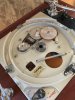
Amazed at the level of design, engineering and attention to detail that went into these, look at the balancing divots in the small belt pulley :eek:

1E3D1A20-91A6-455D-8292-7F5F653FA709.jpeg


VR
Andy
 
I can't argue with your analysis. How significant that becomes at 33 RPM or 45 RPM I couldn't begin to calculate. I'll leave the resonant frequency stuff to the Physics Engineers. Certainly, we all strive to adjust things as close to ideal as possible.

Regarding any vertical movement, I think the flexible aluminum top platter has a very significant effect during rotation.

My aluminum top platter is flexible and anything but perfectly flat. In fact, it is dished. Put a straightedge across your platter and check for yourself.

It has to become dished because every time the clutch is engaged it lifts the aluminum platter from the edges, not the center. I chose to level the aluminum top platter with tape and shims and leave it put. Using the clutch can only stretch the aluminum and reorient the platters.

When I sent my 124 for restoration, the restorer found my upper platter was warped. When I first got it, the seller, who didnt know much about the table, simply dumped the TT in a box padded with crumpled newspaper. I believe I could have avoided a restoration if it was packaged well, probably avoiding the warped upper platter and the bigger tolerance I found between the spindle and the bearing. I was hoping to just do a clean and lube. It wasnt in the stars for me :(

Having said that, the restorer said he has hammered these back to as close as possible, but recommended, if within budget, the Retrotone upper platter. I went with the platter plus the Woodsong platter adapter, whose bearing is almost perfect match to my restored spindle.

Another reason to center the platter, I've gone a good long way to get this table perform as best it can. Many mods added. I wasnt about to save 25 minutes to center the platter mount after the efforts and monies I've already put into it,
WM8nD3Kh.jpg


If my restoration is anything, nothing was spared to get it back to 1964 condition.
 
After reading the historical information that’s available and considering the vast amount of information related to the TD124, my use of a dial indicator was more of a curiosity experiment. Like you, I was able to tap the platter to les than 0.004 but not convinced that was necessary nor that it made any difference in playback. Also checked each rotating device for concentric operation, talk about anal:no:, but that’s another issue…

My conclusion is that the series I 124s were all machined to a specific standard, I’d guess that if we checked most on this site that none would be over 0.006 run out, and many 0.003.

I agree, if you are mounting the platter anyway, do it the best you can. A dial indicator is great if you are trying to see the actual tolerance, but a jerry rigged indicator to eyeball alignment, may be just as good. I can't say what the tolerance should be, cept for what I found on the net, which is factory supposedly is 0.002"

Does it make a difference, I can't say yet as I am in assembly, and I wouldnt have a before condition to compare it with.
 
I agree, if you are mounting the platter anyway, do it the best you can. A dial indicator is great if you are trying to see the actual tolerance, but a jerry rigged indicator to eyeball alignment, may be just as good. I can't say what the tolerance should be, cept for what I found on the net, which is factory supposedly is 0.002"

Does it make a difference, I can't say yet as I am in assembly, and I wouldnt have a before condition to compare it with.

That’s a very nice looking platter….

From the available information it appears the run out testing/measurements were done in a special jig, and it’s unclear, to me at least, whether every spindle/platter was tested?

VR
Andy
 
That’s a very nice looking platter….

From the available information it appears the run out testing/measurements were done in a special jig, and it’s unclear, to me at least, whether every spindle/platter was tested?

VR
Andy

personally, given my impression of swiss machining, as long each component is to specification, a mounting jig is more than enough for the job for centering.

we dont have jigs, so I manually mounted the platter and used the dial indicator to see if I was doing a decent job. Im happy with the result. Its something I can rule out if I get problems.
 
When you get to leveling the table...

I found the installed bubble to be inaccurate. I purchased an Ortofon Bubble Level and took my measurements from directly over the spindle, parallel with the platter.

I had a spool of electrical tape that fit and centered perfectly around the platter's extended 45 adapter.


20180103_011850.jpg
20180102_161501.jpg

IMG_0301_zpscwnmmeu2.jpg

This allowed me to level the table quickly and accurately.
 
When you get to leveling the table...

I found the installed bubble to be inaccurate. I purchased an Ortofon Bubble Level and took my measurements from directly over the spindle, parallel with the platter.

I had a spool of electrical tape that fit and centered perfectly around the platter's extended 45 adapter.


View attachment 2538607
View attachment 2538608

View attachment 2538609

This allowed me to level the table quickly and accurately.

I use my wood shop level and slap it on the platter :)

Im cheap when I can be lol
 
Boy that retrotone top is like a grand or something - eh? Better make sure that two bucks worth of electrical tape roll is level. :)
 
Boy that retrotone top is like a grand or something - eh? Better make sure that two bucks worth of electrical tape roll is level. :)
The edges of the tape roll were in fact parallel.
I was able to verify that as the platter turned.

Sometimes the cheap stuff works.

(That roll of tape is "NOS and vintage", so it's probably worth more than $2 on EBay).
 
Looks like the platter screws to the spindle with a few screws so if your trying to indicate the platter to run true you should first check that there are no burrs in the platters holes that might impede movement when your trying to tap it into alignment.
If after all your attempts to bring the runout to zero is only getting you close but not to zero, than remove the screws and rotate the platter relative to the spindle one hole. Reassemble and try again. Sometimes "precision" parts are not really all that precision. After all, a person machined these parts, when the platter was placed in the jig for the hole drilling, was there a chip that kept the platter from seating correctly? As a last resort, if it's only the holes keeping you from getting it from running true, use a set of number drills and knowing the runout that you have, drill it twice the amount of runout/2 larger. Example, runout is 0.003, platter needs to shift 0.0015 so drill the holes 0.003 larger. This will allow the platter to shift 0.0015.
Number drills generally jump up just a few "thousands" of an inch in size.
This is all of course for those that are super anal about such things.

BillWojo
 
^^^ the platter passed Thorens inspection. I am of the assumption that it will install back to spec. Am totally against modifying the platter, including enlarging the holes.

From online sources, I gathered that total runout should be 0.002” max. Im not very interested in bettering that for many reasons. I got less that 0.001 each side so I am good.
 
Back
Top Bottom