

You are using an out of date browser. It may not display this or other websites correctly.
You should upgrade or use an alternative browser.
You should upgrade or use an alternative browser.
Nobody doesn't like Dynaco A-25's.
- Thread starter jackgiff
- Start date

jackgiff
Well-Known Member
OK, here we go!
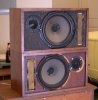
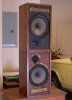
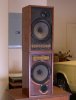
I retested the pair of A-25's in the garage in four stacked configurations. I measured their FR and listened to them for a few minutes. Here are pics of the config's and the FR pics. First pic and FR is the missionary position. Second is the "69." Third is tweeters in. Fourth is woofers in.
There definitely are some differences in the FR's depending on configuration. Some of this is probably due to the fact the microphone was always aimed at one tweeter. It was always aimed at the lowest tweeter. And it may be due to combing, since there are two sources for both bass and treble. Zilch, you can interpret this for me.
As far as listening goes, I prefer the missionary position, or secondly the tweeters in. Getting the woofers farther away from each other doesn't cause as much spreading as getting the tweets farther apart. Bass is supposed to be non-directional at low frequencies, but the crossovers are probably high enough in these guys that you can tell when the sources are further apart. I will bet that effect is significantly less with 4412's due to their lower operating frequency for the woofer..
Hooking up two speakers in parallel gives louder sound, but increasing the amplification to offset this, seems to give a more listenable sound using only one speaker. That is, of course, only my humble two cents.
Jack Gifford
I retested the pair of A-25's in the garage in four stacked configurations. I measured their FR and listened to them for a few minutes. Here are pics of the config's and the FR pics. First pic and FR is the missionary position. Second is the "69." Third is tweeters in. Fourth is woofers in.
There definitely are some differences in the FR's depending on configuration. Some of this is probably due to the fact the microphone was always aimed at one tweeter. It was always aimed at the lowest tweeter. And it may be due to combing, since there are two sources for both bass and treble. Zilch, you can interpret this for me.
As far as listening goes, I prefer the missionary position, or secondly the tweeters in. Getting the woofers farther away from each other doesn't cause as much spreading as getting the tweets farther apart. Bass is supposed to be non-directional at low frequencies, but the crossovers are probably high enough in these guys that you can tell when the sources are further apart. I will bet that effect is significantly less with 4412's due to their lower operating frequency for the woofer..
Hooking up two speakers in parallel gives louder sound, but increasing the amplification to offset this, seems to give a more listenable sound using only one speaker. That is, of course, only my humble two cents.
Jack Gifford
Attachments






Dynacophil
I ain't Phil, I'm 'phile
so variation 1 & 3 are recommended?
jackgiff
Well-Known Member
Dynacophil said:so variation 1 & 3 are recommended?
I would listen to them one pair at a time. If stacking was mandatory, the variations 1 & 3 are how I would do it in that order. Your mileage may vary.
Jack Gifford

Analysis:
Thank you, Jack. Your work with these A-25s is enlightening, and much appreciated. I hope that others with these capabilities will replicate your studies and post their findings here. :yes:
******
I asked Jack to measure with the microphone on axis with one of the tweeters so that the "listening" perspective would be held constant. That also guarantees that there is some difference in distance from each of the other drivers, which is what generates the phase anomalies, both interference and reinforcement, which also vary with frequency.
1) Horizontal, in-line - Looking at the bass first, and using 80 Hz as the reference, I do not see any enhancement in bass extension. As with the original measurements, the response drops linearly by 20 dB from 80 Hz to 28 Hz, the band between 25 and 31.5 Hz. However, mutual coupling is occuring, and the bass is now balanced with the midrange. Compare 80 Hz with 1 kHz. It was down 3 dB in the single speaker measurements, but is equal when the two are playing. Clearly, the response between 80 Hz and 1 kHz is now flatter due to this, and smoother due to averaging of the two sources. Better bass, the woofers are working together.
It all falls apart between 2 kHz and 10 kHz, however, with a 10 dB deep full-octave wide hole in the response caused by phase interference. I suspect the crossover is somewhere around 4 kHz. This anomaly is major; the speakers may as well not be playing those frequencies at all.
Comparing the very high frequency response of the original measurements of singles, which are basically a shelf at -5 dB from 12.5 kHz up, the highs are rolled off when stacked. There are likely more adverse combing effects going on in this range as well, but the RTA does not have sufficient resolution to display them. See the link to my study below.
2) Horizontal, opposed - While the notch at 4 kHz is no worse than in the original measurements, combing ripples are apparent in the response above 400 Hz as compared to the #1 stack, and the VHF rolloff here begins at 10 kHz. I can't really see 20 kHz because of the reflection.
3) Vertical, tweet to tweet - The midrange ripples have moved lower, here beginning at 160 Hz, and the VHF rolloff begins at 8 kHz and falls nearly 20 dB to 20 kHz. All tweeter sizzle is gone.
4) Vertical, woof to woof - The woofers are now close together and there is phase interference at low frequencies, as well. I have no explanation for that; the woofers should be summing as in #1. The flat response of the other configurations is gone above 80 Hz, there are 10 dB holes in the response at both 1 kHz and 4 kHz, and the VHF is rolled off above 9 kHz. "Sucks" comes to mind.
In fact, there's no determining which configuration is best. If Jack were to move the microphone as little as one inch, the pattern of anomalies would be different, and depending upon the position of the listener, the full range of them would occur with any of these setups.
What IS apparent here is that playing both woofers enhances the bass response and balances it better with the midrange. Turn off one of the tweeters, and some of the problems will disappear. However, that scenario should be analyzed in the various combinations as well to determine the optimum configuration.
My recommendation would be the same as Jack's: Use singles against the wall or in corners for boundary bass enhancement; add a sub if still more or better bass is desired....
http://audiokarma.org/forums/showthread.php?p=1138398#post1138398
Also see 2: Demonstration of principle here:
http://www.jblpro.com/pub/technote/fat_wht.pdf
Thank you, Jack. Your work with these A-25s is enlightening, and much appreciated. I hope that others with these capabilities will replicate your studies and post their findings here. :yes:
******
I asked Jack to measure with the microphone on axis with one of the tweeters so that the "listening" perspective would be held constant. That also guarantees that there is some difference in distance from each of the other drivers, which is what generates the phase anomalies, both interference and reinforcement, which also vary with frequency.
1) Horizontal, in-line - Looking at the bass first, and using 80 Hz as the reference, I do not see any enhancement in bass extension. As with the original measurements, the response drops linearly by 20 dB from 80 Hz to 28 Hz, the band between 25 and 31.5 Hz. However, mutual coupling is occuring, and the bass is now balanced with the midrange. Compare 80 Hz with 1 kHz. It was down 3 dB in the single speaker measurements, but is equal when the two are playing. Clearly, the response between 80 Hz and 1 kHz is now flatter due to this, and smoother due to averaging of the two sources. Better bass, the woofers are working together.
It all falls apart between 2 kHz and 10 kHz, however, with a 10 dB deep full-octave wide hole in the response caused by phase interference. I suspect the crossover is somewhere around 4 kHz. This anomaly is major; the speakers may as well not be playing those frequencies at all.
Comparing the very high frequency response of the original measurements of singles, which are basically a shelf at -5 dB from 12.5 kHz up, the highs are rolled off when stacked. There are likely more adverse combing effects going on in this range as well, but the RTA does not have sufficient resolution to display them. See the link to my study below.
2) Horizontal, opposed - While the notch at 4 kHz is no worse than in the original measurements, combing ripples are apparent in the response above 400 Hz as compared to the #1 stack, and the VHF rolloff here begins at 10 kHz. I can't really see 20 kHz because of the reflection.
3) Vertical, tweet to tweet - The midrange ripples have moved lower, here beginning at 160 Hz, and the VHF rolloff begins at 8 kHz and falls nearly 20 dB to 20 kHz. All tweeter sizzle is gone.
4) Vertical, woof to woof - The woofers are now close together and there is phase interference at low frequencies, as well. I have no explanation for that; the woofers should be summing as in #1. The flat response of the other configurations is gone above 80 Hz, there are 10 dB holes in the response at both 1 kHz and 4 kHz, and the VHF is rolled off above 9 kHz. "Sucks" comes to mind.
In fact, there's no determining which configuration is best. If Jack were to move the microphone as little as one inch, the pattern of anomalies would be different, and depending upon the position of the listener, the full range of them would occur with any of these setups.
What IS apparent here is that playing both woofers enhances the bass response and balances it better with the midrange. Turn off one of the tweeters, and some of the problems will disappear. However, that scenario should be analyzed in the various combinations as well to determine the optimum configuration.
My recommendation would be the same as Jack's: Use singles against the wall or in corners for boundary bass enhancement; add a sub if still more or better bass is desired....
http://audiokarma.org/forums/showthread.php?p=1138398#post1138398
Also see 2: Demonstration of principle here:
http://www.jblpro.com/pub/technote/fat_wht.pdf
When two sound sources producing identical program are displaced relative to each other, they will combine to produce a unique interference pattern that depends on the observer's location. The interference pattern is a result of the different arrival times from the two sources.
jackgiff
Well-Known Member
Zilch said:My recommendation would be the same as Jack's: Use singles against the wall or in corners for boundary bass enhancement; add a sub if still more or better bass
Whew!!! Did I pass?
I appreciate your explanations about why the FR's were different. And it was obvious to me which one sounded better.
Now how about your measurements with the 4412's?
Thanks, Zilch.
Jack Gifford :yes: :yes: :yes:
The irony is delicious, of course, given subjectivists' avowed contempt for the specs and measurements....dogscanskate said:I fully agree with your views and happy you can back them up with what "non-believers" always demand, which is data.
 :
:
Our bottom-line recommendations are identical. :yes:jackgiff said:Whew!!! Did I pass?
In the first link I provided above; you'll note the uncanny similarity between my blue curve and your #4.... :thmbsp:jackgiff said:Now how about your measurements with the 4412's
That's not the purpose, apparently.jackgiff said:And it was obvious to me which one sounded better.

Zilch said:COOL, Jack!
Now, what happens when you stack em'?
Maybe try both horizontal like Dynaco suggested, and vertical, tweeter to tweeter.... :yes:
Nice bait & switch.

Radical, in fact.Urizen said:Nice bait & switch.

Considering Jack knows the drill.... :yes:jackgiff said:I am surprised that you asked about stacking them. What are you thinking??? :nono:

gonzomeep
Super Member
More for the person than the measurements. No where have I ever said that I do not respect measurements, nor their usefulness. :thmbsp:Zilch said:The irony is delicious, of course, given subjectivists' avowed contempt for the specs and measurements....
Zilch said:Well, it ain't about YOU then, after all, obviously....
Or you, IMHO.
Remember the attitude part of our credo, eh?
Yup, correct, and understood. It's about putting some effort into figuring this stuff out, reporting the findings, and analyzing and discussing them.... :thmbsp:Urizen said:Or you, IMHO.
Remember the attitude part of our credo, eh?
MarkAnderson
Addicted Member
I regularly listen to stacked New Advents driven by a Sherwood S-7300 and think they sound pretty dang great, response plot be damned. I also regularly listen to stacked Avid 103's and AR-4x's (unlikely pair, aren't they?) driven by an SX-650 and that combo sounds wonderful to me. Maybe I need to get out more. I'on'no.


pmsummer
simul justus et peccator
Celt said:Boy's let's stop the pissing contests and get the thread back on track. Mmkay?
Dang. And here I was saving up a full bladder!
OT: I still want to hear some Dynaco A-25s someday. They are scarce as hen's teeth around these parts. My faulty memory can't recall who might have sold them in the Dallas area back in the day. Allied, maybe (pre-RatShack absorption), Crabtree's perhaps.

jackgiff
Well-Known Member
They do sound nice!
That's why I started this thread. And whether you want to listen to them stacked or not stacked is strictly up to you. If your ears say they sound better stacked, go for it. Your mileage may vary.
I have two pairs of Valencias in the bedroom, and they are both playing when the stereo is on. They are on walls at right angles to each other, and reasonably far apart. Sounds much better to me that way.
If someone really wants to hear A-25's, they are almost always available on E-Bay for about $100 per pair. And once you try them, you won't cry about spending that $100. Or you can keep checking that thrift shop, waiting for the $5 score.
Jack Gifford
That's why I started this thread. And whether you want to listen to them stacked or not stacked is strictly up to you. If your ears say they sound better stacked, go for it. Your mileage may vary.
I have two pairs of Valencias in the bedroom, and they are both playing when the stereo is on. They are on walls at right angles to each other, and reasonably far apart. Sounds much better to me that way.
If someone really wants to hear A-25's, they are almost always available on E-Bay for about $100 per pair. And once you try them, you won't cry about spending that $100. Or you can keep checking that thrift shop, waiting for the $5 score.
Jack Gifford

stuartk
Super Member
Zilch said:OH, also grind off the grille supports and round the edges, apparently, though D'Appolito himself says that's BS.
So he's saying that diffraction is not a problem? Is that just in reference to stacked A-25's, or in general?
As to if they could hold their own in today's marketplace, well, speculation is cheap, of course. Perhaps Pearson should take a shot at that, after conferring upon them the soundstage he suggests they lack.... :yes:
I've never been able to stomach Pearson or his magazine.
Peter Aczel has made some comments about Pearson that are right on target.

gonzomeep
Super Member
jackgiff said:That's why I started this thread. And whether you want to listen to them stacked or not stacked is strictly up to you. If your ears say they sound better stacked, go for it. Your mileage may vary.
Agreed Jack. Our friend norealtalent (banned from the rathole for no good reason too) gave a pair of A-25's to his Mother for Mother's Day. She's stylin'.
(Indian drum beat): Boom! boom-boom-boom, Boom! boom-boom-boom :tears: But seriously, that's my point, it is about what you like for yourself. No harm being armed with some technical info either, just not to the point that you feel any less proud or happy about what you have. Simple.jackgiff said:I have two pairs of Valencias in the bedroom, and they are both playing when the stereo is on. They are on walls at right angles to each other, and reasonably far apart. Sounds much better to me that way.
I tried to sell my Altec Model 1's on that auction site recently for about the same cost as pair of pressed-sawdust chinese-cheapo's @ CC/BB, to no avail. It is hard to believe that there isin't someone out there that recognizes the value of these vintage GEMS, at least to the extent that they're willing to pay a respectable price. I imagine that someone could piece together a nice surround sound suite of these A-25's, or pair them with a decent sub and have a fine 2ch rig. You've given them a proper E-Val. and I enjoyed it. Thanks Jack.jackgiff said:If someone really wants to hear A-25's, they are almost always available on E-Bay for about $100 per pair. And once you try them, you won't cry about spending that $100. Or you can keep checking that thrift shop, waiting for the $5 score.
Jack Gifford