• The move to the new server is done. There are some software and database maintenance updates in process. This has us passing the hat around to help out. We appreciate any donations. Seriously, even a dollar helps. The payment page may be found here - https://www.audiokarma.org/support.html

Nobsound 6p1 Amp flaws/mods

Yes the power transformer is the main limiting factor, but possibly the output transformers are too. If you are going to externally mount a transformer that costs 1/2 the price of this amp, plus replace the output transformers that are another $100+, to me you are getting way outside of what is reasonable. And honestly, this amp's design isn't that great to warrant spending this much effort and money on.

Valid points. I am at a point where I am very happy with the mods already suggested and perfectly fine leaving it alone as-is and not doing anything more to it. Will wait to see what your further research may reveal.

If you want a small amp, my little 6BM8 amp is 1/4 the size of this one at the same power output

Trust me, if I had come across your projects before I had purchased the 6P1, I would have definitely gone with your design. Unfortunately, I got the 6P1 on a sale at $175 and plunked in about the same on upgrades and have a very sweet amp tonally speaking. Since I changed all the caps to high quality caps in the 6P1 + soviet tubes, it is possible I am getting a higher quality of output than just the baseline mods. While I am interested in squeezing a bit more if it is reasonable, I would rather not if I will be sacrificing anything tonally.

I did also see your other video where you were you were sharing negative feedback that you had received - ignore the detractors. I rather have someone who does value based modifications with results seen on a scope rather than one based on theoretical assumptions.
 
I gave up on this amp. Just too puny with very little bass. I went and bought an OldChen el34. Very nice amp which I am happy with.
Dave
 
I wish i had got the same results on the nobsound as you guys.No improvements here, if any thing less power and dynamic

@ramboney we are likely getting these results because we are working within the very narrow limits of this amp. For most people who simply want to buy a class A tube amp that works full range "out of the box" with a pair of speakers should be looking at something like the Willsenton R8 which costs around $1,500 (even that needs another $600 in PSVANE tube upgrades to make it make it truly extraordinary). Anything less and you are likely taking a risk of heavy distortion when running full range. This is where @StepheK 's ground up tube designs under the skunkie designs banner can save you $$$ if you are up to building your own amp.

In my own situation this tube amp only works because I have the following setup:

1. Using a less demanding speaker like the Sound Artist LS3/5a (11 ohm)
2. Using an active DSP crossover set to 90Hz with my MiniDSP DDRC-24, which reduces the load on the amp + offers dirac live to tailor the response curve to my taste (6dB bass boost at the lowest end tapering off slowly until 400Hz, and then gradual linear roll off until 10K hz)
3. RSL Speedwoofer 10s to handle everything below 90Hz.
4. All soviet tubes (cheap, available on ebay)

I also have the Denafrips Ares II for a DAC which has a very natural tonality and big soundstage that I am sure is adding to the overall sense of quality.

It is a good question to ask if (cheap) Class A tube amp is even worth it for the above setup, and in my case the answer is a definite yes! Class A simply has an attack and realism that is missing even in my more expensive Cambridge Audio CXA80. The Nobsound 6P1 is simply my first introduction to tube amps and I will likely upgrade to something like the SMSL VMV A1 in the future to get the Class A sound without the tube hassle which should be plenty enough power for a 80Hz+ Crossover.

Update: Just for kicks I tried to use the 6P1 with my Sound Artist LS3/5a in full range mode (i.e., without using my miniDSP or subwoofer crossed over) through a Earstudio ES100 bluetooth (LDAP codec) connected to my Pixel 5 phone. Other than the fact that deep base is lacking, it still felt very clean, including punchy bass at max volume! The soundstage seem to have gained a bit of depth as well. Given this test, I would suggest speaker matching (8+ Ohm and low fluctuations in impedance) is really crucial to use this amp. If you are looking for speaker to match up to this (or any low power tube amp), I really would recommend the Sound Artist LS3/5a. I even listen to electronic music through it, though it is (like all LS3/5a) typically recommended for vocals and acoustic instruments.
 
Last edited:
Thanks for the good info.Was using it stock as a desk top unit with an old pair of mc-500 (90 some db i think)radio shack speakers old ,and [APC line r-1200}]and it sounded quite good replacing my old Nad 3020 for what it is.Just i find with these mods voices don't sound as clear and less power.Its possible it could be a installation or parts issue but both channel sound the same no buzz or hum etc.R8 a little big for this application and i have Ming Da amp with some tungsols on the front end and kt88 power tubes which i think would give the r8 a run for the money.
Thanks
 
Just i find with these mods voices don't sound as clear and less power.Its possible it could be a installation or parts issue but both channel sound the same no buzz or hum etc.

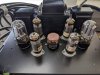
It could be that the specific parts I used might be giving me the results I am getting? Can't tell. I have attached a picture with parts I used.

Also, I wanted to try a solid state rectifier that @StepheK mentioned in her videos to see if the additional 10w (5v x 2a) used to heat the rectifier tube can be better preserved for audio amplification, and it seemed to tighten up the sound a bit. I haven't done extensive testing yet. If anyone is interested, I bought them from Weber Speakers (model=WS1 Copper Cap with Thermister option). There is a "secret link" I found by searching on the website's search box (so much for secret) that discounts the price by $1 which is what I used. This is fully assembled and ready to go, but make sure you buy it with the Thermister option.

https://www.tedweber.com/ws1/
https://www.tedweber.com/ws1-copper-cap-secret-order-link/
 

Attachments

  • FinalModified.png
    FinalModified.png
    781.9 KB · Views: 90
  • SolidStateRectifierWS1CopperCapWithThermister.jpg
    SolidStateRectifierWS1CopperCapWithThermister.jpg
    117.5 KB · Views: 83
Last edited:
I wish i had got the same results on the nobsound as you guys.No improvements here, if any thing less power and dynamic

Strange, as it shouldn't affect the actual power much, but this reduces the distortion very measurably, especially when the volume is turned up.
 
@ramboney we are likely getting these results because we are working within the very narrow limits of this amp. For most people who simply want to buy a class A tube amp that works full range "out of the box" with a pair of speakers should be looking at something like the Willsenton R8 which costs around $1,500 (even that needs another $600 in PSVANE tube upgrades to make it make it truly extraordinary). Anything less and you are likely taking a risk of heavy distortion when running full range. This is where @StepheK 's ground up tube designs under the skunkie designs banner can save you $$$ if you are up to building your own amp.

In my own situation this tube amp only works because I have the following setup:

1. Using a less demanding speaker like the Sound Artist LS3/5a (11 ohm)
2. Using an active DSP crossover set to 90Hz with my MiniDSP DDRC-24, which reduces the load on the amp + offers dirac live to tailor the response curve to my taste (6dB bass boost at the lowest end tapering off slowly until 400Hz, and then gradual linear roll off until 10K hz)
3. RSL Speedwoofer 10s to handle everything below 90Hz.
4. All soviet tubes (cheap, available on ebay)

I also have the Denafrips Ares II for a DAC which has a very natural tonality and big soundstage that I am sure is adding to the overall sense of quality.

It is a good question to ask if (cheap) Class A tube amp is even worth it for the above setup, and in my case the answer is a definite yes! Class A simply has an attack and realism that is missing even in my more expensive Cambridge Audio CXA80. The Nobsound 6P1 is simply my first introduction to tube amps and I will likely upgrade to something like the SMSL VMV A1 in the future to get the Class A sound without the tube hassle which should be plenty enough power for a 80Hz+ Crossover.

Update: Just for kicks I tried to use the 6P1 with my Sound Artist LS3/5a in full range mode (i.e., without using my miniDSP or subwoofer crossed over) through a Earstudio ES100 bluetooth (LDAP codec) connected to my Pixel 5 phone. Other than the fact that deep base is lacking, it still felt very clean, including punchy bass at max volume! The soundstage seem to have gained a bit of depth as well. Given this test, I would suggest speaker matching (8+ Ohm and low fluctuations in impedance) is really crucial to use this amp. If you are looking for speaker to match up to this (or any low power tube amp), I really would recommend the Sound Artist LS3/5a. I even listen to electronic music through it, though it is (like all LS3/5a) typically recommended for vocals and acoustic instruments.
Using a speaker with a nominally higher impedance changes the effective load on the output tubes. I'm not familiar with the Sound Artist version but I have a pair of the original Rogers LS3/5a. Their nominal impedance is 15 ohms. Typically, when you measure a speaker's DC resistance with a meter it will be lower than the nominal rating.

I'm not sure if @StepheK ever measured the primary impedance of the OTs but using a nominally 16 ohm speaker on an 8 ohm tap will double the effective primary impedance of the OT. Tubes are quite forgiving of non-optimal loads, so there's no harm, but you'll get a bit less power and also slightly lower distortion as a result.

On the other hand, the LS3/5a is relatively inefficient (mid-80s?), so in that sense it's actually more demanding in terms of power, but that's not so critical if you don't listen really loud.

Using a higher impedance speaker is not really so important but, as you say, a speaker whose impedance curve doesn't drop drastically or jump all over the place will be much easier to drive. Many people don't realize that a speaker's impedance isn't constant, it varies depending on the frequency. Unfortunately, impedance graphs are often not available but if a particular speaker doesn't sound good, that is often the issue.

IMO, the key to using low powered amps with smaller OTs is, just as you say, having the ability to add a sub if the low end isn't deep enough for you. Depending on the music, this might not be necessary, though. The strength of tubes is in the midrange and up, the strength of SS is bass. Letting each do what they do best works quite well and is much less expensive.

Also, I wanted to try a solid state rectifier that @StepheK mentioned in her videos to see if the additional 10w (5v x 2a) used to heat the rectifier tube can be better preserved for audio amplification, and it seemed to tighten up the sound a bit.
Switching to the SS rectifier plug in affects the audio portion of the circuit because it eliminates the voltage drop of the rectifier tube so the B+ voltage increases. SS diodes also don't have any voltage "sag". The 5v heater winding is a totally different, and independent, secondary winding. If it's disconnected it just reduces the overall stress on the power transformer so it will run a bit cooler.

Rather than simply disconnecting it, you might want to use it as a bucking transformer to compensate for the combination of higher wall voltage and the lower voltage primary found in most Chinese power transformers. This mismatch will result in higher heater voltages which will reduce the life of the tubes.
 
UI'm not familiar with the Sound Artist version but I have a pair of the original Rogers LS3/5a. Their nominal impedance is 15 ohms.

The SoundArtist LS3/5a is a cheap ($600) unlicensed clone designed around a nominal impedance of 11ohms vs. licensed which is 15ohm (though others seemed to have made 11ohm versions as well).

using a nominally 16 ohm speaker on an 8 ohm tap will double the effective primary impedance of the OT. Tubes are quite forgiving of non-optimal loads, so there's no harm, but you'll get a bit less power and also slightly lower distortion as a result.

According to @StephenK, the output tubes in this amp are not stressed at all, only the power transformer is. If I recollect correctly, for the given output transformer, she feels that a single 6P1 should have been sufficient, but they put two in there in parallel for aesthetic reasons (or simply copied an old design without thinking through it). And yes, I have this in a small den/room, and so I rarely drive this above 80dB in that room. Also with the crossover to sub in my setup, there is little to no lower frequencies the amp has to handle.

If it's disconnected it just reduces the overall stress on the power transformer so it will run a bit cooler.

Sorry, this is what I meant to state - lowering the stress on the power transformer. I am not sure if that might help the quality of power delivered in other windings.

Rather than simply disconnecting it, you might want to use it as a bucking transformer to compensate for the combination of higher wall voltage and the lower voltage primary found in most Chinese power transformers. This mismatch will result in higher heater voltages which will reduce the life of the tubes.

I don't know how to do this in terms of using it as a bucking transformer, but I solved the 110v problem using an external APC step-down transformer. So the amp is getting the input voltage it is designed for.
 
According to @StephenK, the output tubes in this amp are not stressed at all, only the power transformer is. If I recollect correctly, for the given output transformer, she feels that a single 6P1 should have been sufficient, but they put two in there in parallel for aesthetic reasons (or simply copied an old design without thinking through it).
I'm sure she'll correct me if I'm wrong but when she says that a single 6P1 could have been used with that OT it's because she thinks the primary impedance is ~5k. As I recall, she didn't actually measure them, but she's seen OTs that look identical being sold as 5k.

The 6P1 is a bit of an oddball tube in that, unfortunately, there is no American tube that's a direct sub. Electrically, it's the same as a 6AQ5 or 12AB5, both of which would like to see a primary impedance of 5k for a single tube. When you run two of them in parallel, they want to see a primary impedance of ~2.5k.

So, if the OT is 5k, there's already a mismatch. That's why she suggests that the OTs are better suited for SE rather than PSE (parallel single ended) use. Running a nominal 11 ohm speaker raises the effective OT impedance from 5k to ~7k but the tubes would operate better at 2.5k.

I don't know that it actually puts stress on anything but the tubes react differently and produce less power but also less distortion.

Sorry, this is what I meant to state - lowering the stress on the power transformer. I am not sure if that might help the quality of power delivered in other windings.

I don't know how to do this in terms of using it as a bucking transformer, but I solved the 110v problem using an external APC step-down transformer. So the amp is getting the input voltage it is designed for.
It probably won't affect "the quality of power delivered in other windings" directly but it will affect reliability and if the PT dies, well that will affect "the quality of power delivered in other windings" because there won't be any. ;)

Whatever method you use, it's important to make an adjustment so that the heaters aren't running too hot, which will shorten tube life considerably.

Welcome to AK, BTW!
 
I don't know that it actually puts stress on anything but the tubes react differently and produce less power but also less distortion.
Probably explains why I am experiencing lower distortion at max volume. I haven't hooked it up to any proper 8ohm speaker yet, but I plan to do so with the Klipsch RP-280F soon.

Not being an electrical engineer anything and just being curious, what would happen if I hook a 4ohm (lowest) speaker on the 8ohm tap? Assuming the factory OT has input impedance of 5K ohms @8ohms, would it not drop the input impedance to 2.5K? I assume this would both stress the power transformer and cause significant distortion, but (theoretically) at low volumes would give maximum efficiency of the 6P1 tubes?

It probably won't affect "the quality of power delivered in other windings" directly but it will affect reliability and if the PT dies, well that will affect "the quality of power delivered in other windings" because there won't be any. ;)

Welcome to AK, BTW!
Thanks! I have to credit @StepheK for helping me become a DIYer. Wouldn't have dared to do any of this on my own, but I have learnt quite a bit along the way.
 
Maybe I'm not that critical, but I'm happy with my Nobsound 6P1 after a couple of mods. My experience is based on building and repairing guitar amplifiers - hifi is a new concept for me and very different than instrument amplification. I don't intend to try to make the 6P1 into something it was never meant to be, so I'm not chasing higher power output - just cleaner sound with greater frequency response. I'm using an APC Line-R and feeding the amp 108 volts. I've thrown out the generic Chinese 6P1 tubes and replaced them with Russian 6П1П-EB. I bought two matched pairs from Riverstone, they're dated 1985 and 1987 from the Svetlana factory in St. Petersburg. This made a dramatic difference - cleaner highs with a bit of sparkle and tighter sound overall.

The first filter capacitor was replaced with a Vishay 22uF-450V. I replaced the coupling capacitors with Solen 0.22uF-630V Fast Caps. This made the bass response tighter and improved overall clarity and note separation. I know I'll never have a thumping, booming bass out of the few watts on hand, but I'm pretty happy with the overall sound. On my amp the caps on the screens were 0.30uF, not 0.22. I might go back into it and replace the remaining capacitors.
 
I should also add - the two 6H8C input (preamp) tubes and the 5ц4C rectifier supplied with the amp are also Russian NOS. They were made at the Novosibirsk factory and should be robust tubes. All of the Russian tubes I have carry the OTK Quality Control codes. The input tubes have 1981 date codes and the rectifier is 1977. Also, the 5ц4C is not a 5U4 type tube. The cyrillic letter ц translates as Tse. The Russian 5ц4C is equivalent to a 5Z4 American tube.
 
Probably explains why I am experiencing lower distortion at max volume. I haven't hooked it up to any proper 8ohm speaker yet, but I plan to do so with the Klipsch RP-280F soon.

Not being an electrical engineer anything and just being curious, what would happen if I hook a 4ohm (lowest) speaker on the 8ohm tap? Assuming the factory OT has input impedance of 5K ohms @8ohms, would it not drop the input impedance to 2.5K? I assume this would both stress the power transformer and cause significant distortion, but (theoretically) at low volumes would give maximum efficiency of the 6P1 tubes?
That's right, if you run 4 ohm speakers on the 8 ohm tap it will cut the primary impedance seen by the tubes in half. Of course, there are very few 4 ohm speakers that are designed for home use. If you have two pair of 8 ohm speakers you can hook them up in parallel, though.

That said, I don't think we really know for sure if the primary is 5k. Perhaps Stephe will measure them at some point but I know she's got other projects that take precedence at this point.

Power transformers are rated for a certain amount of current so unless you change the bias resistors on the output tubes so that they draw more current, the PT shouldn't be under any additional stress.

That's the dilemma with trying to get more power out of some of these Chinese amps. Many of them seem to run the output tubes very gently, presumably because the PT is undersized and can't supply more current without overheating.

Instead of sourcing a PT that allows the tube to be run at normal operating points, they design the amp around whatever undersized PT they can get cheap. Then they set the operating points of the tubes so they produce less power to compensate for the wimpy PT.

In a way, it would make sense if they actually used 5K OT as many nominal 8 ohm speakers can swing close to 4 ohms. I don't know your definition of "home use" but several budget speakers are in the 4-6ohm range. My Emotiva T-Zero+ is nominal 4ohm, my Sony SC-CS5 is 6 ohm, and the Polk R100/R200 that I am considering buying is listed with nominal impedance as 3.6/3.8ohm respectively!
 
I know many would consider this an absolute overkill, but I just tested the 6P1 using the expensive Psvane CV181-T MKII classic matched tubes (about $150-200/pair) and they sound absolutely marvelous! This amp continues to amaze with the quality that can be extracted out of this puppy. Looks gorgeous as well.

I tested this on my current setup which has the SMSL M500 DAC, a Bellari PA555 preamp (with MESA SPAX7), a Bellari SE560 sonic exciter (to pump up the bass a tiny notch without a subwoofer), Klipsch RP-280F (98db sensitivity), and the Weber solid state rectifier.

Nobsound6P1wPsvaneCV181-T MII.png
 
Could anyone post the configuration for "bucking" down 120VAC to 100VAC and the values for the transformer needed? I plan on purchasing the Nobsound 6P1, I don't want to run it beyond testing to make sure it's working before reducing the AC line voltage. I can use a variac to test the unit until I obtain a transformer dedicated to the 6P1 Thanks!
 
been a couple of months, hopefully this doesn't count as thread necromancy. i'm not an audiophile, but i am an electronics geek, though with limited tube experience (i've re-capped some old AA5 radios, lol). So when i bought this amp, the first thing i did was search for mods, because of course i can't leave anything alone, and found @StepheK 's YT channel.... 6 years in the Army (Field Artillery) and i can still hear (LOL) the distortion at high volume levels... i had been feeding a 20-odd year old pair of KLH Pro-6 speakers i got on clearance when i worked for the company that had the big red "R" in a circle as its logo.... think the sensitivity of those speakers is something like 86db (or was 20-odd years ago!) upgrading a brand new pair of Klipsch R-51Ms cleaned up the sound, and added some volume (93db sensitivity)
of course, i'm feeding the amp with an Amazon Echo Dot..... (so many of you probably hate me right now)
anyway..... resistors and caps ordered per StepheK's suggestions... i have to do something with that Blue LED.... ye gods...
also, i haven't cracked the cover yet, but i want to see how they're powering that LED...

my amp, ordered through Amazon, came with Russian 6P1Ps (i have 10 (!) 6P1P-EVs on order from Ukraine since March..... yeh..... not holding my breath)
also ordered qty. 4 Russian rectifier tubes through ebay..... We'll see, LOL
APC power conditioner comes in tomorrow, along with a digital handheld oscope that has received really good reviews... i have an old analog scope with FG built in, but, yeh.... can't screen cap/save traces.... i know someone had asked for a before and after of the signal trace.... i'm planning to sit with the thing at my house voltage (124v) and StepheK's schematic and see what voltages i get, then plug in the 120/110 APC, re-check the voltages
maybe check the signal at both voltages for distortion (it'd be nice to measure the distortion at different output levels, but not having a scope impedance matched to the amp output will screw with the readings...) just eye-balling the waveform, if i can figure out how to screencap the thing, i'll post it here.

then i plan to do the smaller cap mod (i have a 33uF 450v cap on hand, a bit high but still way lower than the supplied cap), the "fast" cap mod, bleeder resistor, and fixed bias mod....

and that blue LED is going bye bye, lol.... then i'll re-look at the wave form and hopefully see a much cleaner signal.

i previously built a kit (from China, via ebay) 6F2 and 6P1 PP (Douk Audio DJ511?) but, something is screwed up with that... and it's built on a circuit board, with zero instructions and an incorrect schematic.... so, yeh.... going to rebuild that as point to point eventually, assuming i don't kill myself with the Nobsound 6P1
 
Last edited:
Update: my Nobsound 6P1 came with 6P1P-EBs, 6H8Cs, and a 5ц4C

my digital handheld scope and APC power conditioner arrived, but none of my replacement parts, for the hell of it i fed the left channel with a 1kHz sine wave at 1V, viewing the output (across an 8ohm dummy load), at 124V from the wall, i started to see distortion on the negative portion of the sine wave about 27 "clicks" of the volume nob (my knob has 40 detent positions from zero to full) i listen to loud, distorted music anyway, but this jibes with people reporting breakdown at about 3/4 volume.

running on 110 (nominal, i haven't measured what exactly is coming from the APC) i (and my neighbors) noticed lower overall volume, less distortion at higher volume levels, and the power transformer is hot (after a couple of hours) but i can rest my hand on it..... which i couldn't do at 124V.
Running a bucking transformer even made the power transformer on my fisher 800c seem much less hot.
 
Back
Top Bottom