• The move to the new server is done. There are some software and database maintenance updates in process. This has us passing the hat around to help out. We appreciate any donations. Seriously, even a dollar helps. The payment page may be found here - https://www.audiokarma.org/support.html

Nobsound E6 Preamp Uses Directly Heated Tubes

I was listening to my tube set-up this morning and the right channel went out, so I immediately shut everything down. After close inspection I noticed one of the Russian tubes on the E6 had burned out. All of the glassy dark grey stuff at the top of the tube was gone and the interior of the tube had a milky/dusty look to it. Oh well. Initially I panicked a little bit and thought maybe my Dynaco ST-35 was in trouble, but it’s fine.

I decided to put my Schiit Vali 2++ head amp/pre into duty but will eventually put the E6 back in. I must say, I like using head amps with pre outs as a preamp. The Vali 2++ is very different than the E6, but very good. Swapping things in and out is part of my listening pleasure. I also use a balanced Geshelli E2 head amp/pre with my solid state set-up and it is excellent. I’ve also used it as a preamp for my Dynaco using a couple of Emotiva xlr balanced to rca unbalanced interconnects. And it sounds great there too.

Oh the madness of it all. Love it!
..
 
Update: have a long piece of foam I bought a while ago that I repurposed to wrap around the tubes. Microphonics is much better but wow... it's remarkable how the E6's sound has leaped. It's like a new pair of tubes altogether compared to what I was hearing before. My only issue is that I want to know if covering the tubes might result in any overheating? The amp has run cool even with foam but I don't know if ventilation will be an issue here. Anyone with know-how please let me know!
Using some kind of foam or rubber O-rings to dampen these tubes shouldn't be a problem. These tubes were designed to be heated with batteries so the voltage and current needed to heat their filaments is really low - 2.2v at only 56mA. As a result they barely get warm at all and also don't light up much. That's why they added an LED underneath them to light them up like a normal tube.
 
I might invest in another unit just to play with it to see if it can be modded to accept the tubes in the case. If it is possible to do it without potential damage to either the tube or the unit, I would prefer to leave the tubes in the can, personally. So the mod would have to include, as we discussed briefly earlier in the thread, enlarging the tube-holes in the aluminum case and snipping the guiding post on the tube shield to a length that it wouldn't contact the LED in the center of the tube socket. On either this thread or the other one on the other site, I recall some concern that removing the LEDs might do something to the voltages/amps because they are sometimes used as resistors or reducers. Don't remember.
If you want to use the tubes without removing them from their stock aluminum shielding I think that the only feasible way would be to move the board into a different chassis and use regular loctal sockets that mount to the top plate of a normal chassis, not sockets designed to mount to a circuit board. That way there would be enough room for the stock locator pin as long as you allow enough space under the socket.

If I were doing this I would remove the board mounted sockets and use wires to connect to the new, chassis mounted, ones. I'm not a fan of circuit boards in general but especially not a fan of board mounted sockets because every time you remove or install a tube you put pressure on the board and the connections. This sometimes results in cracked boards or damaged damaged solder joints. Chassis mounted sockets are much sturdier.

To me the main advantage of moving it to a new chassis would be the ability to reposition the input and output jacks so they are all located on the back of the chassis.
 
I was listening to my tube set-up this morning and the right channel went out, so I immediately shut everything down. After close inspection I noticed one of the Russian tubes on the E6 had burned out. All of the glassy dark grey stuff at the top of the tube was gone and the interior of the tube had a milky/dusty look to it.
The stuff that's deposited on the inside of a tube is called the "getter" flashing. It varies in color, sometimes it's silvery and sometimes darker grey. If it turns white or milky that means that air has leaked into the tube and it has lost its vacuum.

Unless the tube was dropped or cracked, the most likely cause is that the seal around the pins was not optimal and air leaked in. Usually this happens very slowly over a period of many years. During that time the getter will absorb and neutralize the molecules of air, which is what it's supposed to do. The vacuum in a tube is never perfect so the getter is designed to absorb anything that isn't pumped out at the time of manufacture or anything that might leak in over time. If it happens quickly, that would indicate a more serious leakage.

Remember, these tubes were manufactured many years ago. Tubes are mass production items and some end up being sealed better than others. Once or twice I've pulled new tubes from boxes and found that they have, at some point, lost their vacuum. Once or twice I've also tested tubes, put them back in their boxes, and then years later pulled them out to find that they lost vacuum. It happens. Just replace the tube and all should be well.
 
@drjohnnyfeva Here's something that you might try if you want to use the metal encased tubes in the existing chassis.

You could remove the board mounted sockets to create clearance and then attach normal chassis mount sockets to the top of the existing chassis. The socket would probably just drop into the existing holes without enlarging them at all. You would only have to drill mounting holes to attach the sockets and screw them down. If you still don't have enough clearance with the original board mounted sockets removed you could just add some spacers / standoffs to raise the chassis mount sockets a bit.

This would allow you to keep it in its existing case. If it doesn't work or you screw up somehow you can still transfer it all into another chassis.
 
@drjohnnyfeva Here's something that you might try if you want to use the metal encased tubes in the existing chassis.

You could remove the board mounted sockets to create clearance and then attach normal chassis mount sockets to the top of the existing chassis. The socket would probably just drop into the existing holes without enlarging them at all. You would only have to drill mounting holes to attach the sockets and screw them down. If you still don't have enough clearance with the original board mounted sockets removed you could just add some spacers / standoffs to raise the chassis mount sockets a bit.

This would allow you to keep it in its existing case. If it doesn't work or you screw up somehow you can still transfer it all into another chassis.
Took me looking at an octal socket to understand. I'd have to drill holes in the aluminum chassis to hold the socket in place. I think you're right that the socket would fit in the existing chassis tube holes. Which pins need connection? Wouldn't it be easier to leave the existing socket there and just solder wires from the needed pins in the existing socket to the leads of the new socket?
 
Took me looking at an octal socket to understand. I'd have to drill holes in the aluminum chassis to hold the socket in place. I think you're right that the socket would fit in the existing chassis tube holes. Which pins need connection? Wouldn't it be easier to leave the existing socket there and just solder wires from the needed pins in the existing socket to the leads of the new socket?
Looks to me like the existing sockets are fairly close to the top of the case. You'd need enough space under the top of the case for the regular socket's pins so I don't think you could leave the board mounted socket in place.

Sockets vary in size so you'd have to buy some loctal sockets and measure them. The ones I have would extend below the top plate by roughly 5/8".

If you look at the pic of the board in Post #88 you can see where the 8 pins of the socket are soldered to the board. You'd just need to de-solder them and run wires from those spots on the board to the corresponding pins of the new socket. Or leave the board connections alone and clip the pins from the bottom of the existing socket and then solder the wires to the remaining part of the pins.
 
Using some kind of foam or rubber O-rings to dampen these tubes shouldn't be a problem. These tubes were designed to be heated with batteries so the voltage and current needed to heat their filaments is really low - 2.2v at only 56mA. As a result they barely get warm at all and also don't light up much. That's why they added an LED underneath them to light them up like a normal tube.

Thanks for the reassurance! At most, it's gotten warm but nowhere near how the Tube-03 can run. It sounds terrific right now wrapped in foam, but I'll wait for my new shipment of Russian tubes to see if I can find a relatively silent pair.
 
So time to provide a little more information on this Nobsound E6. I posted a little write-up about a swap of film capacitors I did on one of my FX Audio Tube03's on the REDUX and more - FX Audio 6j1 tube preamp - a $31 wonder thread. As part of the comparison between the modded Tube 03 and the E6 I A/B'd the units - almost initially. Somehow, I bi-passed the Little Bear tube unit I use to get some extra signal out of my pc into the E6. So it had a direct line from the pc to the receiver without the benefit of the additional gain. It did not like this arrangement!

I got a lot of microphonics when I had to raise the receiver volume to meet the level of the other line that did have the LittleBear plus the Tube 03. So I think that the E6 needs a sufficient amount of gain to perform properly. I tried adjusting the volume up and down on the E6 and moderate the volume on the receiver to no avail. Once the receiver volume was past about 12 o'clock the E6 started ringing. I took out the Tube03 and replaced the E6 in it's spot after the Little Bear and no such problems.

Of note as well, the modded Tube03 (w/ new WIMA film caps, MUSES8890 opamps, and Motorola 6ak5 nickel plates) sounded slightly better than the E6 with the Russian tubes. I'm going to continue to evaluate the modded Tube03 for a while, because it sounds really good. The comparison was very close, however, when I listened just swapping the Tube03 and E6 in and out of their position.
 
Last edited:
So time to provide a little more information on this Nobsound E6. I posted a little write-up about a swap of film capacitors I did on one of my FX Audio Tube03's on the REDUX and more - FX Audio 6j1 tube preamp - a $31 wonder thread. As part of the comparison between the modded Tube 03 and the E6 I A/B'd the units - almost initially. Somehow, I bi-passed the Little Bear tube unit I use to get some extra signal out of my pc into the E6. So it had a direct line from the pc to the receiver without the benefit of the additional gain. It did not like this arrangement!

I got a lot of microphonics when I had to raise the receiver volume to meet the level of the other line that did have the LittleBear plus the Tube 03. So I think that the E6 needs a sufficient amount of gain to perform properly. I tried adjusting the volume up and down on the E6 and moderate the volume on the receiver to no avail. Once the receiver volume was past about 12 o'clock the E6 started ringing. I took out the Tube03 and replaced the E6 in it's spot after the Little Bear and no such problems.

Of note as well, the modded Tube03 (w/ new WIMA film caps, MUSES8890 opamps, and Motorola 6ak5 nickel plates) sounded slightly better than the E6 with the Russian tubes. I'm going to continue to evaluate the modded Tube03 for a while, because it sounds really good. The comparison was very close, however, when I listened just swapping the Tube03 and E6 in and out of their position.
..
Good info, thanks.
..
 
I should also note that the receiver I fed the un-gained E6 into is a fleawatt (17-25W) Fisher 170. It punches far above it's weight sound wise, but if the E6 craves gain to pass its goodness - which seems is maybe the case, expecting a low watt receiver to compensate for a weak signal might be the reason we are experiencing the ringing. It could just be that a weak input into the E6 causes the ringing problem. Otherwise, when properly "gained" with the Little Bear, this has never occurred at any volume... I hope others will try to confirm or dis-confirm this experience. I believe I read someplace that feeding the E6 with a phone produced terrible results. Amazon reviews? Some other forum? IDK. That could be the ringing issue, tho.
 
A small edit to the above note on the E6...

I used MUSES8920's (not 8890's) in the modded Tube03.

If I have a chance tomorrow, I am going to put the remaining WIMA film caps I have in the E6. The WIMAs happen to be of the same specs as the ones in there and I'm bored while enjoying the new WIMA's in the modded Tube03. More soldering practice, lol.
 
I took out the stock film caps and replaced them with the last 4 WIMA's I had. Sounds great. Still think I'm getting more from the Tube03 with the mods tho. It's super close and probably academic about which one is best. They both sound great. I think the ability to play with the tone a little with the Tube03 is what makes it nicer. The drums sound as they do live. Crisp and clear, punchy and there's good separation between all of the instruments. But I shouldn't take away anything from the E6, tho.

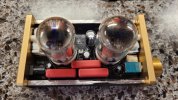
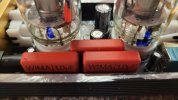
The exchange of film caps went easier this time, but there is one problem everyone should know about. The WIMA's are a 1/2 millimeter taller than the stock ones and that small difference prevented the board from being able to slide back in to the case. I even had them snug to the board. My solution was to cut the whole top off the E6. Rather than go to the store I got out the trusty hacksaw and sliced about a third of the height clean off. There are little protrusions on the inside of the aluminum chassis that accept the boards that go in them and provide a little extra rigidity, I guess. The ones from the top with the punch outs for the tubes were just enough to prevent the new caps from being able to slide in. Also, I figured if I was going to play with using the cased tubes, then other than potentially having to extend the tube socket or lift them as @FlaCharlie has suggested, then part of the problem is already solved. No more tube holes! lol

Anyway, it sounds great. I'm sure I'll find someplace to use it. Probably school, once we go back. Here are some pics.
 

Attachments

  • 20230719_142931.jpg
    20230719_142931.jpg
    118.1 KB · Views: 38
  • 20230719_142944.jpg
    20230719_142944.jpg
    78.7 KB · Views: 39
I figured if I was going to play with using the cased tubes, then other than potentially having to extend the tube socket or lift them as @FlaCharlie has suggested, then part of the problem is already solved. No more tube holes! lol
The diameter of the existing holes was only part of the problem.

The other is that the aluminum locator pin on the stock, fully encased, tubes is too long. It will bottom out when it hits the LED that is mounted on the board in the center of the tube socket. It might even bottom out against the board if you were able to remove the LEDs. In either case, the pins would not make a good connection with the socket.

If you cut the pin or grind it shorter you might also damage the glass that extends into the pin area if you cut too much off. That glass is where they sealed the tube after pumping all the air out of it. If it cracks you lose vacuum and the tube is useless.

If you're determined to try the tubes with their aluminum shells I still think you'd be better off mounting normal (chassis mount, not PCB mount) sockets to another enclosure, relocating the board into it and connecting the board to the new sockets with wires.

I may do that at some point but, as I've said, my main motivation would be to locate both the input and output jacks to the back of the chassis.

Frankly, I'm not convinced that the tubes would sound any different with their shells intact. That's based on my experience with the tube's cousin, the 2P29L, which I breadboarded a while back. They sounded the same with or without the shell.

But this is a different tube that seems to be more microphonic, so maybe I'm wrong. Try it and let us know if you think it's worth the effort.
 
It's interesting to hear the difference from the Nobsound E6 alone compared to when it's daisy-chained with the FX Audio Tube-03.

So my Tube-03 has been emitting really bad electrical hum–it's likely after there was a brief power outage in my place a few days ago. The hum was only noticeable yesterday, so I decoupled it from my system and let the E6 run on its own.

Only then I realized how the Tube-03 has compressed the E6's soundstage and dynamics all this while. Not by a lot, but it's noticeable after comparing. My Tube-03 uses the classic Voskhod 6J1P-EVs.

However, it must be said the Voskhods add some amazing midrange to the combination. So, with the E6 by itself, I've noticed how that is now gone. I'd certainly take the E6's characteristics over the Tube-03 but I can't help but notice the loss now. I'm gonna check what's up with my Tube-03 when I have some time – maybe it's time to finally upgrade the caps? I know nothing about soldering though.

I must note that I've been running my Tube-03 without any op-amps as well.
 
It's interesting to hear the difference from the Nobsound E6 alone compared to when it's daisy-chained with the FX Audio Tube-03.

So my Tube-03 has been emitting really bad electrical hum–it's likely after there was a brief power outage in my place a few days ago. The hum was only noticeable yesterday, so I decoupled it from my system and let the E6 run on its own.

Only then I realized how the Tube-03 has compressed the E6's soundstage and dynamics all this while. Not by a lot, but it's noticeable after comparing. My Tube-03 uses the classic Voskhod 6J1P-EVs.

However, it must be said the Voskhods add some amazing midrange to the combination. So, with the E6 by itself, I've noticed how that is now gone. I'd certainly take the E6's characteristics over the Tube-03 but I can't help but notice the loss now. I'm gonna check what's up with my Tube-03 when I have some time – maybe it's time to finally upgrade the caps? I know nothing about soldering though.

I must note that I've been running my Tube-03 without any op-amps as well.
I go back and forth between the E6 and the Tube03 that I changed the caps and opamps on. I have only tried them together when I first got the E6. I also have that LittleBear T7. The T7 is essential for my setup. The gain it gives from my pc balances everything out and gives me excellent volume control from the PC. I also noticed a bit ago that the E6 does not like a weak signal.

I'd be interested to know what signal you're feeding to the daisy chain and where both units are in it. Mine goes PC - LittleBear - Tube03/E6 - Receiver. I can't really tell much of a difference with either the modded Tube03 or E6 in my setup. The Tube03 with the MUSES8820's, new caps, and RCA tubes is really sweet, but the E6 is just about equal. I like the tone controls. I wonder what the opamaps back in your setup might do too.

I will say this too. In that big $31 Wonder thread there is a lot of discussion about the Tube03 being essentially the same as the Tube01J. I'm no longer so certain of that. I got the original Tube01 from Ali about 6 months ago and it has a different board and had some different copper winding, that I imagine is for getting the tubes to the proper voltage in the center of the board. They also come with two potentially equal but maybe somewhat dissimilar tubes too. I would be interested to hear your impressions using, but minimizing, the opamps. I only tested whether the Tube03 would operate w/o opamps, I never kept them out for any period of time. I know others have, however, to no detriment evidently. But I can't say that I haven't wondered.

From the minimal experience I have with the film cap mod, you can do it, but you need to have a third hand. I bought a little weighted clamp system from Amazon. It helped but wasn't perfect and I wound up using a non-skid mouse pad to put the edge of the board on and pliers on the film cap with the iron on the back side to melt the solder and pull/twist with the pliers to get it free. I know it was amateur hour, but it worked and I got better at it as I persisted. You'll also need either a solder wick or one of those solder removal tools to clean up the holes in the board before soldering new ones in. It was worth it, for nothing else than experience, but it ended up sounding good too, so it was something I was really glad I tried.
 
I go back and forth between the E6 and the Tube03 that I changed the caps and opamps on. I have only tried them together when I first got the E6. I also have that LittleBear T7. The T7 is essential for my setup. The gain it gives from my pc balances everything out and gives me excellent volume control from the PC. I also noticed a bit ago that the E6 does not like a weak signal.

I'd be interested to know what signal you're feeding to the daisy chain and where both units are in it. Mine goes PC - LittleBear - Tube03/E6 - Receiver. I can't really tell much of a difference with either the modded Tube03 or E6 in my setup. The Tube03 with the MUSES8820's, new caps, and RCA tubes is really sweet, but the E6 is just about equal. I like the tone controls. I wonder what the opamaps back in your setup might do too.

I will say this too. In that big $31 Wonder thread there is a lot of discussion about the Tube03 being essentially the same as the Tube01J. I'm no longer so certain of that. I got the original Tube01 from Ali about 6 months ago and it has a different board and had some different copper winding, that I imagine is for getting the tubes to the proper voltage in the center of the board. They also come with two potentially equal but maybe somewhat dissimilar tubes too. I would be interested to hear your impressions using, but minimizing, the opamps. I only tested whether the Tube03 would operate w/o opamps, I never kept them out for any period of time. I know others have, however, to no detriment evidently. But I can't say that I haven't wondered.

From the minimal experience I have with the film cap mod, you can do it, but you need to have a third hand. I bought a little weighted clamp system from Amazon. It helped but wasn't perfect and I wound up using a non-skid mouse pad to put the edge of the board on and pliers on the film cap with the iron on the back side to melt the solder and pull/twist with the pliers to get it free. I know it was amateur hour, but it worked and I got better at it as I persisted. You'll also need either a solder wick or one of those solder removal tools to clean up the holes in the board before soldering new ones in. It was worth it, for nothing else than experience, but it ended up sounding good too, so it was something I was really glad I tried.

Thanks for the soldering tips!

I had those RCA tubes before one of them died out–I'd say it's the Tube03-compatible tube I've tried (before one died out) that sounds closest to the E6 too. I'll also add that the difference between the daisy chain vs. E6 alone is only most apparent through headphones (Grado SR225es).

I'll also say that this is comparing the E6 alone vs the E6 with the Tube-03. I haven't used the Tube-03 by itself ever since getting the E6. I removed the op-amps because I wanted tone controls to be restricted to my integrated amp (NAD 3020i) but that's definitely a point worth considering. I only ever upgraded to the OPA2134PAs and I wasn't entirely satisfied with its sound along the way. For the 8820s, is there any compatibility difference between the 8820Ds and 8820Es? Those are the only ones available on Mouser.

In regards to your query re: signal, for me, there isn't a need for a tube pre-amp strictly to boost the signal. Everything I'm doing is strictly for the fun of it haha. I have a DAC (Topping E30II) that handles my PC's audio so it's just been see-sawing the digital signal and playing around with the analogue volume of the pre-amps. The Topping alone with my NAD sounds good but I noticed the tube pres are crucial in removing the digital glare and harshness it has.
 
Thanks for the soldering tips!

I had those RCA tubes before one of them died out–I'd say it's the Tube03-compatible tube I've tried (before one died out) that sounds closest to the E6 too. I'll also add that the difference between the daisy chain vs. E6 alone is only most apparent through headphones (Grado SR225es).

I'll also say that this is comparing the E6 alone vs the E6 with the Tube-03. I haven't used the Tube-03 by itself ever since getting the E6. I removed the op-amps because I wanted tone controls to be restricted to my integrated amp (NAD 3020i) but that's definitely a point worth considering. I only ever upgraded to the OPA2134PAs and I wasn't entirely satisfied with its sound along the way. For the 8820s, is there any compatibility difference between the 8820Ds and 8820Es? Those are the only ones available on Mouser.

In regards to your query re: signal, for me, there isn't a need for a tube pre-amp strictly to boost the signal. Everything I'm doing is strictly for the fun of it haha. I have a DAC (Topping E30II) that handles my PC's audio so it's just been see-sawing the digital signal and playing around with the analogue volume of the pre-amps. The Topping alone with my NAD sounds good but I noticed the tube pres are crucial in removing the digital glare and harshness it has.
I don't think there is any difference between the 8820D and E's. Iirc, it was only lot differentiation, but I can't remember if that was for MUSES or LME's. I just don't completely recall. I think the 8820's and 8920's are now considered "old stock" and aren't being replenished, but rather replaced by something newer??? Or maybe those are the new stock??? I haven't looked in a while because I'm super happy with the 8820's and I now have them in each of the 3 Tube03's I have.

The Tube03 with the opamps definitely adds additional gain. You should back them down to 12 o'clock or lower to find your sweet spot and then only use your receiver to tweak for different songs or source material. I think 12 o'clock is neutral on the Tube03. Anyway, I'd be interested to know what you think of the daisy chain with the opamps.
 
Just got the E6. Nice! Bought it on the strength of the comments here and happy that I did.

Tried it on my garage system with my go-to test track - Laos’ cover of “More Than a Feeling.”

Impressive punch, very ambient; I don’t think this is my imagination.

Next, I dusted off my Cold Sweat - “Break Out” CD. “Long Way Down” has a mix of finely recorded acoustic and electric guitars. The amplifier tone is one of the finer examples I have ever heard.

Sounds great with the stock Chinese tubes. I can’t imagine how the Russian tubes will be even better, but I am enthused to find out.

No howling or microphonics. I even tapped on the tubes with my fingernail — nothing.

Perhaps Nobsound has sorted out the tube problems?

I will swap out the input and output capacitors for WIMA. If there’s a space issue, it’s doable to shave down the bottom of the capacitors if the matter is merely a half millimeter.

I would have preferred a larger enclosure. Also, RCA jacks on the front are not what I would prefer. Maybe I will rehouse it someday. Then again, I have far more than one project on the back burner…

Orange LEDs under the tubes are kind of dim. I would actually like something brighter! That is something I may very well do when changing capacitors.

SMD modifications are no problem for me. I have some electronic qualifications which include SMD soldering.

Occasionally I am called on to do near-microscopic rework. What I see with the E6 is actually quite manageable comparatively speaking.

So far, liking it a lot. If I can get back to one of my back-burner projects - my Pioneer A-80, I might like to use the E6 with the A-80 as it’s sometimes said that the A-80 is rather sterile sounding.

I have to say that for the money, this is a winner.
 
Back
Top Bottom