You are using an out of date browser. It may not display this or other websites correctly.
You should upgrade or use an alternative browser.
You should upgrade or use an alternative browser.

Register to hide this ad

sKiZo
Hates received: 92644 43.20°N 85.50°W
An LED is an LED ... is not ...
You're talking about Class Two elements. An LED source that isn't safe for the eyes will have warning labels plastered all over it. Even those would require you to stare directly into them - not necessarily the smart thing to do with ANY brighter light source.
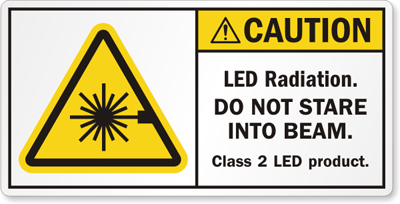
You're talking about Class Two elements. An LED source that isn't safe for the eyes will have warning labels plastered all over it. Even those would require you to stare directly into them - not necessarily the smart thing to do with ANY brighter light source.

restorer-john
Addicted Member
The high intensity blues at close range are not good for your eyes. But then again, staring into any light source for a long period is not good for your eyes.
At distances across a room, blue LEDs are fine.
At distances across a room, blue LEDs are fine.

mroboto
Super Member
I covered the leds of my Yaqin MS-300C with HandiTAK, not because it's dangerous at meters of distance, but because they are really anoying.
If you look to a more powerfull Bell & Howell Tac-Light LED at close range for a moment, sure this can make you permanently blind quickly.
If you look to a more powerfull Bell & Howell Tac-Light LED at close range for a moment, sure this can make you permanently blind quickly.
Last edited:

Light from LEDs, or light-emitting diodes, comes from the short-wave, high-energy blue and violet end of the visible light spectrum. Eyes are not designed to look directly at light — they are designed to see with light. Blue light, which is part of the visible light spectrum, reaches deeper into the eye and its effects can cause damage to the retina with long term exposure. In certain wavelengths, blue light can develop macular degeneration (AMD).So it's important to limit the amount of exposure to blue light, whether it's from LED's or different sources.



vwestlife
Super Member
Cheaper LEDs flicker at the power line frequency (60 Hz in North America, 50 Hz in Europe), just like old tube-style fluorescent lights, which may cause eye strain if you are sensitive to it. The fancier ones use a switching power supply to generate a much higher refresh rate and eliminate flicker, just like most CFLs, but this comes at the expensive of causing some RF interference, which may interfere with radio and TV reception.
And as for the blindingly bright indicator LEDs on some electronic products, you can cover them up with a piece of black tape.
And as for the blindingly bright indicator LEDs on some electronic products, you can cover them up with a piece of black tape.

ConradH
Lunatic Member
I've read some conflicting stuff, some of which doesn't seem to make sense from a spectrum and power viewpoint compared to what you'd get on any sunny day. My eye doctor advises caution and I do find that LED bench lighting (and CFLs) causes me eyestrain. Last time I got glasses they tried to sell me an expensive blue-blocker coating. I declined, but maybe it's worth trying. I'm probably headed for cataract surgery at some point in the future.


Ill give you the science explanation:I see them everywhere. Even some receivers utilize them. So are LED lights safe for the eyes? I see so many conflicting articles on the internet. But nothing definitive. It's almost as if if people are afraid to talk about it.
all leds give off some UV light in the 400nm or smaller wavelength. which is harmful regardless of intensity. however depending on material used, the predominant light wavelengths differ which is why todays clear LEDs are a box of chocolates until you light them up (I think I have white, blue, purple, red, orange, yellow, green all in clear 3mm packages. the materials used are: (from the web)
- Indium gallium nitride (InGaN): blue, green and ultraviolet high-brightness LEDs
- Aluminum gallium indium phosphide (AlGaInP): yellow, orange and red high-brightness LEDs
- Aluminum gallium arsenide (AlGaAs): red and infrared LEDs
- Gallium phosphide (GaP): yellow and green LEDs
but keep in mind, the computer screen you are reading this on gives off UV, the twisty bulbs we used to have and the LED bulbs we have now for household lighting also do, so it could be that the lights in your marantz are just making a meager contribution to harm prevalent everywhere...
(ps - you will note that your wife is annoyed because all of the HGTV hints she got on using grays for tile and paint are foiled because its gray only in the incandescent display at lowes, under the LED lights at home its pinkish purple...)

whoaru99
Epic Member
...It's almost as if if people are afraid to talk about it.
Or, they've concluded there are bigger fish to fry.

whoaru99
Epic Member
I've read some conflicting stuff, some of which doesn't seem to make sense from a spectrum and power viewpoint compared to what you'd get on any sunny day. My eye doctor advises caution and I do find that LED bench lighting (and CFLs) causes me eyestrain. Last time I got glasses they tried to sell me an expensive blue-blocker coating. I declined, but maybe it's worth trying. I'm probably headed for cataract surgery at some point in the future.
FWIW, if the lenses are polycarbonate I think they block 100% UV even if clear (no coating/tint). However, the anti-reflective coatings are nice, IMO, as a long time eyeglass wearer.
DaveVoorhis
Addicted Member
Or don't care. There are so many things that are more worrisome than LED lights. If you're concerned, avoid staring directly into them up close for hours at a time.It's almost as if if people are afraid to talk about it.

arts
Addicted Member
It's almost as if if people are afraid to talk about it.
Reminds me of the microwave oven debate as to whether these devices affected food on a molecular level,and therefore created new and potentially dangerous new compounds. Didn't see that one get far either......

Todd Dodds
Super Member
Or don't care. There are so many things that are more worrisome than LED lights. If you're concerned, avoid staring directly into them up close for hours at a time.
I used to laugh off these things, until the day I noticed I really was growing hair on the palm of my hand.


vwestlife
Super Member
Actually it's the opposite. CCDs are much more sensitive to infrared light than the human eye, which is at the opposite end of the visible spectrum from UV. In fact, that's how "night vision" cameras work -- by detecting infrared light that we can't see.we do know that in indoor settings the UV light overloads the CCD electronics in digital cameras and show up as blue (look at some of my stereo restore pics...the lighting is blue on camera, while in life as the human eye focus does not respond to UV light)
If the colors are coming out wrong in your photos, then you simply need to adjust your camera's white balance. On some the automatic white balance simply doesn't work that well, and it's better to use manual white balance -- hold a white piece of paper in front of the lens and then engage manual white balance, and it will adjust itself to whatever your lighting is.

dosmalo
T-Totaled
The high intensity blues at close range are not good for your eyes. But then again, staring into any light source for a long period is not good for your eyes.
At distances across a room, blue LEDs are fine.
For me blue LEDs are like tinsel.