• The move to the new server is done. There are some software and database maintenance updates in process. This has us passing the hat around to help out. We appreciate any donations. Seriously, even a dollar helps. The payment page may be found here - https://www.audiokarma.org/support.html

Official AR Turntable Owners Thread

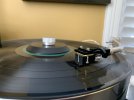
The rabbit hole is winning. I had the DL-103 mounted on a fairly heavy headshell at the end of the Pioneer arm and put it on the AR. I added a 2.5g weight to the headshell and balanced it to 2.5g. The heavier CW is now sitting about 2/3 of the way back on the stub.
So far, it sounds really good and seems to track just fine. I’m listening to John Abercrombie’s great album Timeless and hearing a bit more life out of it. Never heard the room echo just after the kick drum hits. Just a bit more detail in the mids and the top end is very smooth.
Regardless of the cartridge, I always got an airy 3D presentation from the XA, but sometimes thought the low end lacked just a bit. It may still be the case to an extent with the Pioneer delivering a bit more low end, but the midrange isn’t quite as lifelike. The SRA or VTA might be a bit higher on the AR and that may contribute a bit to the difference, but with the conical rock, I doubt it is enough to be significant. Splitting hairs.
Yes, a Denon DL-103 can work on an XA arm which has a technics wand, sapphire pivots and some added mass.
I really need to do the suspension upgrades.
 

Attachments

  • IMG_4137.jpeg
    IMG_4137.jpeg
    83.2 KB · Views: 21
Last edited:
I have been using Dave’s (VN) Linn type springs for quite a while on most of my AR rebuilds, problem was the subchassis always needed extra weight to compress the springs to the proper tension rate for proper jounce. Problem is some customers were just looking for an original restoration and no modifications or altering the table from original. In a conversation with Dave I asked if he could make springs similar to the original AR XA springs and he said why not. Fast forward, he know has the springs and I have used them on three tables with very good success, here’s a pic of the last table I am in the middle of building with the new springs.
SZx6uJ4.jpg
I’m curious about these. My XA is from about 1972 and has the original springs which are probably due for replacement. I had planned to do the mass loading thing but it would involve stripping the TT down and getting out the soldering iron……….. Is mass loading and lowering the center of gravity really that helpful? I did it once and am not sure.
 
Mass loading and rebalancing the subchassis is really important when adding weight to the plater using heavier mats and record weights. Also if replacing the original arm with a heavier arm. When keeping the table in its original state, arm and light mat, these new VN light weight springs are a great alternative. Changing these 40 year old springs really does help with the proper jounce of the suspension, not as sloppy as the old springs.
Linn recommends changing their springs quite often, not sure how necessary that is but I can see every 5 years doing a spring replacement.
 
The mass loading started when the only springs available were Linn/VN type springs designed for Linn tables. They required stiffer tension springs since the plater, suspension and arm was much heavier. Years ago Merrill did sell a lighter tension spring that worked well with the AR table, now that VN sells a spring you don’t need to go through the mass loading if you’re not using any more mass above the subchassis.
 
The mass loading started when the only springs available were Linn/VN type springs designed for Linn tables. They required stiffer tension springs since the plater, suspension and arm was much heavier. Years ago Merrill did sell a lighter tension spring that worked well with the AR table, now that VN sells a spring you don’t need to go through the mass loading if you’re not using any more mass above the subchassis.
Hello Sir!
Been a while! So quick question, is there an advantage to doing the tables using the collector plate, Linn springs and mass loading as Marc did? I'm still doing them that way. It does have a step where we balance the weight so it is centered.
Thank you! Stay warm!
 
Hi José,
Yes there’s an advantage if your adding weight to the plater and arm so the regular AR springs become too compressed to work properly. The reason we started the mass loading was that the Linn type springs were way too stiff for the AR table so needing more weight to compress them to the proper rate. The new VN light weight springs are a hair stiffer than the AR springs so you can add a slight amount of weight to the plater and arm without mass loading. With these springs you can still use a decent weight mat, heavier headshell and counterweight without going to the Linn type springs and mass loading.
 
So if people are asking for mass loading and stiffer springs their options are us VN for their springs versus using Marc's method with the Linn springs and mass loading? Is there an advantage of using one over the other. It does sound like the VN springs mod is easier.
 
I ordered the VN springs. It seems to me that lowering the center of gravity might be a good thing. @sfrost I know you have a lot of experience with the Merrill parts, but I had an AR for many years which used the acrylic Tbar and lead/acrylic platter. It required the heavy springs to balance but all of the weight was above the springs and it always wanted to move side to side. Isn’t that why George used a sliding weight underneath on the Heirloom? That may be an extreme example.
I did the mass loading thing with Linn springs on another table and remember it sounding better but it’s been a minute and I‘m not sure.
 
So if people are asking for mass loading and stiffer springs their options are us VN for their springs versus using Marc's method with the Linn springs and mass loading? Is there an advantage of using one over the other. It does sound like the VN springs mod is easier.
The advantage of mass loading is compensating for additional weight to the parts above the subchassis. You want the subchassis to weigh more so the center of gravity is lower, allowing the slung suspension to move vertically and not horizontally.
I ordered the VN springs. It seems to me that lowering the center of gravity might be a good thing. @sfrost I know you have a lot of experience with the Merrill parts, but I had an AR for many years which used the acrylic Tbar and lead/acrylic platter. It required the heavy springs to balance but all of the weight was above the springs and it always wanted to move side to side. Isn’t that why George used a sliding weight underneath on the Heirloom? That may be an extreme example.
I did the mass loading thing with Linn springs on another table and remember it sounding better but it’s been a minute and I‘m not sure.
Yes, once you add more weight above the subchassis you do need the stiffer springs and mass loading. The Merrill weight he used on the Heirloom subchassis was used to balance the subchassis, was able to rotate the weight to equalize the balance depending on the arm used. Merrill also made springs back in the day with much less tension which didn’t need the mass loading like the Linn springs do.
 
If memory serves me well and others may remember more from conversations with Marc but I vaguely remember him talking about using the collector plate and hanging the lead under that plate to put the mass loading lower.
Did that help to create a more stable vertical movement and reduce any side to side movement? What he called jounce. This is also why he would balance the mass loading
 
Yes, the further down from the sub the more stability you will achieve. This is not new, I believe Grado and Fairchild did this in their tables using flywheels under the table way back in the early 60’s as well as some of the modern super high end tables.
 
I am trying to recall some of my early conversations with Marc Morin. He was such an intelligent man/engineer. My recollection was that his epiphany was driven by the value of adding weight to the suspension...changing resonance characteristics, lowering the center of gravity, adding solidarity to the suspension and changing other dynamics that he probably explained but I could not grasp...etc. My thought is that the potential value of the added weight came first and then the application of the heavier Linn springs to support the added mass. My XB was one of the first he modified to test his thinking.
 
Back to my experience in making a stock DL-103 work on a modified XA arm.
I’m using a 13g headshell with an 8g brass shim. With the CW off it tipped my scale at 31g so I’m going to call that enough mass for the cartridge. The problem with that is that the CW now about 50g shy of ever balancing, but Anthanasios made me a CW that weight 127 so I’m halfway there. Four 1/4oz weights add another 28g. 155g at the back end and I’m now listening to it at 2.38g. The low end is now full and tight, the midrange clear without being spitty at all and the soundstage is wide and deep.
With the added mass on the arm I had to crank the nut on the arm spring one turn. I can live with it.
I understand that this TT may not be ideal for getting the most out of the 103 but I don’t have a Thorens 124 or vintage Garrard.
 

Attachments

  • IMG_4140.jpeg
    IMG_4140.jpeg
    59.2 KB · Views: 33
  • IMG_4141.jpeg
    IMG_4141.jpeg
    70 KB · Views: 33
I would love to see pictures of this.
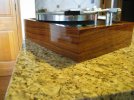
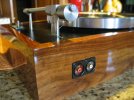
Here are a few. Marc's earliest efforts used round lead weights. He ended up preferring rectangular weights that were easier to mount and balanced the weight better. The walnut plinth was built by a member here. It is 4" high. You can also see the motor bracket Marc added to make the motor even quieter and more isolated.
 

Attachments

  • 2A772BF2-EBFA-44DC-83F9-4BD4CDC10344.jpeg
    2A772BF2-EBFA-44DC-83F9-4BD4CDC10344.jpeg
    111.5 KB · Views: 78
  • D7A7E96B-2A97-4933-82AF-4F594EAC35D0.jpeg
    D7A7E96B-2A97-4933-82AF-4F594EAC35D0.jpeg
    105.9 KB · Views: 75
  • 1B8FB26A-17D5-4540-B47C-A27DEAFBA33E.jpeg
    1B8FB26A-17D5-4540-B47C-A27DEAFBA33E.jpeg
    110 KB · Views: 79
  • 36F36745-1ED3-4060-9126-E5C86C8B1DAE.jpeg
    36F36745-1ED3-4060-9126-E5C86C8B1DAE.jpeg
    128.7 KB · Views: 84
  • C685D224-ADC3-466D-88DF-E9252E4F619C.jpeg
    C685D224-ADC3-466D-88DF-E9252E4F619C.jpeg
    185.1 KB · Views: 91
  • 7BA805F1-0092-4866-A7D2-4D6D542D2A22.jpeg
    7BA805F1-0092-4866-A7D2-4D6D542D2A22.jpeg
    150.2 KB · Views: 85
  • E53DBE55-BE94-4D52-AF97-3A0B7D72D23D.jpeg
    E53DBE55-BE94-4D52-AF97-3A0B7D72D23D.jpeg
    105.2 KB · Views: 80
  • 20462379-BF92-44EA-AF58-4C6794DE54B7.jpeg
    20462379-BF92-44EA-AF58-4C6794DE54B7.jpeg
    89.1 KB · Views: 79
Last edited:
So if people are asking for mass loading and stiffer springs their options are us VN for their springs versus using Marc's method with the Linn springs and mass loading? Is there an advantage of using one over the other. It does sound like the VN springs mod is easier.
I installed the VN springs this evening and it took me just a few minutes to balance everything out and play some music. The first thing I noticed when changing them was the original studs were all quite loose which isn’t all that surprising after over fifty years of use. The new lower rubber bushings look identical to the originals but didn’t have the cardboard tubes and foam so I used those with the new bushings. The wing nuts have nylon inserts to lock in place. The arm is centered in the plinth hole and everything bounces nicely. Spinning Crosby Stills and Nash, CSN and it sounds really good. The low end is full and sounds like a Fender bass through an Ampeg B-15 should. I put the Shure M55E/VividLine on a lightweight headshell on the working end and the stock CW on the other. As MM wrote, ‘A modified XA will charm your socks off’. Yep.
 
So you used the lighter tension spring then?
The Linn springs and the VN are heavier, both black also, and the same tension so need mass loading. Then there’s the white heavy springs which are way too stiff and shouldn’t be used unless you’re using a brick on top of your table.
 
Last edited:
So you used the lighter tension spring then?
The Linn springs and the VN heavier, both black also, are the same tension and need mass loading. Then there’s the white heavy springs which are way too stiff and shouldn’t be used unless you’re using a brick on top of your table.
Light springs.
 
Back
Top Bottom