

You are using an out of date browser. It may not display this or other websites correctly.
You should upgrade or use an alternative browser.
You should upgrade or use an alternative browser.
Official Jolida JD9 thread
- Thread starter helios660
- Start date


Frank Sol
Lunatic Member
I am not sure Frank's question above ever got answered (if there is an answer). I too am rolling 12AU7s and AT7s in my JD9 and think they greatly improve the quality of sound...and plan on continuing the practice.
Please ....thoughts?
I made a post about this in the 'Tube Audio' forum.
http://www.audiokarma.org/forums/showthread.php?t=351420
BTW--- I left the 12au7s in my JD9 and screwed the lid back on and have had no problems since that post... I like the performance of the 12au7s with MM carts.
The next time I open-up my JD9 will be to install new opamps. I have not decided on which ones and how many.

bigdirty
High fidelity brah
hey frank, thanks for biting the bullet and tossing some 12au7 in there. have you experienced any increased heat with the 12au7?
For opamps if your on a budget start with the op627. you can plug them in to any of the sockets and see where they make the most impact. what fun!
big
For opamps if your on a budget start with the op627. you can plug them in to any of the sockets and see where they make the most impact. what fun!
big
Frank Sol
Lunatic Member
bigdirty, I havent measured the heat with a tech instrument... But to the touch I cannot feel any difference. Just slightly warmer than room temp where the vents are on top.
Underwood HiFi uses those Burr-Brown OPA-627. They replace the two output ones for a 'Level 2 mod' and all of them for a 'Level 3'
Underwood HiFi uses those Burr-Brown OPA-627. They replace the two output ones for a 'Level 2 mod' and all of them for a 'Level 3'
Frank Sol
Lunatic Member
Some technical help & advice please, THANKS
Please inform which opamp is which and their operational use (Output ect...) and which should be 'upgraded' 1st. Also which brand opamp would you use in each position in an upgrade (see attached picture 1-6)
Thanks again!

Please inform which opamp is which and their operational use (Output ect...) and which should be 'upgraded' 1st. Also which brand opamp would you use in each position in an upgrade (see attached picture 1-6)
Thanks again!
Attachments

bigdirty
High fidelity brah
Some technical help & advice please, THANKS
Please inform which opamp is which and their operational use (Output ect...) and which should be 'upgraded' 1st. Also which brand opamp would you use in each position in an upgrade (see attached picture 1-6)
Thanks again!
I dont know exactly how a opamp based RIAA works, so someone please correct me if im wrong.
socket five and six would be input buffer, three and four responsible for RIAA, and one and two an output buffer. (off to the googles to research this)
whether the above info is correct or not, I use LT1028 in 5 and 6. opa627 for 3 and 4. with AD843 in 1 and 2. as I said above, start with the op627 since you can put them in any slot.

The RIAA equalization curve is independent of the op amps, using capacitors and resistors externally connected to the op amps. Changing op amps will not change the RIAA equalization it's fixed.
However you can change the gain level and the overall sound (by altering the frequency response) of the amp by changing op amps.
However you can change the gain level and the overall sound (by altering the frequency response) of the amp by changing op amps.
bigdirty
High fidelity brah
learning out loud
of course without the schematic of the JD9 this is only a guess, but the info on this link seems similar to the JD9.
http://www.platenspeler.com/background/riaa/uk_riaa_background_3.html
the bit about the low pass filter and pole zero filter could be happening around socket 3,4,5,6. with 1 and 2 as an output buffer/amp. again, only a guess and learning out loud here.
anyone with some insight please contribute
of course without the schematic of the JD9 this is only a guess, but the info on this link seems similar to the JD9.
http://www.platenspeler.com/background/riaa/uk_riaa_background_3.html
the bit about the low pass filter and pole zero filter could be happening around socket 3,4,5,6. with 1 and 2 as an output buffer/amp. again, only a guess and learning out loud here.
anyone with some insight please contribute

ggrey
Sonically Insane
I made a post about this in the 'Tube Audio' forum.
http://www.audiokarma.org/forums/showthread.php?t=351420
BTW--- I left the 12au7s in my JD9 and screwed the lid back on and have had no problems since that post... I like the performance of the 12au7s with MM carts.
Thanks for the link Frank. Interesting although no concrete answers.
I have been using 12AU7s in my JD9 now for approx 24 hours (3+ at a time)
no excess heat and no distortion detected . But plate voltage worries me. I may just go back to 12AT7s to be safe. I have a couple pair of RCAs and a Tele that sound very good. I have not yet found a 12AX7 I like...too harsh, but will keep looking.

Mr. Lin
Lunatic Member
Don't worry about RIAA curves. The tubes are in the output stage (buffer amp).
Aha, gotcha! I didn't even think of that. The tube phono preamp I was using at the time is a different type of circuit, with pairs of tubes at the inputs and outputs.
Knowing that, I recommend those of you who are experimenting with different tube types try the 5751.

PickyEars81
Super Member
I got bored today and have been feeling like I am not "getting enough" out of my benz/jd9. I finally got around to taking mine apart, and I have to second a previous poster's opinion (Brett, IIRC that there is quite a significant improvement running it with bare tubes and no cover in place...

rkay5
Active Member
Hi,
This preamp sounds like the way to go but, I just got a new Pro-ject phonobox SE to go with a new Creek Evolution 5350 integrated amp.I was going to use the Creek CMC phono board in the Evo 5350 but can't because of the very large size of transformer inside the EVOLUTION 5350 and the magnetic field it generates.Creek Audio said it not advised to use the moving coil phono board in the Evo 5350.So I got the Pro-ject SE preamp from local dealer for $300,it sounds good with the Denon DL103R(waiting on a DL301mkII)so would the Jolida JD9 Tube Phono Preamp be better, I never had any tubes is my system.So should I sale the Pro-ject SE and get a Jolida JD9
This preamp sounds like the way to go but, I just got a new Pro-ject phonobox SE to go with a new Creek Evolution 5350 integrated amp.I was going to use the Creek CMC phono board in the Evo 5350 but can't because of the very large size of transformer inside the EVOLUTION 5350 and the magnetic field it generates.Creek Audio said it not advised to use the moving coil phono board in the Evo 5350.So I got the Pro-ject SE preamp from local dealer for $300,it sounds good with the Denon DL103R(waiting on a DL301mkII)so would the Jolida JD9 Tube Phono Preamp be better, I never had any tubes is my system.So should I sale the Pro-ject SE and get a Jolida JD9
bigdirty
High fidelity brah
So should I sale the Pro-ject SE and get a Jolida JD9
keep both. A/B. sell the loser
Frank Sol
Lunatic Member
I got bored today and have been feeling like I am not "getting enough" out of my benz/jd9. I finally got around to taking mine apart, and I have to second a previous poster's opinion (Brett, IIRC that there is quite a significant improvement running it with bare tubes and no cover in place...
The guys at 6moons agree...
Mr. Lin
Lunatic Member
I got bored today and have been feeling like I am not "getting enough" out of my benz/jd9. I finally got around to taking mine apart, and I have to second a previous poster's opinion (Brett, IIRC that there is quite a significant improvement running it with bare tubes and no cover in place...
I always remove tube shields from components. I know they're there for a reason, but I think in general sound improves with them removed. If you have a little extra $$ to experiment with, consider trying some tube dampers. I use the ones from Herbie's Audio Lab, which are quite popular, and he has a good return policy should you discover they're not for you.
rkay5
Active Member
Hi,
I just ordered a Jolida JD9 from jolida.net what pain in the ass.After 5 emails to China english as 2nd:scratch2:, I got how to place a order.Because at jolida.net it said they would send a paypal invoice but they don't.So I just ordered by paying $315.00 with paypal to payment@jolida.net/SHANGHAI SHENDA SOUND ELECTRONIC CO.,LTD. and hope for the best??
I just ordered a Jolida JD9 from jolida.net what pain in the ass.After 5 emails to China english as 2nd:scratch2:, I got how to place a order.Because at jolida.net it said they would send a paypal invoice but they don't.So I just ordered by paying $315.00 with paypal to payment@jolida.net/SHANGHAI SHENDA SOUND ELECTRONIC CO.,LTD. and hope for the best??

Brett a
~◦●○o0o○●◦~
I swapped my stock output caps for a pair of Obbligato Aluminum Films which I chose after reading the excellent article linked to from Bigdirty back in post 34.
The article said this about them:
Even though this guy was testing these in speaker X-overs, I think I'm finding his description to be fairly accurate at least initially. Although I have to admit, I was hoping for more bass energy as my system tends toward lean.
I have a couple question at this point as I am new to DIY/internal tweaking.
When I first fired this up and spent a couple hours listening, I was disappointed at the recessed soundstage and compressed dynamics; it wasn't night-and-day; someone else might not have noticed but I know my system well enough to notice the attack was softened and the sound was too smooth.
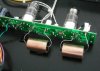
This morning, I decided to re-do the solder points at the backs output cable sockets. This time I wrapped the joint with a coil of copper wire (from a CAT5 line). The little nubs ate just that; little and I figured the added copper coil would help provide solid contact.
I think it sounds better now. Am I imagining this? Or are solder joints like this successful to degrees as opposed to go/no go?
Still not sure if I like them. They haven't made as big a difference over the stock caps as I had hoped. I'll live with them for a while.
The article said this about them:
http://www.humblehomemadehifi.com/Cap.html
Obbligato aluminium-foil MKP 630VDC – 5% tolerance
Technical specifications: Chinese built, extra tight winding, no voids and thick-coated aluminium film imported from Germany. Very low inductance. Lead-outs are tinned copper, solid core.
Sound: Analogue is the word that keeps popping-up in my head when trying to describe these capacitors. They have a rich texture and produce an open and smooth image with realistic dynamics and good retrieval of ambient information. They have slightly less depth than a Clarity Cap DTAC but are also very detailed and never get harsh. They seem to have a sort of detailed warmth about them. In a direct comparison to the Clarity Cap PX, I would say that they are in the same league up to / into the midrange; however the Obbligato have more definition in the upper mid and treble; tones such as an acoustic guitar or solo violin attacks seem to gain in clarity and have better separation, the image seems to be less flat. Therefore the timbre of instruments is a bit more accurate with more air in between, allowing a more "naturalness" of the sound scene. Though they have higher definition, they are never harsh nor harsher than the smooth Clarity Cap PX and let me hear some nice but soft inner details. That's probably why I define them as "analogue". Very nice especially when you look at their price!
Verdict: 10
Even though this guy was testing these in speaker X-overs, I think I'm finding his description to be fairly accurate at least initially. Although I have to admit, I was hoping for more bass energy as my system tends toward lean.
I have a couple question at this point as I am new to DIY/internal tweaking.
When I first fired this up and spent a couple hours listening, I was disappointed at the recessed soundstage and compressed dynamics; it wasn't night-and-day; someone else might not have noticed but I know my system well enough to notice the attack was softened and the sound was too smooth.
This morning, I decided to re-do the solder points at the backs output cable sockets. This time I wrapped the joint with a coil of copper wire (from a CAT5 line). The little nubs ate just that; little and I figured the added copper coil would help provide solid contact.
I think it sounds better now. Am I imagining this? Or are solder joints like this successful to degrees as opposed to go/no go?
Still not sure if I like them. They haven't made as big a difference over the stock caps as I had hoped. I'll live with them for a while.
Attachments

Last edited:
PickyEars81
Super Member
I swapped my stock output caps for a pair of Obbligato Aluminum Films which I chose after reading the excellent article linked to from Bigdirty back in post 34. Which said this about them:
Even though this guy was testing these in speaker X-overs, I think I'm finding his description to be fairly accurate at least initially. Although I have to admit, I was hoping for more bass energy as my system tends toward lean.
I have a couple question at this point as I am new to DIY/internal tweaking.
When I first fired this up and spent a couple hours listening, I was disappointed at the recessed soundstage and compressed dynamics; it wasn't night-and-day; someone else might not have noticed but I know my system well enough to notice the attack was softened and the sound was too smooth.
This morning, I decided to re-do the solder points at the backs output cable sockets. This time I wrapped the joint with a coil of copper wire (from a CAT5 line). The little nubs ate just that; little and I figured the added copper coil would help provide solid contact. (see the attached photos)
I think it sounds better now. Am I imagining this? Or are solder joints like this successful to degrees as opposed to go/no go?
Still not sure if I like them. They haven't made as big a difference over the stock caps as I had hoped. I'll live with them for a while.
You could have had a cold solder the first time? For things that aren't particularly delicate, I use low wattage, and heat the components, letting the wire "suck" the solder in, like a sponge. Solder joint should be shiny upon completion...If the wire has slack in the hole moves before the solder adequately cools. a cold solder may occur.
Last edited:
PickyEars81
Super Member
I always remove tube shields from components. I know they're there for a reason, but I think in general sound improves with them removed. If you have a little extra $$ to experiment with, consider trying some tube dampers. I use the ones from Herbie's Audio Lab, which are quite popular, and he has a good return policy should you discover they're not for you.
Thanks, I think I will check those out. :thmbsp:
Brett a
~◦●○o0o○●◦~
I wondered about the dullness of my solder. It seemed to take forever to heat the component enough to get the solder to melt at all. I did heat it from the other side of the work, but still...You could have had a cold solder the first time? For things that aren't particularly delicate, I use low wattage, and heat the components, letting the wire "suck" the solder in, like a sponge. Solder joint should be shiny upon completion...
What temp would you suggest I set my station at next time? And how long would you expect it to take before it melted Cardas solder (it states 338°F)?