• The move to the new server is done. There are some software and database maintenance updates in process. This has us passing the hat around to help out. We appreciate any donations. Seriously, even a dollar helps. The payment page may be found here - https://www.audiokarma.org/support.html

Onkyo M-508. A couple of questions for the experts

I have been contemplating replacing the thin twisted wire I used with some 14 gauge solid copper wire- I may do that when I'm in there replacing the tired old relays. Someone who put new caps in a M508 used a custom 3D printed block to hold the caps- I wish he would produce many many more and sell them
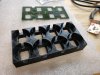
74476829_504682640131527_8284816009303425024_n.jpg
 
I have been contemplating replacing the thin twisted wire I used with some 14 gauge solid copper wire- I may do that when I'm in there replacing the tired old relays. Someone who put new caps in a M508 used a custom 3D printed block to hold the caps- I wish he would produce many many more and sell them

View attachment 2584829
Yeah that would be nice. It is thick enough to use 14ga solid wire to extend the leads for even the 4 pin snap-in caps without worrying about shorting against the aluminum plate. And not too thick for the caps I ordered for their length. :thumbsup:
 
Yeah that would be nice. It is thick enough to use 14ga solid wire to extend the leads for even the 4 pin snap-in caps without worrying about shorting against the aluminum plate. And not too thick for the caps I ordered for their length. :thumbsup:
It is BK Precision Audio that did a cap replacement using that plastic block- I asked them on their Facebook page where I could get one, I hope they respond with something positive..

https://www.facebook.com/bkprecisionaudio/photos/pcb.504683010131490/504682280131563
 
BK says he is doing another M508 in a week or so and will print out a few of these brackets- contact them on FB to get one for yourself.
 
BK says he is doing another M508 in a week or so and will print out a few of these brackets- contact them on FB to get one for yourself.
I'm not on FB, but thanks. I'm not going to need one now anyways. I've decided to use 16ga solid wire to reproduce the 4 original leads. It is much easier to bend into shape, and 16ga at about an inch in length will easily handle the current. I carved the aluminum plate to clear the leads, but need to use a diamond burr on a Dremel to finish smoothing out the edges from the rotary file chucked in a drill press. I have thick enough Neoprene O-rings to take up any space to hold the caps firm. I will glue the rings to the caps, nip out a couple of gaps for ventilation, then glue them to the plate for stability. At least they'll get a little air flow that way, and vent if need be in case of a power surge.
 
I look at the facebook mess only a couple times a year.. I wish it would die off already (F you Zuckerberg!) I had thought of using 3/8" x 3/8" wood pieces to make a lattice for the caps to sit up on, but I'll see if the guy comes through with the 3d printed block before I do anything.. He said he would print a few, maybe I'll get two and send you one...
 
Last edited:
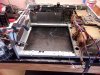
Today I'm ill with what feels like CV-19 (massive headache, fever & chills, eyes are burning, stomach is flip flopping, and it hurts to breathe- so much for getting 4 vaccinations). The wife is going to take me in for a test tomorrow AM. Since I didn't feel up to doing much I put new relays in my old M-508. Super simple to do: take off the back panel, separate the relay board from the speaker terminal board (4 plastic clips holding them together), get out the magical Hakko 301 de-soldering gun and get to work. All went very well and Mr. Dim Bulb Tester said I didn't jack anything up... new Omron MY4-02-DC12 relays fit like a glove after snipping off and filing down the bottom row of pins. They are also SUPER quiet when they switch on (the same nearly silent click as the new ones in my M-506RS).
001.jpg 002.jpg 003.jpg 004.jpg 005.jpg
 
Last edited:
quick question on film capacitors- my M508 service manual lists several of the film capacitors like this: 0.1uF 50V (DEW)

What is this "DEW" ???

And now for fun: it also uses some MUSE electrolytic caps (Bipolar ?)...so if the Muse caps do not have a positive or negative polarity, why are they not used (or can they be used) in other locations that use standard electrolytic capacitors?
 
Why not bipolar caps everywhere? Most likely due to extra cost for no gain in performance or reliability.

The bipolar caps are physically larger for a given capacitance & voltage rating than their polar counterparts. Look up a Nichicon FW polarized audio grade cap and you'll see they have a smaller footprint than the ES series bipolar's of the same rating. If there are a lot of caps then the boards may have to be increased slightly in size. Most boards are sold based on size so increasing the size by even a few sq inch will cost slightly more per unit. The bipolar's themselves will also typically have an extra cost associated with them over the equivalent polar counterpart.
 
That has me wondering why they used them at all ? All the M508 service manuals are poorly scanned and hard to read, so I can't really figure out why they used six of them on the main amp board in the first place.
 
quick question on film capacitors- my M508 service manual lists several of the film capacitors like this: 0.1uF 50V (DEW)

What is this "DEW" ???

And now for fun: it also uses some MUSE electrolytic caps (Bipolar ?)...so if the Muse caps do not have a positive or negative polarity, why are they not used (or can they be used) in other locations that use standard electrolytic capacitors?
I can't answer about DEW code for Onkyo. However bi-polar electrolytics are actually 2 polarized cores in the same can to form a single bi-polar unit. That is why the MUSE bi-polar are larger than their comparable (voltage/current) polarized counterpart.
 
That has me wondering why they used them at all ? All the M508 service manuals are poorly scanned and hard to read, so I can't really figure out why they used six of them on the main amp board in the first place.

C413 - 416 have signal passing through them. If signal is passing through the cap then a bipolar is a better choice. You can bias a polar cap to allow it to operate in this instance and still pass signal but the bipolar will do it with less distortion.

C423 - 424 are across the bias network and have opposing polarity signals on them. A polarized cap would've sufficed here but possibly they saw a possibility of reversed polarity in some instance and decided to use the bipolar for reliability or maybe they thought the bipolar sounded better here due to the fact its contacting the signal path.
 
It also uses MUSE caps on the meter protection board in C215,216,217, and 218 (100uF 25 V). replacement would be the Nichicon UES1E101MPM.

Thanks for the responses, they make a lot of sense.
 
BK Precision Audio made two capacitor blocks for me for $30 total with shipping (surprised he didn't want a LOT more), they're on their way via USPS. I purchased the eight filter caps from Digi-key (they have about 45 left in stock and are going quickly- they had 90 last week) CDE brand 10,000uF / 100V, # 382LX103M100A082:
https://www.digikey.com/en/products/detail/cornell-dubilier-electronics-cde/382LX103M100A082/2295343?s=N4IgjCBcoCwGxVAYygMwIYBsDOBTANCAPZQDaIArAAwVgKHUwDsATCALqEAOALlCAGUeAJwCWAOwDmIAL6EWVGAE5EIFJAw4CxMuCr6qAAgCtAMQ7c+kEAFVxongHlUAWVzpsAV2G5Z8qkwq0GpoWHiEJJDkYPqGAGoWILz8dg7Obh7evnIgALRsweointqR5BQcMjkVwVxQYNx1kCwUVUA

I also purchased all new Nichicon audio grade small value caps from Mouser, they will be here next week.

The last time I replaced the big filter caps I did not have the correct soldering iron to be able to reuse the thick copper plates that connect them and they have grown legs and walked away (I suspect the wife threw them out) so I bought a 6" x12" 16 gauge (.051" thick) copper plate to make all news ones out of.
 
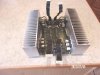
Old caps are out, I'll have to fix a trace that lifted/fell off, but otherwise the board turned out to be in pretty good shape. The old caps all look to be fine but my multimeter won't read them, and with them being 23 years old it is time to replace them.
109_2646.jpg 109_2652.JPG 109_2643.jpg
 
Old caps are out, I'll have to fix a trace that lifted/fell off, but otherwise the board turned out to be in pretty good shape. The old caps all look to be fine but my multimeter won't read them, and with them being 23 years old it is time to replace them.
View attachment 2606710 View attachment 2606711 View attachment 2606712
Thanks for the photo of the foil side. That will help me tremendously for those "jumpers". The one you have in red being the most important. This one I have here already had jumper wires, one on each channel, and a trace intentionally "cut" to reroute the connection. I "forgot" to take a photo right after I removed the copper plates. :thumbsup: Now I know the correct path to take when I get back to it.
 
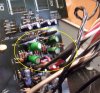
I took the beasty completely apart today so that I would be able to get to the boards easily...surprisingly there was very little desoldering needed to get everything out. I do have a question on Muse Bipolar caps: the service manual shows 100uF 25 Volt MUSE caps for C215 thru C218 (on the meter board),so I bought Nichicon UES Muse caps but when I took a look at the board it has plain old 100uF 25 Volt polar caps in those locations (big black stripe on the green cover)... the Muse caps I bought are quite a bit larger but will fit, but is it okay to use them when the originals are not bipolar? (see pic 3)
109_2653.JPG 109_2654.jpg C216-216-217-218 MUSE compatible.jpg
 
Thanks for the photo of the foil side. That will help me tremendously for those "jumpers". The one you have in red being the most important. This one I have here already had jumper wires, one on each channel, and a trace intentionally "cut" to reroute the connection. I "forgot" to take a photo right after I removed the copper plates. :thumbsup: Now I know the correct path to take when I get back to it.

Here is a much larger pic of the bad trace:

bad trace.jpg
 
Back
Top Bottom