• Check out the Annual AK Secret Santa exchange Program, signup before November 23rd in the AK Charities & Christmas forum!

Open Baffle Epiphany!

If you choose high sensitivity drivers, you will not need high powered amps.
If you use a tweeter you need at least one cap.
If you have a spare sub with a low pass, you could use it with a Full range to save $$$.
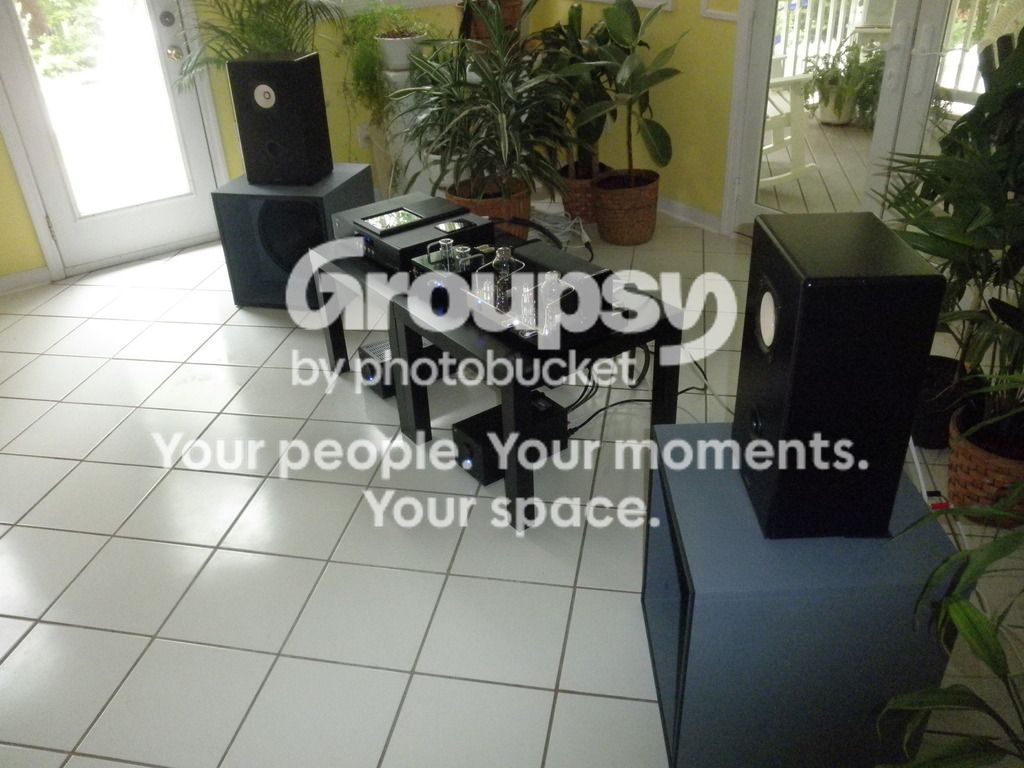
I'm screwing around with old Hi-Fi speakers (Magnavox). 12'" woofer with a Tweeter and a cap. I made a separate baffle for them and I can rotate them in and out.
Good cheap fun!
 

Attachments

  • IMG_1220.JPG
    IMG_1220.JPG
    76.3 KB · Views: 44
Hi all,

Apologies as I have not read all 96 pages of the thread - maybe 30 or so, and I started getting a bit lost.

Let's see if I can summarize what I believe I learned so far:

- You use a full range speaker on the open baffle
- If you would like to add a tweeter, you can either use a high pass filter, a capacitor, or bi-amp separately
- Bass may be lacking, but you can either bin the bass, eq it, or build a 10' wide baffle for it
- Passive x-overs are a no-no

Did I catch the main gist, and it's now up to me to source some full range speakers, a baffle, and figure out how to @#%$@&^ biwire the things?

I've got a set of Technics speakers in the the garage which can provide some donor parts for me. I like the idea here - seems like the OB concept would be great for a wide soundstage on orchestral music.

If I've missed any of the main bits, someone feel welcome to disabuse my of my incorrect thoughts.

Oh, and how would coaxial speakers work in this application (i.e. Kef iQ)

You got a lot of it. Most full range drivers should work but if you do a single very few will offer enough bass plus they'll require a large baffle. Best to use a full range driver augmented with bass woofers that will move lots of air in free space like the Eminence Alpha. Baffle size is not so critical if you use full rangers and big woofers. Bi-amping is the way to go and if the full range drivers are HE then you can use a highly resolving flea amp ( tube or class D ) with a SS powering the woofers. An active crossover can make things much less complicated and 2 ways make lots of sense. I use an active now days but only on the LF.
 
I built MJK's H-frames years ago and still listen to them most everyday. They produce some very nice bass and you can experiment with a variety of FR tops. They even sound good as speaker stands for monkey coffins.:D

PC120001.jpg
 
Last edited:
I think there's too much to like about OB bass to use an enclosure. Linkwitz claims it's the most accurate of all.
More specifically, dipole bass. From his site:

"Dipole woofers have the advantage of less room mode excitation and thus preserve articulation in bass sounds, which matters even in a highly damped recording/mixing studio. "

I have long found that to be true. I just prefer the nearly massless variety. :)
 
And from the same site:

  • Realistic bass levels can be obtained from dynamic drivers in open baffles, not from panels. For extreme SPL requirements the number of drivers could get very large and, therefore, below 50 Hz they are more economically replaced by sealed box subwoofers.
 
Ah, so that's an H-Frame. Apparently missed that post though did see the pics.

Seems setting it back a bit may also help with time alignment.
 
For extreme SPL requirements the number of drivers could get very large and, therefore, below 50 Hz they are more economically replaced by sealed box subwoofers.

I certainly don't have "extreme SPL requirements" - having stopped attending deafening wall of mud rock concerts after high school, but agree that having 32 square feet of diaphragm does not come cheaply. :)

You really ought to try out his dipole stuff. That's where the magic lies.
 
Last edited:
On those same H-frames I've had a blast listening to 4.5 inch Fostex, 8 inch Betsy, 8 inch Pioneer BoFu, 8 inch Tang Band W8-1808, 12 inch Beta 12LTA and now my favorite the 12 inch Zenith 49CZ802 alnico.
 
Last edited:
On those same H-frames I've had a blast listening to 4.5 inch Fostex, 8 inch Betsy, 8 inch Pioneer BoFu, 8 inch Tang Band W8-1808, 12 inch Beta 12LTA and now my favorite the 12 inch Zenith 49CZ802 alnico.

Of the three 8" you listed, how do they rank? I believe I have a pair of BoFu's somewhere in the basement.
 
Let's see if I can summarize what I believe I learned so far:

- You use a full range speaker on the open baffle
- If you would like to add a tweeter, you can either use a high pass filter, a capacitor, or bi-amp separately
- Bass may be lacking, but you can either bin the bass, eq it, or build a 10' wide baffle for it
- Passive x-overs are a no-no

Did I catch the main gist, and it's now up to me to source some full range speakers, a baffle, and figure out how to @#%$@&^ biwire the things?

No, I don't agree.

A full range driver or a mid and tweeter will work on an OB. If you use a 4" full range driver, or even smaller, it is easier to mate with a OB woofer and will extend higher in frequency not needing a tweeter.

The bass can be easily added with a 15" or 18" woofer with a Qts > 0.7 and probably best around 1.0 on a reasonably sized baffle. Either OB or U/H frames will work to produce excellent deep bass.

Passive crossovers work very well if the drivers have the right relative SPL/w/m values. A crossover is required on all drivers, running one full range is a mistake. I have used passive and active crossovers on my various dipole speaker designs and I would prefer a passive crossover if possible.

The free BASTA program, google "BASTA from Tolvan" to find a copy that can be downloaded and installed, works well for designing OB speakers and crossovers.
 
Of the three 8" you listed, how do they rank? I believe I have a pair of BoFu's somewhere in the basement.

1. Zenith - just does everything right, piano, vocals etc. Once folks discover this $20 sleeper they'll soon be bought up. The gorgeous TB at $200+ each is a distant 2nd.
2. Tang Band - very smooth and refined but a bit too polite for my tastes - lacks the grandeur and sense of scale of the Zenith or Beta
3. Beta - huge sound stage but less refined, needs a tweeter - if you want OB rock this is it. ( hard to decide between the TB and Beta )
4. Betsy - other than the Zenith this is the only one that works without a woofer but needs the big folding wings to produce bass. Very good all around performer - a desert island type driver
5. Pioneer - needs a tweeter and sounds big but lacks the detail of the smaller Fostex - overall an enjoyable FR speaker. With a piezo it's a very good choice for a BIB.
6. Fostex - incredibly detailed but with much less cone area it comes off sounding thinner than the others. Works best in a back loaded horn.
 
Running a full range driver full range makes sense to me. I also avoid a passive crossover like the plague but I certainly respect MJK's opinion.
 
I believe some of you have the Caintuck Audio OB's which make good use of the Betsy drivers. The Betsy's run full range as they were designed to do and if bass augmentation is desired customers can opt for plate amp powered OB Alphas. No passive crossovers are used in this system and the sound is excellent.

http://www.caintuckaudio.com/
 
If you run a full range driver without a high pass crossover and use a woofer in parallel with a low pass crossover to add bass a couple of things happen that to me are not desirable.

1. Low frequencies (bass notes) are sent to the full range driver which can cause excessive cone motion. By removing the low frequencies with a crossover the cone deflection will be greatly reduced (less distortion) and the driver will play to higher SPL values before becoming deflection limited. It will probably be thermally limited before the cone starts to approach Xmax. In my opinion and experience this gives a much tighter, cleaner, and open sound from the full range driver. The full range driver is only being asked to reproduce frequencies where it is strongest, the mid range and up.

2. Without the crossover the full range driver and woofer are both producing the bass output. This will tend to over emphasize the bass because it will be combined coming from two drivers and louder than the mid and high frequencies coming from the only full range driver itself. At first it will sound warm and appealing, after a while it will sound fake and exaggerated.

Measurements will show these effects. I have experimented with and without the crossover on the full range driver and in my opinion and experience it is a mistake to not apply the passive or active high pass filter to the full range driver. Measurements are the truth and reveal a lot about an audio component's performance, boutique brands tend to not supply measurements and rely on well written prose to sell products. It is hard to separate the really good from the mediocre, be careful.
 
It's common to see full range single drivers in horns or box speakers powered by their own amp and augmented by subwoofers. I consider the H-frames to be subs as they have their own amps which have built in crossovers to filter the highs. Can't imagine why you'd need a passive crossover for the FRSD in such an arrangement. Here's a picture of what I'm talking about and it sounds quite good.

Maybe we're talking about two different situations.

P6030003.jpg
 
Are those full range drivers in OBs?

I am talking about OB applications where there is no box to load the full range driver at low frequencies. A single full range driver in a modest sized baffle will not produce decent bass, you need a helper woofer. In that case a crossover on both the woofer and full range driver will get the best out both drivers, you will be playing to the strength of both drivers and limiting the frequencies where they struggle.
 
Back
Top Bottom