I figured I'd start my own thread to ramble on about my never ending test equipment repairs. I post some of these as vids on my YouTube channel: Phil's Analog Basement
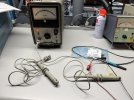
This weekend I'm working on calibrating my HP 428B clip on DC milliammeter. It's a really neat tool and as far as I know, HP's last vacuum tube device as it was in the catalog up until around 1986. I bought it last year, and it didn't work - I found a tube had gone to air. I replaced that tube and it now works. However, it reads low on all ranges. The tube I replaced was V8, a 12AU7. I replaced it with a Hewlett Packard labelled GE tube that has perfectly matched triodes for both plate current and transconductance. I actually tried a few others in there and it didn't behave any better, so I don't think that's it.
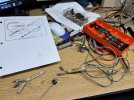
This is a later production unit, around 1980 which used a PCB. The earlier versions were point to point wired.
The calibration process doesn't seem too bad, but once I really started digging into it, I found that I ended up needing quite a bit of equipment. Luckily I have everything I need to make with happen.

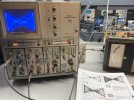
Analog scope for XY mode to perform the final adjustment.
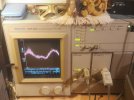
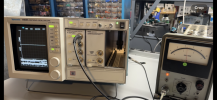
One of the steps calls for an oscilloscope with 10 vertical divisions. They suggest a HP 130C scope in the manual. I remembered the 11403A displays 10 vertical divisions so I pulled that off the shelf for that step. The rest of my scopes have 8 or less. I could have made it work by scaling it down to 5, but this scope needed some runtime anyways.
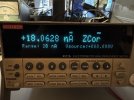
Fluke 5101B calibrator as the current source. Most of the calibration requires DC current however there is one where it needs to see AC current, which this does. The manual calls for a HP 6920B which can apparently supply up to 5 amps. The fluke only goes up to 1.99999 so I'm just using some 26awg wire and looping it through the probe 5 times for the 10A range (they have you do this on other ranges since the 6920B has limited selections - will be easier with the Fluke since I can key in whatever I want)
One of the tests required a very low frequency square wave (5 uHz), but at a higher amplitude than my Siglent SDG1032X or HP 3325B could provide, so the 467A amplifier to the rescue.

This weekend I'm working on calibrating my HP 428B clip on DC milliammeter. It's a really neat tool and as far as I know, HP's last vacuum tube device as it was in the catalog up until around 1986. I bought it last year, and it didn't work - I found a tube had gone to air. I replaced that tube and it now works. However, it reads low on all ranges. The tube I replaced was V8, a 12AU7. I replaced it with a Hewlett Packard labelled GE tube that has perfectly matched triodes for both plate current and transconductance. I actually tried a few others in there and it didn't behave any better, so I don't think that's it.
This is a later production unit, around 1980 which used a PCB. The earlier versions were point to point wired.
The calibration process doesn't seem too bad, but once I really started digging into it, I found that I ended up needing quite a bit of equipment. Luckily I have everything I need to make with happen.
Analog scope for XY mode to perform the final adjustment.
One of the steps calls for an oscilloscope with 10 vertical divisions. They suggest a HP 130C scope in the manual. I remembered the 11403A displays 10 vertical divisions so I pulled that off the shelf for that step. The rest of my scopes have 8 or less. I could have made it work by scaling it down to 5, but this scope needed some runtime anyways.
Fluke 5101B calibrator as the current source. Most of the calibration requires DC current however there is one where it needs to see AC current, which this does. The manual calls for a HP 6920B which can apparently supply up to 5 amps. The fluke only goes up to 1.99999 so I'm just using some 26awg wire and looping it through the probe 5 times for the 10A range (they have you do this on other ranges since the 6920B has limited selections - will be easier with the Fluke since I can key in whatever I want)
One of the tests required a very low frequency square wave (5 uHz), but at a higher amplitude than my Siglent SDG1032X or HP 3325B could provide, so the 467A amplifier to the rescue.
Last edited:


 my secondary workbench is also a home for the DSA602 here... they are heavy metal and they can provide a great job, still fast enough for something.