


Greetings AK,
This is going to be a very long post (scroll down if you just want pictures). I was looking for a project over the summer and decided to restore a Sansui Six. People on AK and elsewhere seemed to agree that the Six is a well-built, warm-sounding receiver, which is exactly what I was looking for -- it's going to be part of a secondary system along with a pair of Paul Carmody S2000s I've yet to build.
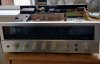
I ended up purchasing a broken unit for about $80 on Ebay; working ones are often listed for $200-$300, and I planned on replacing problem components regardless of initial condition. It came with a number of original parts, including two replacement fuse lamps and some plastic equipment for antenna mounting. It was in quite good condition apart from many decades of dust and a bunch of scratches on the wooden case. All the lamps worked perfectly out of the box, so I suspect it didn't see much use.
The build quality of the Six is quite impressive. I've worked on a few other receivers, including units from well-respected companies such as Marantz, and none of them felt as solid as the Six. The faceplate uses 4 mm thick aluminum, the heatsinks are unnecessarily bulky, and the steel chassis barely flexes even when all other panels and supports are removed. My only gripe: I'm not a fan of the plastic buttons on the front panel.
The Six's internal layout is quite pleasing. Everything is logically placed: amp boards near the back with the output transistor heatsinks, tuner boards up front next to the variable capacitor, power supply board right next to the transformer and 120VAC wiring. Moreover, the amp and EQ boards are socketed, which makes repairs far easier. And the non-socketed boards can be easily accessed for component replacement as well. One other cool thing: the bass and treble controls are stepped attenuators rather than pots and use a bunch of hand-wired discrete resistors. Nowadays you mainly see stepped attenuators in boutique gear, so I was quite surprised by this.
Thus far, I've re-capped the unit (electrolytics only) and gotten the amp section working beautifully -- both DC offset and bias exhibit almost no fluctuation. A word of caution for anyone else recapping: the unit has a few bipolars, some of which are not marked on the PCB. I also replaced the mica and grease output transistor thermal solution with non-conductive pads (apologies to the purists). There were a few miscellaneous issues that had to be addressed, including a broken trace on the power supply board, and I installed a new relay for good measure. Unfortunately, it's not yet fully working; one channel of the preamp section is dead and both channels exhibit an abnormal amount of noise. Bad transistors seem a likely explanation. Luckily, the Six's pre section can be completely bypassed by removing the pre out to main in jumpers, so I've been using it happily as an amp. I'll make another post on sound quality once I've had more time to compare the Six to my other amps.
Pictures:

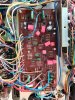
As you can see, I have an affinity for WIMA caps. The stepped attenuator resistors are visible to the left.
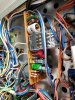
This cap on the protection relay board was bipolar even though the board has a polarity marking. Replaced with a bipolar to be safe. Relay is a new MY-4-02 DC24.
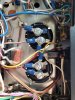
Re-did the filter caps with screw terminals and spades. Ended up replacing a lot of wiring here because the old solid-core wires were brittle.
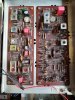

Love the perfectly symmetrical layout of this board.
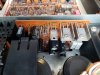
Power supply board looks kind of sad with modern Panasonic caps. It used to be more densely populated.

Filter caps are 4,700uf KEMETs, same value as originals. Probably could have gone for more capacitance.
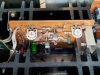
Heatsinks are quite beefy but don't have much surface area. No matter -- they hardly get warm during normal operation.
This is going to be a very long post (scroll down if you just want pictures). I was looking for a project over the summer and decided to restore a Sansui Six. People on AK and elsewhere seemed to agree that the Six is a well-built, warm-sounding receiver, which is exactly what I was looking for -- it's going to be part of a secondary system along with a pair of Paul Carmody S2000s I've yet to build.
I ended up purchasing a broken unit for about $80 on Ebay; working ones are often listed for $200-$300, and I planned on replacing problem components regardless of initial condition. It came with a number of original parts, including two replacement fuse lamps and some plastic equipment for antenna mounting. It was in quite good condition apart from many decades of dust and a bunch of scratches on the wooden case. All the lamps worked perfectly out of the box, so I suspect it didn't see much use.
The build quality of the Six is quite impressive. I've worked on a few other receivers, including units from well-respected companies such as Marantz, and none of them felt as solid as the Six. The faceplate uses 4 mm thick aluminum, the heatsinks are unnecessarily bulky, and the steel chassis barely flexes even when all other panels and supports are removed. My only gripe: I'm not a fan of the plastic buttons on the front panel.
The Six's internal layout is quite pleasing. Everything is logically placed: amp boards near the back with the output transistor heatsinks, tuner boards up front next to the variable capacitor, power supply board right next to the transformer and 120VAC wiring. Moreover, the amp and EQ boards are socketed, which makes repairs far easier. And the non-socketed boards can be easily accessed for component replacement as well. One other cool thing: the bass and treble controls are stepped attenuators rather than pots and use a bunch of hand-wired discrete resistors. Nowadays you mainly see stepped attenuators in boutique gear, so I was quite surprised by this.
Thus far, I've re-capped the unit (electrolytics only) and gotten the amp section working beautifully -- both DC offset and bias exhibit almost no fluctuation. A word of caution for anyone else recapping: the unit has a few bipolars, some of which are not marked on the PCB. I also replaced the mica and grease output transistor thermal solution with non-conductive pads (apologies to the purists). There were a few miscellaneous issues that had to be addressed, including a broken trace on the power supply board, and I installed a new relay for good measure. Unfortunately, it's not yet fully working; one channel of the preamp section is dead and both channels exhibit an abnormal amount of noise. Bad transistors seem a likely explanation. Luckily, the Six's pre section can be completely bypassed by removing the pre out to main in jumpers, so I've been using it happily as an amp. I'll make another post on sound quality once I've had more time to compare the Six to my other amps.
Pictures:
As you can see, I have an affinity for WIMA caps. The stepped attenuator resistors are visible to the left.
This cap on the protection relay board was bipolar even though the board has a polarity marking. Replaced with a bipolar to be safe. Relay is a new MY-4-02 DC24.
Re-did the filter caps with screw terminals and spades. Ended up replacing a lot of wiring here because the old solid-core wires were brittle.
Love the perfectly symmetrical layout of this board.
Power supply board looks kind of sad with modern Panasonic caps. It used to be more densely populated.
Filter caps are 4,700uf KEMETs, same value as originals. Probably could have gone for more capacitance.
Heatsinks are quite beefy but don't have much surface area. No matter -- they hardly get warm during normal operation.


