• The move to the new server is done. There are some software and database maintenance updates in process. This has us passing the hat around to help out. We appreciate any donations. Seriously, even a dollar helps. The payment page may be found here - https://www.audiokarma.org/support.html

Partially complete Sansui Six repair and restoration (with pictures!)

So I've been using the Six to drive my Stax headphones with a transformer box and it sounds absolutely phenomenal. I have state-of-the-art modern amps which play cleaner and tighter, but the Six has a great tone that helps mitigate some of the Stax's shortcomings (namely brittle, irritating treble). Since I use digital volume control and EQ on my computer, I've had no real need to fix the pre section of the Six. But today I put in a parts order for my cursed Pioneer M-22 and finally got around to buying replacements for the Six's noisy low-power transistors. Not planning on doing the PSU replacements at the moment because the voltages are spot on as is. Will update once I'm done with the work -- hopefully I'll have a working pre section!
 
So I've been using the Six to drive my Stax headphones with a transformer box and it sounds absolutely phenomenal. I have state-of-the-art modern amps which play cleaner and tighter, but the Six has a great tone that helps mitigate some of the Stax's shortcomings (namely brittle, irritating treble). Since I use digital volume control and EQ on my computer, I've had no real need to fix the pre section of the Six. But today I put in a parts order for my cursed Pioneer M-22 and finally got around to buying replacements for the Six's noisy low-power transistors. Not planning on doing the PSU replacements at the moment because the voltages are spot on as is. Will update once I'm done with the work -- hopefully I'll have a working pre section!
Having steady voltage is only one aspect of the power supply. But I would not hesitate to replace the two 2SD330 transistors with more beefy MJE15032. And diodes can become noisy too creating hash noise. But my SIX does have the original rectifier diodes and seem very quiet. I would also be replacing all of the electrolytics without hesitation. Take note of the height though, it's a bit cramped, especially at the antenna mount when fully retracted.
 
Recap is already done (and relay replacement etc.) but I'll try and grab MJE15032s with my next order. I also have replacement trimmers sitting around but honestly the original ones are working perfectly fine so I'll probably just keep those as spares.
 
Recap is already done (and relay replacement etc.) but I'll try and grab MJE15032s with my next order. I also have replacement trimmers sitting around but honestly the original ones are working perfectly fine so I'll probably just keep those as spares.
Yeah the trimmers in these are very robust. I left mine in as well.
 
My unit ended up having a flaky transistor. I can't recall offhand which exact one, but it's replacement was ksa1845 and works wonderfully now!
 
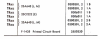
Hey, my transistors got here and I'm wondering if anyone can help me read this service manual. I'm trying to find out if any of these pairs need to be matched. Some of the transistors in the parts list have the letters L, M, and E next to them. Does this mean anything? Here's a picture -- it's from the HFE manual.

SansuiTransistorList.png
 
Hey, my transistors got here and I'm wondering if anyone can help me read this service manual. I'm trying to find out if any of these pairs need to be matched. Some of the transistors in the parts list have the letters L, M, and E next to them. Does this mean anything? Here's a picture -- it's from the HFE manual.

View attachment 1781998
ALL of the 2SA640 get replaced, they go noisy no matter where they are, or which boards they're on. Replace them with KSA992FTA. The 2SC1222 gets replaced with KSC1845FTA. The "TA" means they come on tape and are very close to each other in gain (hFE) so no "matching" is needed. However is very convenient when matching really close since you can write on the tape what they measure without touching the transistor. If you buy them in bulk (KSA992FBU/KSC1845FBU) (the "BU" means bulk) and will be more random and less likely to be closer matched. The "F" is the hFE ranking. Sadly, it's the highest available any more but they work just dandy. It's what I put in my own SIX.
 
Hey, my transistors got here and I'm wondering if anyone can help me read this service manual. I'm trying to find out if any of these pairs need to be matched. Some of the transistors in the parts list have the letters L, M, and E next to them. Does this mean anything? Here's a picture -- it's from the HFE manual.

View attachment 1781998
The (L,M) and (E) are the gain group. But with the modern replacements available the original rankings mean nothing, just use the ones I mentioned. If you are curious, look up the datasheets for those transistors to find what the rankings are for each letter. Always try to get replacements as close as possible to the original specs *when possible*. Otherwise, you just have to use what is available and enjoy the music. :music:
 
Back to working on this thing; started developing a nasty hiss and and DC offset on the left channel. Seems the A706 is dabbling in NPN, unfortunately I don't think I have a sub on hand. I'm thinking KSA1381 and replace the complement with KSC3503. The range of hfe for the KSA1381 is not great, but I think if I order a few of them I can find one with enough gain. I have a good curve tracer that can replicate the in-circuit conditions so I'll just compare the A706 from the good channel to the KSA1381 to make sure everything looks good. Also gonna do the power supply pass element transistors while I'm at it. I do have subs for those.
 
Back
Top Bottom