How Does It Sound? Part 2
I'm hardly the Stereophile dictionary of audio terms type when it comes to describing sound, as along with being so subjective in nature, the terms are also so intricately detailed that I get lost in their translation. This is no criticism of those who use such terms to define a sound to themselves for reference purposes. But it is to say that used as a language of communication to/with others, it leaves open a wide path of endless interpretations. Therefore, I chose to list the musical pieces I use for evaluation, with more general comments as to what I hear and listen for, for context.
The associated equipment used includes a basically stock Fisher 400CX-2 preamp (tweaked only to ensure proper channel balance and intended response characteristics are achieved), stock Denon DCD-1520 CD player, and stock Klipsch Cornwalls speakers (3ed version -- 101 db sensitivity), in a quiet, acousticly flat (not alive, not dead) 15X20 foot listening room with 10 foot ceiling. No power conditioners were used, and cabling was all capable, quality pieces, but not of any unique pedigree. The Cornwalls were connected to the 8Ω output taps, and the input attenuators I developed for the D115 were used and certainly needed: Without them, quiescent low level noise was unacceptable, and the volume control was below weed level. With the attenuators, the noise floor was very acceptable, as was volume control action.
The listening material used included:
1. The Rippingtons -- Various CDs:
A. Wild Card -- "Gypsey Eyes": A bass heavy track that does not have the usual detailed high frequency content that Rippington recordings typically contain. With the heavy bass content, it can easily overwhelm even power capable amplifiers whose IM distortion or overload characteristics are less than admirable. The D115 was unflappable with this recording, giving no notice to its presence in the amplification chain at all.
B. Wild Card -- "Till You Come Back to Me": Chante Moore's voice is lush, detailed, and smooth. Very listenable and completely natural sounding -- although still has a "recorded" characteristic through no fault of the D115. Still, and excellent recording for use in evaluating reproduction of the female voice.
C. Welcome To The St. James Club -- "Welcome to Th St. James Club": Typical Rippingtons recording, with a good blend of electronic and acoustic (Sax) instruments. Plenty of high frequency information and detail, but well balanced across the audio spectrum. The high frequency information is very accurately presented: very present but not shrill or glaring. A dynamically well balanced recording.
D. Curves Ahead -- "Aspen": Smooth jazz. There is plenty of space between the various instruments to enjoy each one for its own qualities.
2. Benny Andersson -- "Piano" Any piece on the CD. Andersson is the genius writer/performing part of the 70's megagroup ABBA, and every bit a concert pianist in his own right. I particularly enjoy the track "You and I" from the musical "Chess" which he wrote the score for. Without a doubt, this is the best close-mic recordings of a piano I've ever heard, capturing all the transients of the hammer strikes, resonances of the sounding board, and harmonies of the various notes. Andersson makes full use of the instrument throughout the various recordings. A recording you can truly close your eyes and hear the piano in front of you.
3. Sinatra Reprise (The Very Good Years) -- "That's Life": One of the better 60's recordings with early stereo separation techniques. It captures all the nuances of Sinatra's voice as it is pushed through out the song. Good detail to reveal range of his vocal capability.
4. Pops In Love -- "Canon" -- Superb strings recording where they all stay separated and the details of each instrument can be distinctly heard. Dynamically huge for strings.
5. Telarc Sampler 4 -- "Fanfare" -- Extraordinary recording of Brass instruments. Never harsh or shrill as brass can sometimes be. Huge dynamics with the Timpani drums. Superb recording in the tradition of virtually all Telarc offerings.
6. Michael Murray Encores -- "Toccata, Symphony V" -- Classic pipe organ piece well recorded, and played in the typical grand Murray style. Good separation of pipes, wide dynamics, wonder ambience due to the setting. The recording captures all of it.
7. Rachmaninoff Piano Concerto No. 2 -- Cecile Licad CSO -- For piano and orchastra together, you would be hard pressed to find a more realistic recording. Close your eyes and you're there.
8. Saint Saens Symphony No. 3 "Organ" Eugene Oermandy, Philadelphia Orchestra, Murray Organist -- The whole second movement. For an organ in an orchestral setting, this is the ultimate high. Huge dynamics, huge detail, Grand Canyon space. Wonderful separation of the various instruments. Unmatched Timpani ending.
9. Come On Come On -- Mary-Chapin Carpenter -- "I Am a Town" -- Mary's voice is startlingly real on this recording, making you immediately take notice of it. A real showcase for the female voice.
10. Of course if you just want to show off, there's always the cannon shots and bells of Telarc's recording of the 1812 Overature. Always difficult for any system to do true justice to, as
some element if not most of the system will be challenged. The D115 as would be expected rose to the challenge as if it were no big deal for it (and it wasn't).
There are of course many more, but these are some of my favorites for critical listening to any piece of audio equipment. On my systems, for the comments given for each recording, they all present with a clarity, detail, balance, authority, and effortlessness that make long listening sessions so enjoyable. They are all simply a joy to listen to.
So what then does the D115/V70 bring to this party? Authority, and
tons of it. Under quiescent and normal listening conditions, it is as docile as your favorite EL84 amplifier with virtually no intrusion into the listening area, except for it's massive size. It is completely humless on my Cornwalls, and remarkably quiet mechanically given its massive power transformer. It's noise floor is very acceptable, and as good as it can get for dual 100 watt amplifiers with an input sensitivity of just 0.6 vac. The input attenuators make the full sensitivity of the amplifier very usable with typical preamp offerings. But that authority! Emotionally, it leaves you with a feeling of unending amounts of reserve power available (because there is!). But having that feeling from an amplifier of this power level that does everything so right is special. There are surely other vacuum tube amplifiers of this power level. But usually as available power increases, detail and finesse tend to decline. Not so with this amplifier. Which brings me to a final point: With amplifiers that in a blind fold setting and normal listening conditions sound so similar -- then what is it that makes us prefer one amplifier over another? Besides the emotional feelings that music can evoke, I believe the answer to that lies in many other emotional aspects of our equipment, which include (in no particular order):
1. Use of a favorite tube. It doesn't matter why, it's just your favorite.
2. A physical look -- some pieces are timeless in appearance, some age gracefully, some look old, worn, and hopelessly outdated.
3. A favorite manufacturer -- or one you rotate to frequently.
4. A favorite or unique type of design.
5. A level of build quality.
6. Weird stuff (said affectionately) that's off the beaten high fidelity path.
7. A favorite pioneer in the industry.
I know I'm guilty of attaching myself to virtually all of these things, and I know many others are too. Want proof? Look how many AKers talk about equipment in their "rotation". Granted, in stock form and due to design goal differences and component tolerances, different amplifiers can surely sound different -- even within the same brand and model. But once a more uniform high quality level of sound has been achieved, then why all the multiple pieces of gear? I maintain that it's because once the emotional element of the music is satisfied, we're so involved with our equipment, that we seek to satisfy the emotional element of it as well. Which amplifier is better? It depends on the day, the mood you're in, and the context of the question.
The D115 surely sits at the top of its class --
along with the other amplifiers that belong there as well. Meaning it's not necessarily better at anything than its equivalent peers (except for how any of the 7 emotional qualities make it so) -- it's just different. But also a truly wonderful amplifier. About the only negative online comments I could find regarding it are that it was a little thin in the LF department. The
only thing I can offer regarding that comment is the rather low input impedance of the D115 as designed: 65KΩ calculated and measured (although specified at 75KΩ) which will be challenging to any vintage preamp to drive, which will result in a reduced LF response. However, the attenuators I devised for the D115 raise the input impedance that the preamp sees to 225KΩ, which any quality vintage preamp can easily drive with a flat response over the full audio spectrum. I would ultimately offer then that other than for the low input impedance that must be appropriately accounted for when choosing a preamp to mate with this amplifier, there is absolutely no shortage of LF punch, power, drive, whatever, in the D115 at all: Bring on the cannon shots!
Finally, I have zero experience with vintage Marantz equipment. I know it is fine equipment. One AKer suggested its designer was ahead of his time in terms of addressing the transient side of an amplifier's performance. Considering the type of tubes used in the input/driver stage, that may well be true. But others of that day were credibly addressing it as well -- Hafler for one, and McIntosh for another. Within the highest tier (virtually cost no object) of vintage audio equipment however, it was Mac and Marantz who owned the market -- but of those two, Mac was the innovator with the historically significant Unity Coupled Output Stage design, that propels them even to this day. When they originally stopped producing vacuum tube equipment, ARC picked up the cost no object mantel, which then invites the inevitable comparison between the two brands.
From a sonic standpoint, once again, don't bet the farm, as my MC240 and the D115/V70 sound virtually identical on my speakers at normal listening levels -- and they should as after all, my Mac easily meets the 7 criteria for a practical ultimate vacuum tube amplifier listed earlier -- just as the D115/V70 does as well. My Mac doesn't have as much power (virtually producing half that of the D115), but at the power levels these amplifiers produce, versus the needs of the speakers and listening environment, that's basically a moot point. So looking at the other 7 emotional areas, Nos. 2, 3, 4, 5, and 7 certainly come into play with my Mac equipment -- reinforced by the annals of time, and now -- in significant part due to this project -- Nos. 2, 4, 5, and 7 come into play with ARC, with time likely adding more to that as well. However.........
This is all based on my D115/V70 as
now modified -- meaning, with the dependability measures now installed. But if you include the historically documented dependability issues with this period of ARC amplifiers, then it changes the game completely. Viewed from the angle of dependability and the rate at which they chewed up output tubes, and with all else being equal, then vintage McIntosh equipment wins hands down: You bought it, finally expend the tubes over (usually) a couple of decades, changed them out, and then kept on truckin'. As well, there were no adjustments to make when the tubes were changed out, either -- and they just continued to meet their performance specifications. ARC certainly has the history of quality sound that Mac has, but at least in the 80s, couldn't come close to the dependability record that Mac established and maintained for (at least) the preceding 20 years with its vacuum tube equipment. And for such a uniquely different approach to generating quality sound that is certainly on par with Mac equipment, that's sad because operating correctly, it's darn good stuff. There was a member over on the Mac Forum who was involved with the Mac Clinics back in the day (apparently) of the D115's production, and posted that when ARC power amplifiers of that period were brought to the clinics, they had a history of not meeting their published specifications. Based on my knowledge gained through this project then, it doesn't surprise me. For my particular ARC D115/V70 however, I believe the modifications I made to it have completely resolved the dependability issues noted, so that it will continue to perform and meet its specifications without issue for many years to come.
To that point, because of the performance capability and (now) dependability I believe this D115/V70 represents, I went ahead and sought out a companion ARC preamp to go with it. Since I like to have the ability to alter the response of the amplifier as needed (tone controls), I've got to go all the way back to the ARC SP-3-A1 to get that feature, and have now received it. While I'm still learning about and getting used to it, mine is an original SP-3, that was apparently updated by ARC to the SP-3-A1 design about 20 years ago. By all accounts, it is in perfect working order, with pristine appearance, and sounds wonderful.
Other than that, I have gone ahead and added a switched AC power receptacle on top, and in the front left corner of the V70 chassis -- this to power the dual quiet muffin fans I anticipate mounting on the back side of the tube cage, so there won't be an additional power cord hanging off the back of the cage, and the amplifier can remain self contained (power wise) when the cage is installed:
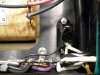
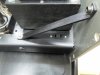
The plug is inconspicuous enough that even with the cage removed, the plug hardly stands out as an aftermarket modification -- and -- I believe the fans just arrived! Now, to figure out how to cut two 3" holes in the cage to accommodate the fans.
And with that, it completes the long and winding saga of my Parts and Pieces ARC Mystery, coming to a conclusion and outcome I never could -- nor would have predicted when it started. But what a learning tool it has been for me! Thank-you to those who have followed along! One final pic of the project is presented to close it all out.
Dave




 )
)



 ,
,  ,
,