

You are using an out of date browser. It may not display this or other websites correctly.
You should upgrade or use an alternative browser.
You should upgrade or use an alternative browser.
Passive Radiators
- Thread starter Theophilus Punoval
- Start date


guiller
Toscaninichus Australis
This question has probably been asked and answered before, but here goes anyway: What are the advantages/disadvantages of passive radiators?
There is a nice related thread here: http://www.audiokarma.org/forums/index.php?threads/thoughts-on-passive-bass-radiators.258080/

Watching the video above, made me remember one the memorable enclosures I built, years ago.
It's actually somewhat amazing. to see a well-built, well-tuned passive radiator system in action. I once built a very large sub for a client- a JBL 2245h 18", with an 18" passive radiator, in a 26" cube (about 8.5 cubic feet). The enclosure was tuned to about 23 Hz, with a built-in 500 watt bass amp, with a parametric EQ (which was tuned for about 7dB of boost at 24 Hz).
The amazing thing, was when you reached enclosure resonance (23 Hz), you could see the woofer ALMOST COMPLETELY NOT VISIBLY MOVING- but the passive radiator would be moving like CRAZY. I mean, the woofer might be moving 1/4" in-and-out- but the passive radiator would be moving OVER AN INCH in and out, at the same time (BTW, the plate glass windows in the room were ALSO moving significantly at that time, I might add!).
When the enclosure is the right size, built tightly and well-sealed, and tuned properly with a PR, it just is a remarkable thing to see and hear...
Regards,
Gordon.

I think you meant 50 hz and below.They tend to be tighter than ports and not quite as a Sealed enclosure but dont suffer from the loss as a sealed.. Now Throw a curve into the mi as Vandersteen uses a Active passive coupled driver ! Its not a sub that is powered but rather a ACTIVE PASSIVE design..It only plays 500hz and lower but is usless without the 8 inch running in phase with it.. I know I tried when replacing them .. When together its amazingly deep and tight bass... Not sure how but it gives damn good bass

DEFTECHY
Well-Known Member
Klipsch also uses passive radiators in some of their current and older models, like quartet, forte, chorus2 and many of the 90's era KG series. Passives always have excellent bass with no port noise/chuffing that ported speakers can have but they are more sensitive to placement if the passive is in the rear like many are vs a front ported or sealed speaker.
I am thinking of replacing the single 6th order vented bandpass box in my Nissan truck, with a pair of slightly smaller bandpass boxes (for stereo bass).
The only issue, is that the ports required to do that, would be prohibitively big, and take up WAY to much box volume. In fact, the current box was about as small as could be done, and still have reasonably low vent velocity. Using slot or pipe vents in an even smaller enclosure- well, that just ain't gonna cut it...
So- I am planning to do a pair of passive-radiator 6th order bandpass:

Each box will have an internally mounted 7" woofer (probably a Dayton Audio), and a 7" passive radiator tuning the front chamber, and a second 7" passive radiator tuning the rear chamber. Should be able to get down to 22 Hz f3 (!) before cabin gain is considered- and even lower, in vehicle. With two of these, it should be PLENTY of output (should be about the same as a pair of 10" in sealed boxes, only with more low end extension). And the boxes will only be about 7.5" tall... leaving plenty of space behind the front seat in the truck, for tools, luggage or other stuff...
Regards,
Gordon.
The only issue, is that the ports required to do that, would be prohibitively big, and take up WAY to much box volume. In fact, the current box was about as small as could be done, and still have reasonably low vent velocity. Using slot or pipe vents in an even smaller enclosure- well, that just ain't gonna cut it...
So- I am planning to do a pair of passive-radiator 6th order bandpass:
Each box will have an internally mounted 7" woofer (probably a Dayton Audio), and a 7" passive radiator tuning the front chamber, and a second 7" passive radiator tuning the rear chamber. Should be able to get down to 22 Hz f3 (!) before cabin gain is considered- and even lower, in vehicle. With two of these, it should be PLENTY of output (should be about the same as a pair of 10" in sealed boxes, only with more low end extension). And the boxes will only be about 7.5" tall... leaving plenty of space behind the front seat in the truck, for tools, luggage or other stuff...
Regards,
Gordon.

Lavane
Lunatic Member
Very cool idea Gordon. Will you use those adjustable passive radiators PE sells?I am thinking of replacing the single 6th order vented bandpass box in my Nissan truck, with a pair of slightly smaller bandpass boxes (for stereo bass).
The only issue, is that the ports required to do that, would be prohibitively big, and take up WAY to much box volume. In fact, the current box was about as small as could be done, and still have reasonably low vent velocity. Using slot or pipe vents in an even smaller enclosure- well, that just ain't gonna cut it...
So- I am planning to do a pair of passive-radiator 6th order bandpass:
View attachment 2870135
Each box will have an internally mounted 7" woofer (probably a Dayton Audio), and a 7" passive radiator tuning the front chamber, and a second 7" passive radiator tuning the rear chamber. Should be able to get down to 22 Hz f3 (!) before cabin gain is considered- and even lower, in vehicle. With two of these, it should be PLENTY of output (should be about the same as a pair of 10" in sealed boxes, only with more low end extension). And the boxes will only be about 7.5" tall... leaving plenty of space behind the front seat in the truck, for tools, luggage or other stuff...
Regards,
Gordon.
I like the idea. My 2002 Jeep Wrangler has a small area behind the back seat.
I've tried several ported subs and just don't like how they sound. I have to use smaller boxes to fit the area and I get port cuffing. I didn't even think about using passive radiators.

kevintomb
Well-Known Member
I'm not sure that a port is actually a substitute for a PR.
I was under the understanding that a port is used to tune the resonant frequency of the enclosure and that tuning would allow for additional output down to the tuning frequency. Once the signal is below the tuned frequency the driver can become "unloaded" and the port becomes a liability. Ported enclosures do not afford the same control of the woofer that a sealed enclosure does, sometimes being described as sounding "slow" or lacking impact.
I believe the PR offers many of the benefits of a ported enclosure without some of its limitations. The PR allows for increased low frequency output due to the increased surface area exciting the air, without the potential of becoming unloaded and loosing control of the driver and since the enclosure remains sealed there is no real sacrifice of "impact" or speed.
I am not an engineer and could be completely off base here and welcome any information that might enlighten me to the errors of my misconceptions.
Port and Passive radiator are almost exactly the same.
Passive has ALL the advantage and disadvantages, it is NOT sealed at all. The movement of the cone makes it not sealed, same as port.
A port has "Slightly" better low end than a passive of equal box size....SLIGHTLY.......Otherwise mostly identical. No port noise, but they can hit excursion limits with a passive.
I've heard acoustic suspension speakers bottom the VCs when driven hard.
I restored a pair of Ohm Acoustics H speakers with an 8" mid-woofer and 12" passive.
They are ruler flat down to 32hz, then roll off at 24 db per octave. (per design)
A port would have had to been 32' long to get the same response, per vintage Ohm literature.
They are much better sounding than my old KLH 6 and 23 speakers. Sold those off...
And yes, the 6s and 23s were redoped and capped, before anyone asks!
Pics below show before and after resto. Notice the PR has a reverse roll suspension, as original.

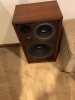
I restored a pair of Ohm Acoustics H speakers with an 8" mid-woofer and 12" passive.
They are ruler flat down to 32hz, then roll off at 24 db per octave. (per design)
A port would have had to been 32' long to get the same response, per vintage Ohm literature.
They are much better sounding than my old KLH 6 and 23 speakers. Sold those off...
And yes, the 6s and 23s were redoped and capped, before anyone asks!
Pics below show before and after resto. Notice the PR has a reverse roll suspension, as original.

Lavane
Lunatic Member
All the speakers I've heard so far with passive radiators tend to have tighter bass with more impact. Some like the tighter bass, some don't. I have speakers with both passives and ports. I do tend to like passive radiators a bit more than ports personally. I love the impact you get with things like the kick drum. Yes, there are a few pros and cons for both designs though.

Chris Brown
Super Member
Passive has ALL the advantage and disadvantages
There is significant overlap, but there are still differences.
A passive radiator will never have "port chuffing" or other sound resulting from air turbulence through the port.
A passive radiator can add a certain "texture" to the bass that is different than a port. This is subjective and you may or may not prefer this.
With a passive radiator, you can adjust the tuning via changing the mass of the passive radiator. This is similar to changing the size of the port tube. Many passive radiators have "mass rings" or other weights on them that can be added or removed in a non-permanent way, which makes it more practical to make adjustments to suit your taste.
Although a passive radiator serves the same function as a port tube, it can allow for configurations that would not be practical with a port tube. For example, a certain configuration might require a 10 foot long port tube, which would not be practical in most cases, but you could replicate that with a passive radiator.
A passive radiator can allow for configurations that essentially bridge the gap between ported and sealed, such as the above example that would require a port tube of impractical length. The increased resistance to airflow through the equivalent of the very long port tube (adding a lot of mass to the passive radiator) brings performance closer to what you would expect from a sealed design.
Using a passive radiator in a "standard" (non-bandpass) bass reflex enclosure, can allow tuning for better transient response, than a standard vented enclosure. Dan Wiggins of Adire Audio did quite a bit of experimentation, and published quite a bit on tunings involving a slightly smaller-than-normal enclosure size (smaller than a standard B4 or QB3 vented alignment), using lower frequency tuning than normal. This does sacrifice a bit of bass extension compared to a B4 alignment- but the group delay is quite a bit better.
By allowing lower-than-normal tuning in a smaller-than-normal box size- which would normally require extremely long ports, to get enough port area- a passive radiator can result in very good response, in compact enclosures. I've built a few in tuning alignments similar to what Dan did (in fact, the subs in my den, using EPI 8" woofers behind my couch, use passive radiators in such an alignment), and they sounded quite good...
The above plan I posted, will be the first time I've tried doing a 6th order bandpass with passive radiators. But, the math is there- so I have great expectations for it. Now, to just get enough time where I'm actually at home for a reasonable, continuous period, to be able to build them...
Regards,
Gordon.
Really not much to a PR, anyone here ever "roll their own". ?
take an old 10-18" driver with blown VC, pop of the magnet add a little weight.whala, PR.
The subs behind my couch, have passive radiators made from some junk 15" woofers. I just drilled out the rivets and removed the entire magnet structure, then "reconed" the basket with a heavy cone, soft spider, foam surround, and a bolt-and-nut mounted into the center of the cone, so I could mass-tune the PR for the correct resonance in the enclosure.
The woofer frames were free (dead Behringer PA woofers that had shifted or broken magnets, so they couldn't be reconed as woofers, IIRC)- the only real cost was the woofer cone, surround, spider, dust cap and gasket- which are usually the cheaper parts of a recone kit (the voice coil- which is not needed here, obviously- is usually the most expensive part). Plus a few bucks for some bolts, nuts and washers for weight- voila, tunable passive radiator...
Regards,
Gordon.
Lavane
Lunatic Member
PE sells some that are tunable but tightening ir lossening a nut on the back.Really not much to a PR, anyone here ever "roll their own". ?
take an old 10-18" driver with blown VC, pop of the magnet add a little weight.whala, PR.

Ron Brown
Cultosaurus Erectus
Ignorance is bliss...YES, I put a bid on a pair of Kef Calinda once, and the guy on the phone became angry when I suggested the bigger driver on the bottom is a passive one and not a woofer.
I should not have told him, because his price was okay but he told me even if I would pay asking price he did not want to sell it to me anymore, he was so much pissed off....
Ron Brown
Cultosaurus Erectus
My ESS amt 1aM speakers have 12" drivers and 12" passive radiators. They produce profound bass that is clean and pleasing at all the volumes I've tried. I've probably sterilized most of the neighborhood cats at this point...They tend to be tighter than ports and not quite as a Sealed enclosure but dont suffer from the loss as a sealed.. Now Throw a curve into the mi as Vandersteen uses a Active passive coupled driver ! Its not a sub that is powered but rather a ACTIVE PASSIVE design..It only plays 500hz and lower but is usless without the 8 inch running in phase with it.. I know I tried when replacing them .. When together its amazingly deep and tight bass... Not sure how but it gives damn good bass

NH-MAN
Addicted Member
A brother from another mother to the Ohm H above the Optimus 10 was well done and I feel from experience by far the best sounding speaker from RS.
For someone wanting to try a speaker with a passive for little money the Polk S6 is great small speaker with big sound excellent imaging and can tolerate a surprising amount of abuse. Do not let the cheap looks fool you.


For someone wanting to try a speaker with a passive for little money the Polk S6 is great small speaker with big sound excellent imaging and can tolerate a surprising amount of abuse. Do not let the cheap looks fool you.
Similar threads

- Replies
- 7
- Views
- 9K

- Replies
- 0
- Views
- 266


- Replies
- 2
- Views
- 1K