• The move to the new server is done. There are some software and database maintenance updates in process. This has us passing the hat around to help out. We appreciate any donations. Seriously, even a dollar helps. The payment page may be found here - https://www.audiokarma.org/support.html

Phono "motorboating" solved(?)

I have had recurrent problems with low frequency "motorboating" on several 2230/2245/2270's after updating the phono boards. There has been a lot of discussion about it here, with no definite fix determined that I could find. The closest I have come was thinking that the KSC1845's often used to replace 2SC458's were not as good of a match as KSC1815. In most of my cases, when I had the problem, I had replaced the 2SC458's and the four 2SC1000's with KSC1845's. That muddied the water a little bit as to the source of the problem. Well, today I had a 2245 that I did a complete recap/restore on about two years ago and has been sitting on a shelf since then. I wanted to check it out from top to bottom. Everything was wonderful until I got to the phono. In my case, what usually happens is that everything sounds good when I put it in Phono mode. Then I hit the start switch on my Dual 1229 turntable. During automatic translation of the tonearm, the turntable shorts the leads from the cartridge to block out the noise caused by arm movement. As soon as those contacts short, loud, low frequency motorboating starts. It continues until the tonearm sits down, the shorting contacts open, and then the music sounds perfect. I found the turntable didn't matter as long as it was automatic and shorted the cartridge during tonearm movement. I tried my Marantz tt530 linear tracker and got the same noise while the arm was moving. If you removed the turntable, and just short the RCA cable, you get the same result. Well, this time, there was a difference. The right channel did not motorboat, and the left channel reliably made the sound. Also, it turned out I had only replaced the 2SC458's. The 2SC1000's were still in place, so it removed them as a variable. I loosened the board from the chassis, and as long as it was 1/4" away from the standoffs, the motorboating went away. But if I pushed it toward the standoffs, just before it touched, the left channel would start doing it. It was completely repeatable. I looked for wiring problems to no avail. If that board was near the standoffs, it was going to motorboat on the left side. So.....I removed the KSC1845 on the left channel and replaced it with a KSC1815 with little confidence that would solve the problem. But I fired it up, shorted the inputs and zero motorboating. I could move the board away from the chassis or push it against the standoffs, and silence. So, I screwed the board to the chassis, plugged the turntable back in, hit the start button, and the tonearm moved and set down with zero noise. I did it several times and it never motorboated again. Why did it do it just on the left side? I don't know. But I'm 99% sure that KSC1845 is the problem. I guess before I close it up, I'll change out the other 1845, even though it doesn't make the noise at this point. Hopefully, it won't screw something up to do it, but I figure both sides ought to have the same transistor. I know in the future, I will be using KSC1815 to replace 2SC458 in these phono boards.

I've been harping on this for a while... Iirc the gain shouldn't be super important here as it's limited by feedback, but it seems that something about the 1845 causes oscillations... I have also been able to solve it by leaving the 1845s in as the first Transistor, having an 1815 as the middle and then the 1845 as the third, as the manual does call for a lower gain Transistor in that 2nd position.
 
I've been harping on this for a while... Iirc the gain shouldn't be super important here as it's limited by feedback, but it seems that something about the 1845 causes oscillations... I have also been able to solve it by leaving the 1845s in as the first Transistor, having an 1815 as the middle and then the 1845 as the third, as the manual does call for a lower gain Transistor in that 2nd position.
The interesting thing is that on these two units I just worked on, I left the first four originals, and just changed the 2SC458’s to KSC1845 on one of them. On the other, I replaced all six with KSC1845. Both motor boated when the input was shorted. And in both cases, replacing the ones in the 458 slots immediately fixed the problem. I still have the 2230 on the bench with 1845’s at the first four positions. It would be interesting to see what happens if I swap those middle 1845’s with the 1815’s at the 458 positions.
 
You'll lift a pad! Our version of "You'll shoot your eye out kid!"
R4f79345056c4cc2bc91345b2a0e59b15
 
Boy, I just bought an older turntable I was gonna clean up and get back to groves. I have yet to touch a phono amp board and thought it would be pretty straight forward operation.

Well this opens another can of worms. I think I will put off "motorboating" and save it for a summer activity.
 
Boy, I just bought an older turntable I was gonna clean up and get back to groves. I have yet to touch a phono amp board and thought it would be pretty straight forward operation.

Well this opens another can of worms. I think I will put off "motorboating" and save it for a summer activity.
I do t think you have anything to worry about as long as you replace the 2SC458’s with KSC1815 instead of KSC1845.
 
Just checked. The 1845 is listed for the 1328. For my phono amp I just might stick with the 1815.
The first 4 Transistors in these boards are usually 2SC1345/2SC1000 and I think maybe 1328s. Last two afaik are always 458s unless previously changed.
 
The first 4 Transistors in these boards are usually 2SC1345/2SC1000 and I think maybe 1328s. Last two afaik are always 458s unless previously changed.
Yep. I don’t see any need to replace those first four transistors unless testing shows them to be bad. I just replace the 458’s because of their reputation.
 
Yep. I don’t see any need to replace those first four transistors unless testing shows them to be bad. I just replace the 458’s because of their reputation.

I always replace the 2SC1344/45s, they seem to go noisy too, not as often but they've bit me in the rear at least once.
 
Well, another data point on this motorboating thing. I have a 2270 that I rebuilt a couple of years ago, and have been using it for playing music from my phone in my workshop. Today, I decided to check the phono to see if it made the horrible sound. Sure enough, it did, but at a lower frequency than usual -- maybe 2-3 beats per second. I knew I had rebuilt the phono board, but had no idea what I had used. Opened it up and found that I had used KSC1815's at the 2SC458 spots. Hmmm. Was my theory wrong that 1815's were the answer to the problem? Checked the other four transistors to see what I had put in the 2SC1000 slots. They were KSC1845's. I removed the 1845's and replaced them with KSC1815YTA, and the motorboating was gone! The 1815's are a better match for the 1000's specwise anyway. I just have no doubt that KSC1815YTA is the better sub for both the 2SC1000 and the 2SC458 transistors on these early 22xx receivers.
 
Ya, that's enough data points for me.
There are a couple of units that I'll go back and swap those out. It's a easy swap.
Thanks so much for all your work on this.
 
The reason I had so many units to work on in such a short period of time is that I had completely restored 6 or 8 units a couple of years ago that sounded great, but ended up with this problem. The units kind of got put on a shelf for a time when I could research the problem and experiment. That time finally came, and I just went through them one by one. Every time, the 1815's solved the problem. The good thing is that in those two years on the shelf, these receivers have at least doubled in value. I need more problems like that. :D
 
One more data point: Marantz 2285 with a dead left channel on the bench, H401-H404 transistors are 2SC1344, and H405/H406 are 2SC1775. Replaced the 2SC1344s with KSC1845s and the 2SC1775s with 2SC1815s. Left channel function restored, but oscillation observed in both channels; tell-tale rapid fluctuation of DC voltage at H405/H406 collector. Replacement of KSC1845 transistors at H403/H404 with KSC1815 resolved the oscillation. Interestingly, 10pF miller capacitors were added to H401/H402 at the factory (this suggests that Marantz was aware of the potential for oscillation with 2SC1000 transistor substitutions).

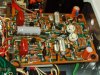
Phono stage original.jpg
P400 restored.jpg
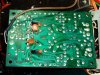
P400 solder side.jpg
 
One more data point for motorboating. I recapped the P700 board in my 2230 and decided to replace the 2SC1000s and 2SC458s with KSC1815s based on multiple threads. I also upgraded the input and output caps to 1uF film and added the 47 ohm resistors to the outputs . . . . I got motorboating! put the 2SC1000s back in and it's fine. I'm leaning towards Leestereo's theory that the Cob of the 2SC1000s, listed as 6 - 10pF, is the primary reason they don't oscillate. All the KSC transistors have a very low capacitance. I suppose i could have tried a couple of 10pF caps across B-C but i'd already spent too much time on this one. I'll leave that experiment for the next time.
 
Back
Top Bottom