Can't claim credit, Tom is the one who posted this. I've currently got a 2230 on the bench now giving me heartburn. Now it's the tuner I'm dealing with.Glad you thought of this Ray! It’s another automatic mod I do if they aren’t there.


Can't claim credit, Tom is the one who posted this. I've currently got a 2230 on the bench now giving me heartburn. Now it's the tuner I'm dealing with.Glad you thought of this Ray! It’s another automatic mod I do if they aren’t there.

Video coming soon?Can't claim credit, Tom is the one who posted this. I've currently got a 2230 on the bench now giving me heartburn. Now it's the tuner I'm dealing with.

I’ll be home tomorrow and can get you voltages or scope pix if it helps!Can't claim credit, Tom is the one who posted this. I've currently got a 2230 on the bench now giving me heartburn. Now it's the tuner I'm dealing with.
Thanks Randy! Might be taking you up on it. I'll PM you later and fill you in on my tale of woe.I’ll be home tomorrow and can get you voltages or scope pix if it helps!

Please do! Misery loves company!Thanks Randy! Might be taking you up on it. I'll PM you later and fill you in on my tale of woe.

I was having motorboating issues on a 2230 after restoration as well. Used KSC1815s. Was pulling my hair out until I found a post from Catrafter. Tom had said to look at the 2325 phono board. It's almost the same as the 2230, but they added 47Ω resistors to isolate the outputs. That's what worked for me.
View attachment 3151407
Tom, I know you no longer contribute here, but you are missed!
Looks right. 47 ohm and traces cut.Are these them? This is on my 2245, dated Feb 27, 1976.
View attachment 3158887

That is a great suggestion and I’m going to try it as I have the same issue. But I can use. Aux and phono 1 and 2 without a problem but if I connect anything to the tape loop, that’s when I get the rhythmic thumping. I’ve been chasing this issue for quite a while.Wanted to leave a comment on this.
Have a 2270 i fully restored, Played it for months on Aux sounded great. Decided to do some records and got the motor boating. The phono board was rebuilt according to to leestereos guide. The only transistors replaced were the 458s with 1845s. It did it even when the record player was off, and only stopped when i unplugged the rca’s. Also tried a reverse Phono adaptor i have for my phone and got the same result.
Swapped the 1845s with 1815s i had and happy to say not a single issue 3 hours later.

I added them to the same location they were on my 2325 I did a while back, 3-10pf at Hx01 and Hx02. Since the circuit relies on feedback I am not sure how much different it would be adding them to x03 and x04.
I also swapped the original 22 µF decoupling caps for 470 µF ultra-low-ESR Panasonic FM electrolytics, each bypassed with a 1 µF film cap. That gives the phono stage a cleaner, more isolated power feed and filters noise coming from the rest of the preamp. But I think 470 µF might be a little bit excessive, but it is working just fineI Can Verify This Fix
After fighting the dreaded motorboating on my Marantz 2270’s P700 phono board, I can confirm this simple fix completely solves it.
This oscillation or thumping started after I did a complete recap of the unit and installed the two new transistors that came with the kit in the phone on board the KSC1815s
In my case, the amp would start pulsing the moment anything was plugged into the Tape 1 or Tape 2 jacks — even if the tape loop wasn’t engaged — but only when Phono 1 or Phono 2 was selected as the source. The problem came from using modern low-capacitance transistors (like KSC1815s) in place of the original 2SC458s.
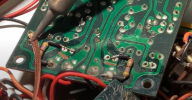
The cure: solder a 10 pF C0G/NP0 ceramic capacitor between the base and collector of (I did this on the underside of the board as they are pretty tiny) H705 and H706. That’s it. The phono stage is now totally stable, even with my reel-to-reel deck connected to both Tape 1 In and Out.
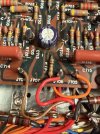
If your rebuilt 2270 motorboats when tape gear is attached and a phono input is selected, this tiny two-cap fix works wonders. Somebody mentioned that I should’ve posted some pictures before and after, but here is a picture of the phone board, and the two transistors that are in between the blue electrolytic capacitor, and I added the small disc capacitors on the bottom of the board underneath sorry I didn’t take a picture.

Have you done any sweep testing to verify riaa?I also swapped the original 22 µF decoupling caps for 470 µF ultra-low-ESR Panasonic FM electrolytics, each bypassed with a 1 µF film cap. That gives the phono stage a cleaner, more isolated power feed and filters noise coming from the rest of the preamp. But I think 470 µF might be a little bit excessive, but it is working just fine
I added a small 33 Ω resistor in series with the DC + feed, forming a simple RC filter with the new cap. Together these changes lower background noise, tighten the low end, and keep the phono stage rock-solid even with tape decks or long cables connected.
The only side effects are a slightly slower voltage rise at power-on and a tiny bit more inrush current — both completely harmless.

The 22uF capacitors at C703/704 are in the signal path; they are the high pass filter for the RIAA equalization. See here for more details: https://audiokarma.org/forums/index...pgrade-of-a-marantz-2270.793805/post-10982411I also swapped the original 22 µF decoupling caps for 470 µF ultra-low-ESR Panasonic FM electrolytics, each bypassed with a 1 µF film cap. That gives the phono stage a cleaner, more isolated power feed and filters noise coming from the rest of the preamp. But I think 470 µF might be a little bit excessive, but it is working just fine...
Thanks for the detailed explanation! In my unit, those 22 µF capacitors were replaced with higher-value electrolytics that are bypassed with small film capacitors, not full film replacements. I had thought they were just part of the DC supply, but it makes sense now that they’re tied into the RIAA feedback network and influence the low-frequency response. That also explains why stability changed after the transistor swap — everything’s solid now after adding the tiny base-to-collector caps on the diff pair.The 22uF capacitors at C703/704 are in the signal path; they are the high pass filter for the RIAA equalization. See here for more details: https://audiokarma.org/forums/index...pgrade-of-a-marantz-2270.793805/post-10982411