
Speakerbox
Super Member
Good Goobly Goo!



Hello everyone. I am new to this forum and thought this would be a good thread for my first post. I firmly believe that the listening room and the locations of the speakers and listener within it is a primary component of any system, and possibly the most important. Having issues there will never allow the rest of the components to be at their best.
I was fortunate to have been able to build a dedicated listening room a while ago. It is a medium sized room with good acoustic dimensions of 21.5' x 15.2' x 10' (average of the cathedral peak). I listen with the speakers set up along the long wall. I prefer that extra width which does equate to my soundstage presentation wall to wall. However, this does create two nulls at certain low frequencies. But, then there are always compromises it seems and although I can measure the nulls, I really cannot hear their effects. There are no existing peaks.
The cathedral ceiling was a choice made modeled after a friends room that I thought worked out well. That too has some drawbacks. Although it gives a huge visual impression it can cause some strange focusing issues. I was able to take care of those with my room treatments.
Those treatment panels are DIY 4" thick 703 type rigid fiberglass. They are all intended for broadband bass absorption. Except for the one wall center and the ones along the cathedral peak, they are reflective of higher frequencies. The room corners are completely full of that 703 cut into triangles and also reflective of higher frequencies.

These are the new VMPS RM-V60 speakers with the VLA bass towers. I call it the VMPS reference system. It replaced my Infinity RS1bs of some 17 years. I am now using actual amp stands which can be seen in the last photo.


The sculpture was installed by the artist. His work back then were almost always life sized and sciencefiction themed. His inspiration for this one was when Hans Solo from Star Wars was frozen in carbonite. He is now a very successful artist with bronze statues all over the country.
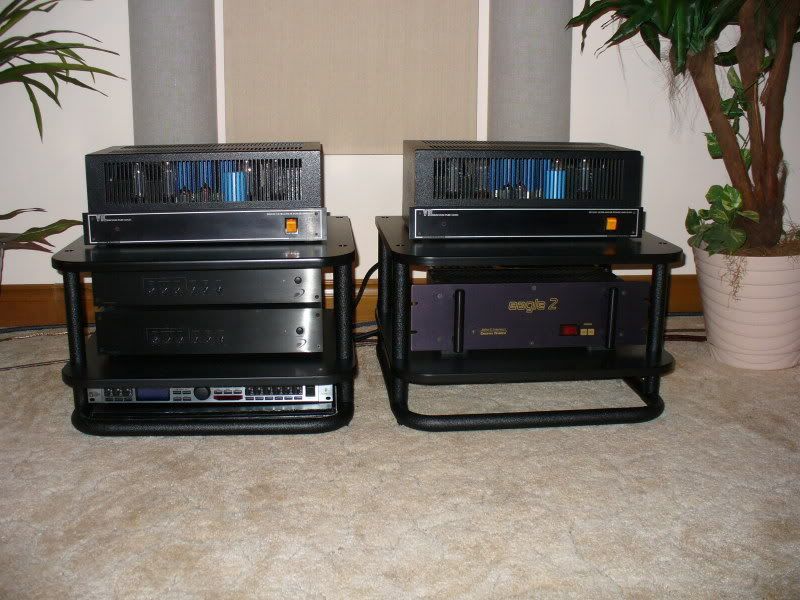
I do have some older gear, but I was never one to buy something new just for the sake of buying something new. These are still great performers. Those are VTL Delux 100 monos (only a few pair were ever made) for the mid and high frequencies and an Electron Kinetics Eagle 2a for the mid bass down to 57Hz. The mono Dayton sub amps take it own the rest of the way for the bass towers. And yes that does appear to be a lowly Behringer DCX as the active crossover, but it is much more than that. It has been highly modified by Mike Galusha with the following:
Linear Audio (Didden) analog IO kit
Frank Oettle SRC (Sample Rate Converter)/Clock/Input Receiver
All electrolytic caps on DSP/DAC board replaced with Black Gate
Voltage regulators on DSP/DAC board replaced with Oettle regs
Digital input wired direct to transformer with RG-179 75 ohm coax and
terminated with precision 75 ohm resistor
DAC's upgraded to latest AKM AK4396 (this was a special one time thing - not sure if the chips can be easily obtained again)
+/- 15V analog power supply lines have 100uH chokes and two of the caps
on the DAC/DSP board changed to 220uF create an LC filter. These are the
only two caps that are not Black Gate.
"Felix" power conditional/filter between IEC and switching PSU. All
power wiring replaced with 18GA cryo treated teflon insulated wire.
Install AudioQuest Silver NextGen 75 ohm RCA female socket.
This is one truly transparent piece of equipment.


Hello everyone. I am new to this forum and thought this would be a good thread for my first post. I firmly believe that the listening room and the locations of the speakers and listener within it is a primary component of any system, and possibly the most important. Having issues there will never allow the rest of the components to be at their best.
I was fortunate to have been able to build a dedicated listening room a while ago. It is a medium sized room with good acoustic dimensions of 21.5' x 15.2' x 10' (average of the cathedral peak). I listen with the speakers set up along the long wall. I prefer that extra width which does equate to my soundstage presentation wall to wall. However, this does create two nulls at certain low frequencies. But, then there are always compromises it seems and although I can measure the nulls, I really cannot hear their effects. There are no existing peaks.
The cathedral ceiling was a choice made modeled after a friends room that I thought worked out well. That too has some drawbacks. Although it gives a huge visual impression it can cause some strange focusing issues. I was able to take care of those with my room treatments.
Those treatment panels are DIY 4" thick 703 type rigid fiberglass. They are all intended for broadband bass absorption. Except for the one wall center and the ones along the cathedral peak, they are reflective of higher frequencies. The room corners are completely full of that 703 cut into triangles and also reflective of higher frequencies.
These are the new VMPS RM-V60 speakers with the VLA bass towers. I call it the VMPS reference system. It replaced my Infinity RS1bs of some 17 years. I am now using actual amp stands which can be seen in the last photo.
The sculpture was installed by the artist. His work back then were almost always life sized and sciencefiction themed. His inspiration for this one was when Hans Solo from Star Wars was frozen in carbonite. He is now a very successful artist with bronze statues all over the country.
I do have some older gear, but I was never one to buy something new just for the sake of buying something new. These are still great performers. Those are VTL Delux 100 monos (only a few pair were ever made) for the mid and high frequencies and an Electron Kinetics Eagle 2a for the mid bass down to 57Hz. The mono Dayton sub amps take it own the rest of the way for the bass towers. And yes that does appear to be a lowly Behringer DCX as the active crossover, but it is much more than that. It has been highly modified by Mike Galusha with the following:
Linear Audio (Didden) analog IO kit
Frank Oettle SRC (Sample Rate Converter)/Clock/Input Receiver
All electrolytic caps on DSP/DAC board replaced with Black Gate
Voltage regulators on DSP/DAC board replaced with Oettle regs
Digital input wired direct to transformer with RG-179 75 ohm coax and
terminated with precision 75 ohm resistor
DAC's upgraded to latest AKM AK4396 (this was a special one time thing - not sure if the chips can be easily obtained again)
+/- 15V analog power supply lines have 100uH chokes and two of the caps
on the DAC/DSP board changed to 220uF create an LC filter. These are the
only two caps that are not Black Gate.
"Felix" power conditional/filter between IEC and switching PSU. All
power wiring replaced with 18GA cryo treated teflon insulated wire.
Install AudioQuest Silver NextGen 75 ohm RCA female socket.
This is one truly transparent piece of equipment.


Hello everyone. I am new to this forum and thought this would be a good thread for my first post. I firmly believe that the listening room and the locations of the speakers and listener within it is a primary component of any system, and possibly the most important. Having issues there will never allow the rest of the components to be at their best.
I was fortunate to have been able to build a dedicated listening room a while ago. It is a medium sized room with good acoustic dimensions of 21.5' x 15.2' x 10' (average of the cathedral peak). I listen with the speakers set up along the long wall. I prefer that extra width which does equate to my soundstage presentation wall to wall. However, this does create two nulls at certain low frequencies. But, then there are always compromises it seems and although I can measure the nulls, I really cannot hear their effects. There are no existing peaks.
The cathedral ceiling was a choice made modeled after a friends room that I thought worked out well. That too has some drawbacks. Although it gives a huge visual impression it can cause some strange focusing issues. I was able to take care of those with my room treatments.
Those treatment panels are DIY 4" thick 703 type rigid fiberglass. They are all intended for broadband bass absorption. Except for the one wall center and the ones along the cathedral peak, they are reflective of higher frequencies. The room corners are completely full of that 703 cut into triangles and also reflective of higher frequencies.
The sculpture was installed by the artist. His work back then were almost always life sized and sciencefiction themed. His inspiration for this one was when Hans Solo from Star Wars was frozen in carbonite. He is now a very successful artist with bronze statues all over the country.
I do have some older gear, but I was never one to buy something new just for the sake of buying something new. These are still great performers. Those are VTL Delux 100 monos (only a few pair were ever made) for the mid and high frequencies and an Electron Kinetics Eagle 2a for the mid bass down to 57Hz. The mono Dayton sub amps take it own the rest of the way for the bass towers. And yes that does appear to be a lowly Behringer DCX as the active crossover, but it is much more than that. It has been highly modified by Mike Galusha with the following:
Linear Audio (Didden) analog IO kit
Frank Oettle SRC (Sample Rate Converter)/Clock/Input Receiver
All electrolytic caps on DSP/DAC board replaced with Black Gate
Voltage regulators on DSP/DAC board replaced with Oettle regs
Digital input wired direct to transformer with RG-179 75 ohm coax and
terminated with precision 75 ohm resistor
DAC's upgraded to latest AKM AK4396 (this was a special one time thing - not sure if the chips can be easily obtained again)
+/- 15V analog power supply lines have 100uH chokes and two of the caps
on the DAC/DSP board changed to 220uF create an LC filter. These are the
only two caps that are not Black Gate.
"Felix" power conditional/filter between IEC and switching PSU. All
power wiring replaced with 18GA cryo treated teflon insulated wire.
Install AudioQuest Silver NextGen 75 ohm RCA female socket.
This is one truly transparent piece of equipment.
 :ntwrthy::ntwrthy::ntwrthy:
Housteau, can we have a picture from the listening chair?

Housteau,
I like the isolation platform for the chair!
 That was my way of raising my listening position a bit. That platform is not there now. I have added some pillows to the seat instead. That also helps to raise my ears just above the taller back of the chair.
I want your house.
. It is home to one of my other passions, swordsmanship.


