• The move to the new server is done. There are some software and database maintenance updates in process. This has us passing the hat around to help out. We appreciate any donations. Seriously, even a dollar helps. The payment page may be found here - https://www.audiokarma.org/support.html

Pioneer M-22; Worth a Repair Attempt?

AlexHempel

AK Subscriber
Subscriber
Greetings AK denizens,

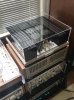
I recently purchased a Pioneer M-22 on Ebay and am in a bit of a quandry. The first few times I flipped the switch it refused to turn on (no LED, no relay clicking, and no output on the terminals). I then plugged the cord into a different outlet and it powered up. In retrospect, this was probably a coincidence, because it is again refusing to turn on today. Moreover, the original outlet was working with other electronics. I tried swapping outlets and flipping the switch a bunch of times but no dice.

In addition, it shut itself off once while I was listening last night, probably due to overheating. The manual mentions this as a standard functionality and it was a hot evening, so I doubt this is related to my power-on issue. I didn't attempt to turn it back on immediately after this, as it was already quite late -- time flies when listening to new gear!

The seller generously provided a 30-day return window, so I still have a week or two to send it back. However, I'd love to keep it if possible -- it pairs wonderfully with my Stax headphones and was relatively cheap for an M-22. It's also the 120v US version, which is rare. Unfortunately, the conditions of the return policy prevent me from opening the unit, so it will be difficult to definitively diagnose the issue prior to making a decision. I'm wondering if anyone here could speculate on what's going wrong and how difficult the repair is likely to be. I know the M-22 has a relatively sophisticated soft-start system thanks to its massive caps and high current draw; perhaps an issue with this circuitry is the culprit. I'm handy with a soldering iron and have restored a few receivers but have limited time and money to dump into this thing. Thanks for the help!
 
Register to hide this ad
You may also share the group your location, there might be someone in your area that can help you too. I am personally planning to get one soon if the price is right, for me it is worth to have it fixed specially if still in good condition. Welcome to AK!

:lurk:
 
After consulting the schematic, I suspect it might be an issue with FU1, a 3A mains fuse. The M-22 claims almost 300W of power consumption, so it seems this fuse is conservatively rated and could have blown due to aging or some other normal degradation. Also possible the unit is running a bit hot due to high bias and that tripped the fuse. Maybe I could find a way to test this fuse without opening the unit?

Edit: Didn't realize the schematic is for the 220V version. Back to hunting...
 
In most (if not all) cases the schematics differ for different line-voltages from the power cord through the power transformer, no further. That part is pretty simple to follow and troubleshoot without a schematic and the rest of the schematic should be the same. Those with specific M-22 experience/knowledge might have different information than mine.
 
I flipped the unit over and took a look through the grill holes -- really frustrating that I can't open it. Looks like there's some burnt electrolyte on a few of the bigger axial caps, so the unit probably needs a recap in addition to fixing the power switch issue. Given the temps this thing runs at (painful to touch for more than half a second) I'm guessing tons of components should be replaced, including most caps and the power supply diodes. Gonna have to decide whether I'm up for such a job, as I'm already in the midst of restoring a Sansui Six with a broken tone board.

Another thing that might be of interest to would-be M-22 owners: my M-22 seems to have slightly reduced treble levels compared to my reference Hypex NC400 monoblocks (which are class D). Based on playing around with an EQ until the NC400s sound roughly like the M-22, I'd say my M-22's treble is about 2db lower at 5k. Of course, this M-22 is unrestored, which could be the reason for this discrepancy.
 
Greetings AK denizens,


I recently purchased a Pioneer M-22 on Ebay and am in a bit of a quandry. The first few times I flipped the switch it refused to turn on (no LED, no relay clicking, and no output on the terminals). I then plugged the cord into a different outlet and it powered up. In retrospect, this was probably a coincidence, because it is again refusing to turn on today. Moreover, the original outlet was working with other electronics. I tried swapping outlets and flipping the switch a bunch of times but no dice.

In addition, it shut itself off once while I was listening last night, probably due to overheating. The manual mentions this as a standard functionality and it was a hot evening, so I doubt this is related to my power-on issue. I didn't attempt to turn it back on immediately after this, as it was already quite late -- time flies when listening to new gear!

The seller generously provided a 30-day return window, so I still have a week or two to send it back. However, I'd love to keep it if possible -- it pairs wonderfully with my Stax headphones and was relatively cheap for an M-22. It's also the 120v US version, which is rare. Unfortunately, the conditions of the return policy prevent me from opening the unit, so it will be difficult to definitively diagnose the issue prior to making a decision. I'm wondering if anyone here could speculate on what's going wrong and how difficult the repair is likely to be. I know the M-22 has a relatively sophisticated soft-start system thanks to its massive caps and high current draw; perhaps an issue with this circuitry is the culprit. I'm handy with a soldering iron and have restored a few receivers but have limited time and money to dump into this thing. Thanks for the help!

Speculation as requested :):
I looked at the schematic for the 120vac version (KL) in the service manual from hifiengine.com. The soft start circuit is actually a very simple circuit. It consists of a 1.5Ω 5W resistor in series with the power transformers' ac input, and a half-wave rectifier making dc that feeds current through a 1kΩ 5W resistor to a cap across a relay coil. When the power switch is closed the power to the transformers is limited by the 1.5Ω resistor and the DC rises across the relay (slowed slightly by the 1k resistor) until the relay closes, which shunts out the 1.5Ω resistor and makes full power available to the transformers (paraphrased from SM page 8). IF it is the problem it should not be difficult to troubleshoot that circuit. Can you hear a relay click when you turn it on? It will be much faster than the protection relay click. If it is not closing then the 1.5Ω resistor will stay in the power input path. That won't make much difference when the amp is sitting idle, but under load it may cause power supply sag and may cause excessive heat, though even if the amp is drawing the full rated 280W off the AC line (2.3A) it only will drop 3.5 volts and dissipate just over 8 W (an unlikely scenario). I don't see a thermal protection fuse near that resistor in the schematic like Pioneer used on some of its other soft-start circuits. I doubt the soft-start is the problem, unless you have a broken trace in just the wrong place, or bad connection on the ac feed through the AWK-058. The Pilot lamp runs off of 1/2 of the AC winding that feeds the +/- 45vdc unregulated supply that feeds the +/- 36vdc regulated supply for the right channel, other than a bad lamp or blown internal fuse no lamp light makes me suspect no power to the transformer at all when it won't power on. My primary suspect is an intermittent connection in the ac line (did you move the amp when you changed outlets?) or the power switch itself. :blah::rolleyes:

FWIW, I have not worked on an M-22 before, just looking at the schematic. If the price was on the good to low side I would keep it and fix it, if the price was on the high side you might want to return it. Those with actual experience with the M-22 may have better advice.
 
Last edited:
An anti-climactic update: @merlynski's helpful post explained a lot of my symptoms and I concluded it must be something relatively simple happening before the transformers, so I sent a message to the Ebay seller telling him I'd keep the unit. I then started inspecting the power cord very closely and noticed a bit of a cut in one part. It looked minor but I bent it backward and discovered that one side of the cable is completely severed! It must have been working earlier because the cord was positioned in such a way that it happened to make contact. I'm not sure whether I did this or it happened during transit, but I'm assuming the cable got sandwiched between the sharp chassis edge and a hard place. I'm about to order a new (nicer) cable, which should fix the issue.

On one hand, I'm a bit annoyed I didn't notice something this simple earlier. On the other hand, I'm glad I don't need to source a new power switch or something similar. Given how hot this thing runs, I plan on doing a thorough restoration relatively soon -- I'll start a new thread with pictures etc. Thanks all for the advice!
 
Glad I could help :thumbsup:. When you replace the power cord make sure you connect the hot side to the switched, fused, relay side of the power input circuit if you use a polarized plug (just in case you didn't know). Looking forward to seeing how this turns out :D.
 
Curious about how hot other M-22's run. I would describe mine as very warm, not hot, certainly not hot enough to burn. This is without the fan I normally use.
 
Mine can heat a room in the winter to 80F easily. Not that is gets hit but it continually puts out that heat is the issue.

I've been using mine with Magnepan LRS's (4 ohm) and still does not get that hot. Maybe it needs a trip to the doc.
 
Mine was at the Doc :D

Also, don't forget the M-25 looks the same and that one is class A/B. I am sure you know what you have, just saying.....

LOL, yeah, it's an M-22. It was checked by a former ModWright tech, so I know it's healthy. Maybe my perception of "hot" is different. Could be my hands need service!
 
Finally have an update: I received my 14 gauge replacement power cord and popped the bottom off the M-22 to make the swap. As I was poking around, I noticed that the mains fuse is completely nuked. Pulled out a multimeter and no continuity. So the power cord, while certainly a problem, probably wasn't what caused it to fail. Hopefully it's just a faulty fuse and there's no underlying issue. Since it was working perfectly right until shutdown I'm optimistic, but I'll post another update once I fix everything and give it a try.

Another thing: one of the big filter caps still had charge, but the others were empty. I'm guessing this means they could use replacement, since they should all have about the same amount of charge? I'm planning on fully recapping anyway, but not exactly sure how I'll secure the new filter caps. Perhaps the screw terminals alone are enough as long as I'm careful.
 
With regards to heat, I had it running for about two hours on a relatively warm (80 degree) evening -- it was not hot enough to burn but quite uncomfortable to touch for more than a few seconds. Re-applying thermal compound and buying new mica washers is definitely on my todo list, as is checking the bias.
 
Finally have an update: I received my 14 gauge replacement power cord and popped the bottom off the M-22 to make the swap. As I was poking around, I noticed that the mains fuse is completely nuked. Pulled out a multimeter and no continuity. So the power cord, while certainly a problem, probably wasn't what caused it to fail. Hopefully it's just a faulty fuse and there's no underlying issue. Since it was working perfectly right until shutdown I'm optimistic, but I'll post another update once I fix everything and give it a try.

Another thing: one of the big filter caps still had charge, but the others were empty. I'm guessing this means they could use replacement, since they should all have about the same amount of charge? I'm planning on fully recapping anyway, but not exactly sure how I'll secure the new filter caps. Perhaps the screw terminals alone are enough as long as I'm careful.
Residual charge is not uncommon in large caps that do not have bleeder resistors, but it does not mean they are bad, or that caps that do not have residual charge are bad. Residual charge depends on size and connected circuits.
The blown fuse could have been caused by the intermittent connect and disconnect of the power cord and with the soft start relay still pulled in. Replace the power cord and the fuse and plug it in to a DBT for the first power-on test. If the bulb goes dim then try it on full power.
 
My reasoning on the non-charged caps being bad was that it's a dual-mono setup, so it seems the opposite cap (which is the same value and connected to a basically identical circuit) should have about the same charge. However, I'm no expert so perhaps this is simply incorrect or a negligible difference in leakage results in this discrepancy.

Good point about the power cord causing the fuse to blow -- it occurred to me as well, although I wasn't touching anything when it blew so I'm not sure why it would have lost then regained contact. Perhaps thermal expansion?
 
negligible difference in leakage results in this discrepancy.
Yup, I agree this is a likely explanation. Test them for capacitance, ESR and leakage to be certain about good or bad, but if it plays and sounds good don't worry about it.
 
Back
Top Bottom