• The move to the new server is done. There are some software and database maintenance updates in process. This has us passing the hat around to help out. We appreciate any donations. Seriously, even a dollar helps. The payment page may be found here - https://www.audiokarma.org/support.html

Pioneer M-22; Worth a Repair Attempt?

Watch also for even temperatures in the large caps, if one or more run warmer (not because of proximity to hot heat-sinks) then it is likely leaky. Personally I like to replace them when I restore, old electrolytic capacitors are well beyond their design life, and they're not that expensive vs the value of the equipment. From my experience however they will usually get warm and/or cause a hum as they fail, or leak electrolyte / bulge.

Yes do check the amplifier voltages (bias & offset / idle). If it's not biased correctly you are stressing lots of components unnecessarily.
 
Another thing that might be of interest to would-be M-22 owners: my M-22 seems to have slightly reduced treble levels compared to my reference Hypex NC400 monoblocks (which are class D). Based on playing around with an EQ until the NC400s sound roughly like the M-22, I'd say my M-22's treble is about 2db lower at 5k. Of course, this M-22 is unrestored, which could be the reason for this discrepancy.

For what it’s worth, my M-25 (the Class A/B relative of your amp) has flat response across the audio spectrum, even without being fully recapped. So I think your last sentence may be correct: that some aging parts are degrading the amp’s frequency response. Unless there’s a weird interaction between your speakers’ impedance curve and this amp.
 
For what it’s worth, my M-25 (the Class A/B relative of your amp) has flat response across the audio spectrum, even without being fully recapped. So I think your last sentence may be correct: that some aging parts are degrading the amp’s frequency response. Unless there’s a weird interaction between your speakers’ impedance curve and this amp.

I'll probably go with a full recap regardless, but the amp didn't have any other issues typical of degrading caps such as muddier sound, weak/bloated bass, etc., so I'm not sure that's what it is. I think your point about the impedance curve is an interesting one; I do most of my critical listening with Stax electrostatic headphones driven through an SRD-7 transformer box. I've always wondered what type of load they present, and amps tend to get relatively hot driving them.

The 2db figure is also very rough, as I only got to listen to the M-22 for a few hours before it kicked the can. Once I get it running again (hopefully tonight or tomorrow) I'll do some more listening.
 
There are other things that can go bad on the M-22 boards - the diodes can vary since the QA/QC on the early diodes were not as good as they are now. I would also look at those. On mine they did vary quite a bit from the specs, so a recap and diodes replaced was done on mine was well as some of the orange drop resistors.

As of now my wishlist for restoration based on reading a few threads is:
  • Diodes, especially in the power supplies
  • Trimmers
  • Electrolytic caps, possibly including the big PS filter caps (need to think about mounting)
  • Mica washers and new thermal compound for the TO-3s
  • Relays, but still unsure of the correct subs
There's a post over on SBAF that's particularly informative and I was planning on basing my efforts on that. IIRC it's called "Using the M-22 as a Headamp" or something.

@botrytis thanks for mentioning the orange drop resistors -- I'll add those to the list.
 
Ok, so I spent much of today working on the M-22 and I've got the new power cord soldered in and the fuses replaced. Electrocuted myself in the process but hey, win some lose some. I also wired up a DBT last weekend and bought a 150w bulb.

I plugged the M-22 into the DBT and flipped all the switches -- the 150w bulb glows very brightly and the soft start relays don't trip. I left it on for about a minute. I then measured the voltage across the caps (was zero before I turned the amp on) and only got about 3 volts; seems the DBT is preventing the caps from charging? I'm guessing there's a huge current draw to fill all four caps from zero volts and maybe my DBT is too restrictive. Tempted to just throw it on a normal socket and see what happens (after all, it is fused) but thought I'd check in here first.
 
@avionic Is there any way to check without removing all eight of them and diode testing? I tried touching the package and they all seem quite cool.
 
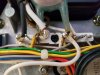
Ok, upon further inspection I'm noticing more oddities with this unit. I think someone removed the soft-start circuitry. The wiring of my M-22 mirrors the version without soft start, but it has a soft start relay! It's just not connected to anything. And I see some severed wires which I'm pretty sure used to be connected to the soft start circuit.
 
Ok, upon further inspection I'm noticing more oddities with this unit. I think someone removed the soft-start circuitry. The wiring of my M-22 mirrors the version without soft start, but it has a soft start relay! It's just not connected to anything. And I see some severed wires which I'm pretty sure used to be connected to the soft start circuit.
Something is shorted. My money is on the output(s)..
 
Here are some pictures of what I'm talking about. In the first one, you can see the soft start relay with no wires attached. In the second, you can see a severed brown and yellow wire (not cut by me).20191019_171451.jpg 20191019_171506.jpg
 
Thankfully, all the outputs are good. Something I noticed while removing them: whatever voltage is present in the front two filter caps is also present from the collector of the PNP transistors to the chassis of the amp. Best to discharge the filter caps before attempting any work on the unit.

I think the next order of business is to give it wall power? Unless anyone has other checks I should attempt beforehand. Seems like the current draw of the filter caps sans soft start is going to cause DBT issues unless I get a massive bulb.
 
Has it actually passed the dbt? Flared bulb bright at power on, then dimmed down to dark or just barely glowing? While still on dbt: Is dc offset adjustable on both channels (leave at 0vdc)? Does the bias circuit work, increasing and decreasing with with the adjustment (turn to minimum before going off dbt)? A failure in the bias circuit may look like a shorted output on dbt (bright bulb), but testing the outputs as good does not indicate the problem has been solved. If either of these are not functioning on dbt they will probably cost you time and money if you power up on full mains voltage. I would also repair the soft-start before trying full power. For the dbt bulb I start with 60W, then if it passes go to 120W. The higher the bulb wattage the less protection it provides, but the closer to full power it passes through.
 
It has not passed the DBT on 150w. The bulb remained bright for about a minute or so and then I turned it off. But since the power consumption of this thing is like hundreds of watts during normal operation (and presumably the current draw is much higher on startup) wouldn't a bulb of like 60w glow regardless? I'm still new to this whole DBT thing so apologies if these are dumb questions.
 
Back
Top Bottom