• The move to the new server is done. There are some software and database maintenance updates in process. This has us passing the hat around to help out. We appreciate any donations. Seriously, even a dollar helps. The payment page may be found here - https://www.audiokarma.org/support.html

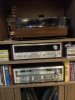
Pioneer Sx780 not working AC power problems.

Well
I exchanged the circuit breaker and rewired one exclusively outlet for the receiver.
Worked fine all day, and now I turned up the receiver and start to clicking again.
Probably the building is using more power and the voltage is low.
Should I thing on bypassing the relay?
Our replace the original one in the unit?
 
so its looking like an amp problem then . or it doesn't like your speakers .

I guess the next step is moving to a new apartment.

I'm gonna try plug in the Sx780 in the back of my Sx626.
I tested 3 different pairs of speakers, even without speakers, still clicks.
 

Attachments

  • 20210807_193928.jpg
    20210807_193928.jpg
    91.5 KB · Views: 8
Did you try powering it from a pure sine wave output UPS or battery backup?
I am reluctant to believe that it is an amp problem if it works fine in all other locations, but not in your apartment.
Is there anything in that area that generates RF noise, on the power line or through the air?
Build a full surround Faraday Cage with fine mesh metal screen, that is grounded, and try it in there.
https://en.wikipedia.org/wiki/Faraday_cage
 
Did you try powering it from a pure sine wave output UPS or battery backup?
I am reluctant to believe that it is an amp problem if it works fine in all other locations, but not in your apartment.
Is there anything in that area that generates RF noise, on the power line or through the air?
Build a full surround Faraday Cage with fine mesh metal screen, that is grounded, and try it in there.
https://en.wikipedia.org/wiki/Faraday_cage

I used a nobreak with battery and worked fine.

I unplugged everything and try it and still clicks, there's nothing in the air, clear space.

I ll take some photos of the boards, maybe you guys seeing something that I don't.

I just wanna to thank you all for the help, I really appreciate.
 
i don't suppose you have or could borrow an oscilloscope ? i would like to see the sinewave of your mains power supply .
another thing to try if you can get hold of one is an isolation transformer .
 
You have only one pair of speakers connected, at 6Ω, right?
Popping at power off usually means the protection circuit is not dropping the relay soon enough after ac loss.
I suspect you have a tired old protection circuit that could use a rebuild. Has anything been done to this unit, as far as servicing it?

I was looking through AK and find this thread and was thinking that mine was storage for 30 years, maybe some things are tired and not behave like suppose to.
 
i don't suppose you have or could borrow an oscilloscope ? i would like to see the sinewave of your mains power supply .
another thing to try if you can get hold of one is an isolation transformer .

Unfortunately one oscilloscope isn't easy for me to grab.
But I'm considering one isolation transformer, is expensive here in Brazil, but if do the work, I'm happy to see the receiver working.
I listened all Saturday and was very pleasant.
All day worked, but now at night... clicking
 
When it starts again in the evening, Can you try
I used a nobreak with battery and worked fine.
when it is doing it,and does that stop it? Just pull the nobreak plug out of the wall. Does that stop it? turn down the volume and listen carefully for anything rhythmic coming through the speakers. Turn to AUX, turn up the volume (make the silent channel LOUD) to hear any induced interference.

We are looking for any interference to the power amp's signal that would trigger the protect circuit.

That would exonerate any interference coming in on the speaker lines or other cables (including the antenna). It would simplify things considerably.

We call them UPS's (Uninterruptable Power Supplies) and except for the very expensive models, most are filters that pass through the AC from the wall, and only start up generating their own AC waveforms when the power from the wall ceases.

As far as the connections TO the SX-780, there is the power cord, the antenna and the wires to the speakers.

I would like to try a ferrite filter on the SX-780 power cable AT the back panel. If you can't find one easily commercially,
they can be salvaged from discarded cheap computer cables where they are used to contain emissions.
The cables are run through (or wrapped through) masses of Ferrite.

To everyone:
The SX-780's protect is based on the PA3004 chip (sometimes the ghosts of earlier protect circuits cloud our minds)
to refresh our memories:

PA3004
pin 1 13.5v power supply INput
pin2 x
pin 3 relay drive OUT, 0v is off, above 0.6v is on
pin 4 protection DC INput from Left and Right speaker leads through 75k resistors
pin 5 ground
pin 6 -7v INput from the -40v regulated supply
pin 7 AC voltage INput, from green (50 vac?) secondary transformer winding, through a 1 meg & 1 meg voltage divider. My target!!
pin 8 timing capacitor

I am very suspicious of the pin 7 AC input. A lot will depend upon Carl's future results of going to straight UPS power while it is clicking (just pulling out the UPS's wall plug to simulate a power failure). will it:
1. keep on doing it
2. stop doing it and operate nicely
3. stop doing it, yet hear some type of junk interfering with the audio (think thump which could have been camouflaged by the relay disconnect).

I remember a SX-1280 that gave us fits....

To the OP: are you near an Airport?
 
When it starts again in the evening, Can you try when it is doing it,and does that stop it? Just pull the nobreak plug out of the wall. Does that stop it? turn down the volume and listen carefully for anything rhythmic coming through the speakers. Turn to AUX, turn up the volume (make the silent channel LOUD) to hear any induced interference.

We are looking for any interference to the power amp's signal that would trigger the protect circuit.

That would exonerate any interference coming in on the speaker lines or other cables (including the antenna). It would simplify things considerably.

We call them UPS's (Uninterruptable Power Supplies) and except for the very expensive models, most are filters that pass through the AC from the wall, and only start up generating their own AC waveforms when the power from the wall ceases.

As far as the connections TO the SX-780, there is the power cord, the antenna and the wires to the speakers.

I would like to try a ferrite filter on the SX-780 power cable AT the back panel. If you can't find one easily commercially,
they can be salvaged from discarded cheap computer cables where they are used to contain emissions.
The cables are run through (or wrapped through) masses of Ferrite.

To everyone:
The SX-780's protect is based on the PA3004 chip (sometimes the ghosts of earlier protect circuits cloud our minds)
to refresh our memories:

PA3004
pin 1 13.5v power supply INput
pin2 x
pin 3 relay drive OUT, 0v is off, above 0.6v is on
pin 4 protection DC INput from Left and Right speaker leads through 75k resistors
pin 5 ground
pin 6 -7v INput from the -40v regulated supply
pin 7 AC voltage INput, from green (50 vac?) secondary transformer winding, through a 1 meg & 1 meg voltage divider. My target!!
pin 8 timing capacitor

I am very suspicious of the pin 7 AC input. A lot will depend upon Carl's future results of going to straight UPS power while it is clicking (just pulling out the UPS's wall plug to simulate a power failure). will it:
1. keep on doing it
2. stop doing it and operate nicely
3. stop doing it, yet hear some type of junk interfering with the audio (think thump which could have been camouflaged by the relay disconnect).

I remember a SX-1280 that gave us fits....

To the OP: are you near an Airport?
Hello @markthefixer
A little sound of waves appears but only if I put the max volume, I guess its normal, nothing like static power trough the speaker.
When i connect directly to the battery doesn't click and stay the same little wave noise at full power.
But when starts clicking, I'm gonna let run only on batteries to confirm.
Now is 10 A.M e it's working nicely, gonna let working all day and if starts to click, I'm gonna look to find whatever is different .
My house is 2.5 miles away from the airport, a little one who doesn't have technology, planes don't land in raining days because there's not equipment to guide them.
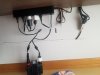
I have stripped one old VGA cable and took the ferrite and put on the cables of the Sx780 and the reducer.
 

Attachments

  • 20210808_093821.jpg
    20210808_093821.jpg
    62.7 KB · Views: 23
Well, you got ahead of me there.. The Ferrite should be right at the back of the SX-780 cabinet where it disappears into the back panel.

(and laughing with hope and glee) it may NEVER misbehave again with the Ferrite's on the job!!!

My concern about the airport was if it has a rotating radar dish that is used to control that airspace, and when it "paints" your apartment like a searchlight beam with it's radar
pulses it gets into the power amp some how.

We shall see, time will tell.
 
Well, you got ahead of me there.. The Ferrite should be right at the back of the SX-780 cabinet where it disappears into the back panel.

(and laughing with hope and glee) it may NEVER misbehave again with the Ferrite's on the job!!!

My concern about the airport was if it has a rotating radar dish that is used to control that airspace, and when it "paints" your apartment like a searchlight beam with it's radar
pulses it gets into the power amp some how.

We shall see, time will tell.

I followed your advice on the ferrite, gonna move up to the back.

The clicking comeback at night, after 6 p.m was impossible to use.

I turned down all the circuits in the house, only let the one whit the receiver and did not worked.

The click is different from the normal relay, is faster.

Gonna upload videos .
 

Good morning to all, thanks again for the help.

I upload the video from yesterday after 6 PM, I guess that the building use more power when is night time.

After 29 seconds one of the clicks is slown then the others.

It must be low voltage on my circuits, and I'm wondering if I do something on the power circuits of the receiver, it might help?
 
Just to keep track:
Again after 18:15 PM the unit stopped working.

It must be the power source of the building.

DC offset adjustments could help in this case?
 
Back
Top Bottom