• The move to the new server is done. There are some software and database maintenance updates in process. This has us passing the hat around to help out. We appreciate any donations. Seriously, even a dollar helps. The payment page may be found here - https://www.audiokarma.org/support.html

planning DIY SE KT88 build

I'm getting 448v at B+ and 425v at #6 and #1 on the 6N1P but I'm getting zero on pin 8 and 3 on it.
I'm getting 6.3v between at 4/5 and 9 but no warmth or glow at all out of that tube. I also get no connection between the 4/5 and 9 pin on an ohm meter.

Bad tube?

amp-pins.jpg
 
Last edited:
You may simply have a dead tube. But if I recall correctly - you should have 6.3V between pins 4 and 5. Pin 9 is just a grounding point. If you applied 6.3 volts between 4 and 9, or 5 and 9 you could just kill the tube.
 
Last edited:
I think your B+ is too high for the tubes you are using. You have:
450V - B+ - data you provided;
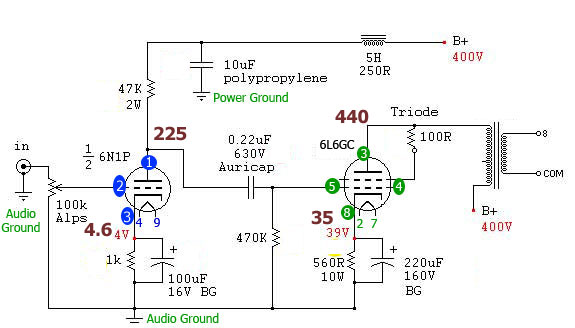
440V at the plate of 6L6GC - 10V loss at the OPT (my guesstumate, give or take)
44V at the cathode of 6L6 due to the higher B+ (my guestimate).

Each of your 6L6GC will draw 78mA (44V/560R=.078A). You have about 396V (440V-44V=396V) between plate and cathode, so the tube's plate dissipation is 30.088W (396V*.078A=30.088W), which is at its max rating. RCA manuals and other respectable sources say one should not exceed more than 75%-80% of tube's max dissipation. If you drop your B+ to 400V per schematics, your output tubes will feel much more comfortable.

Recalculating it at 400V B+:
400V - B+
390V - at the plate
39V at the cathode.

Plate current draw: 39V/560R = ~.070A
Plate/Cath voltage: 390V-39V = 351V
Dissipation Power: 351V*.070A = 24.57W, which is about 80% of total dissipation.

The latter numbers are much better (although I would reduce current draw to 60mA by increasing the cathode resistor to about 650Ohm).

Lets look at the driver tube:

it consumes 4mA (4V/1000R=.004A)
V drop after choke;1V (250*.004=1V)
V drop at plate resistor: 188V(47000*.004=188V)
Voltage at the plate: 450V-1V-188V=261V

If you are getting 425V at the plate, something is wrong with your plate resistors, and it would harm the tube, as its max rating at the plate is 300V.

Cheers, Paul.
 
Last edited:
thank you for the information. I swapped the output tubes out for ones that I won't cry if they get cooked until I get this all figured out. With these 6L6GC tubes in it I took a bit more time to get more readings around and ended up with what is shown below. Are the readings on the power transformer going to be right under load because I'm getting 390 where it should be 375?

 
If you were measuring your power supply tranny without the load (without tubes in the amp), then yes, the tranny will measure 375-0-375 under the load, as it should. I would not worry about higher voltage without load, this is normal.

Your driver tube voltages look fine now.

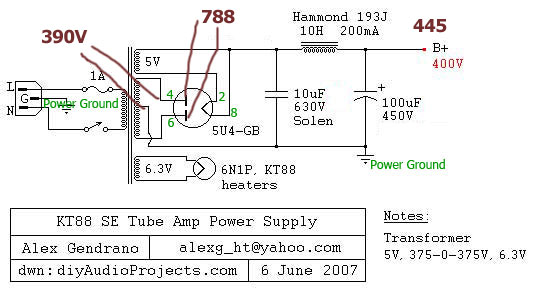
Your B+ is still too hot for the output tubes, as they are running at ~28W (30max) You can reduce voltage two ways:
1. Change your PS topology from CLC to LCRC
2. Add an RC stage to your existing PS to drop the voltage a bit.

If you do 1, you need to do two things: a) remove the first cap (before the choke), letting the rectified voltage hit the choke first; b) add 50-100 Ohm resistor (2W) after choke; c) connect the cap you disconnected in a) at the end of the resistor. So your PS looks like this: Rectifier->Choke->Cap->Resistor->Cap, hence LCRC

If you do 2, you need to add another resistor and capacitor at the end of you existing PS. To calculate value of the resistor, we need to know: a) how much volts we need to drop; b) how much current is passing through that resistor. So, 440V-400V=40V (To be dropped);
35V/560R=0.0625A Output tube current
4.6V/1000R=.0046A Driver tube current
.0625*2+.0046*2=.1342A total current draw.
40V/.1342A=298Ohm
So the value of the resistor should be around 300Ohm... The last thing to figure out is the power rating of this resistor: 40V*.1342A=5.368W. So your resistor should be rated at 10W.

Cheers, Paul
 
Paul,

Thank you so much for the detailed information. It is very helpful.

On the power supply the 390 reading is with a load on it.

With all the tubes out it comes in at just over 400 on both sides. Unless there is something else causing it I'm a bit disappointed in the power transformer.
 
Last edited:
If you do 1, you need to do two things: a) remove the first cap (before the choke), letting the rectified voltage hit the choke first; b) add 50-100 Ohm resistor (2W) after choke; c) connect the cap you disconnected in a) at the end of the resistor. So your PS looks like this: Rectifier->Choke->Cap->Resistor->Cap, hence LCRC

So the end product would look like this:
lcrc.gif


thanks again for all the help. The learning about and small tweaking of the settings is actually fun.
 
Looks correct...
I would also suggest modelling your power supply in PSUDII. It is very educational, the software is accurate, easy to do, and saves a lot of time. the URL for downloading it is as follows: http://www.duncanamps.com/psud2/

Also, your street power could be a bit higher that what the trafo is rated for, and that would account for higher output voltage on the secondaries, If the transformer primary is rated at 117V, and you get 125, that would bring the secondary voltage to 400V. Or, if the primaries are rated at 110, and you have 117V street power, result would be the same.
Cheers, Paul.
 
I got 442V B+ with my XPWR-222 Edcor power transformer (375-0-375). I added a 100ohm 10W power resistor right after the 10H choke and now I'm getting 406V B+ with the 5U4GB.
You could also probably put it between the 10uF and 100uF filter caps too.
 
Last edited:
I put 600 ohms at the end of the power circuit with a 10uf capacitor at the end of that and ended up with 394V B+

I'd have to check my numbers at home but I ended up with around 54ma on the 6L6GC output tubes.

I used K40 capacitors for the .22 in place of the Auricap but I do have the two Auricaps so I'm trying to, at least for awhile, resist swapping them to see what difference it makes. I've only got about 8 hours on it so far.

The sound is really clean. One song had some narration at the start of it and when the voice came on I jumped because it sounded like someone was in the room.

My subwoofer has speaker level inputs but it is stuck behind the tree for a couple more weeks.
 
The sound does seem to be improving with more hours and getting more full sounding. Thank you to everyone for their help. Including all those who's other posts I read through.

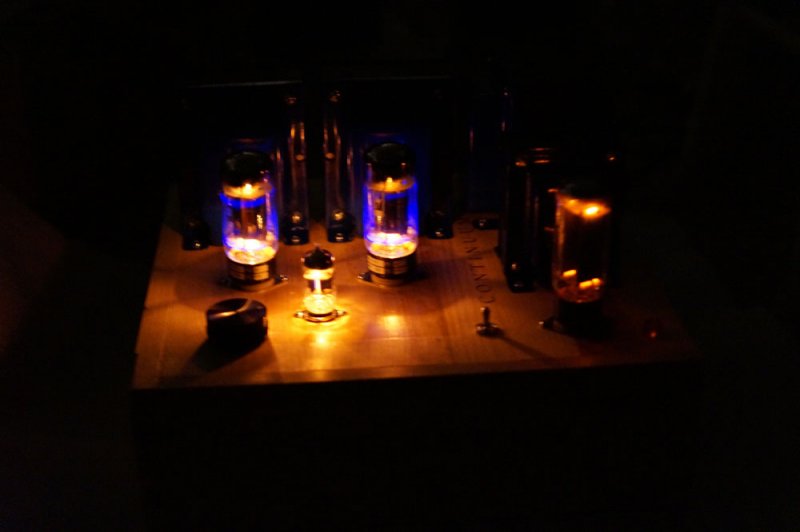
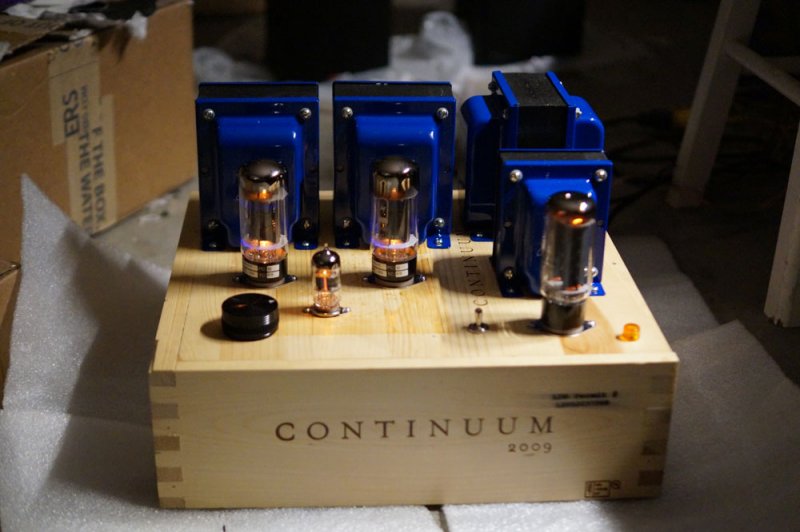
And it looks really cool glowing on the shelf
t-pic1.jpg t-pic2.jpg t-pic3.jpg t-pic4.jpg
 
VFR800fiman, thanks for your KT88 website. It was a major reference for me when I built my amp.

Prelius, thanks for the detailed calcs and explanation. Really easy to understand.

Invaderzim, nice pics! The glow looks cool on that wood surface. How about some underside pics?

I have a couple of questions for you.
1) Did you use Auricap .22uF for the coupling caps? I bet those sound plenty good! Kimber in mine.
2) Does your 5U4GBEH make a "jingling" noise when you turn the amp on? Mine does and I'm just wondering if there is a loose piece of metal or if they all sound like that.
3) What made you choose the 6L6GC? I ask only because it is kind of rare and you ventured away from the standard tube.

I was enjoying mine last night too. I really understand the term "revealing" now. Some recordings are muddy and so-so, but on fine recordings you can even hear the musician breathing. All kinds of detail is revealed with this amp (horns help, but not necessary....). I can hear Stan Getz' saxophone valves clapping shut and have heard some singers parting their lips and taking a breath to sing. On "Ella & Louis" ....Louis' voice is so close that he is in my comfort zone. :eek: Some of those 1950's recordings are flat out amazing. Maybe it's the lack of processing, or the microphone quality, but....wow....
 
I agree, it was crazy the first time I realized I could hear them inhale. The level of talent that some of them had back then is amazing when you consider what we are hearing is how they sounded not how they sounded after a computer processed it.

I ended up using the K40-9y for the coupling caps. I started out with the Auricaps but the K40s ended their month and a half journey from Russia just as I was finishing up. I did run it for a bit with the Auricaps but unfortunately, I switched speakers at the same time I switched the caps. The ones I was using for testing got moved to work and in-wall speakers that were just sitting on the workbench took their place so it was impossible to tell any sound difference. I may someday switch back for comparison but the amp is not only really heavy but top and back heavy and awkward to move so it will likely be awhile before I try anything. But I did end up with enough spare parts that I keep thinking 'maybe I should build something else'.

It is funny that you ask about the 5U4GBEH; I kept thinking that I should research the sound it makes at startup. I guess that is just what they do.

I went with the 6L6GC because I had a few spares of those. It was my 'hey, this could be cheap because I've already got the tubes'. The amp that got me started in all of this is a Heathkit A9C with 6L6GB tubes. I picked up a few 6L6GCs to try in it so that was my starter parts. But of course the 58 year old GE tubes already in it sounded the best of any I got. Which lead to the irony of it that I didn't end up using the spare tubes I had I picked up a pair of GE 6L6GC tubes from '63 mid project.

For the last decade I used a Sony amp, granted it was just a Sony but it was their high end ES line. When I bought it I was excited because it was digital and 7.1 and the sound was going to be amazing. However, no matter what adjustments I did it just never had a sound that made me want to listen to it. Listening fatigue would set in really fast so I'd rarely use it. I actually often missed my simple, and cheap by comparison, 2 channel Kenwood that it replaced. I was starting to think I just didn't like music that much anymore. One day I was up in the attic and remembered the old tube amp my Dad had built nearly 60 years ago so I got it down, dusted it off, and since I hadn't read anything on here to know better, plugged it in. I hooked up two tiny old speakers that I just hadn't gotten around to throwing away and was shocked at how good it sounded; especially considering it was just mono going to two speakers. I kept it in the garage for music and started replacing capacitors on it. Then I found myself finding projects and excuses to be in the garage and listen to it. My fancy receiver was getting beaten by a mono amp that, even adjusting for inflation, cost 1/4 as much. That was when I decided it was time to build one for the living room.

I have a couple pictures of the under side of it, I'll have to get them off the old tablet I used. To be honest it is a bit embarrassing compared to the perfectly laid out wiring I see on here but I don't have any hum :)
 
Glad you're enjoying your amp!
You should try some KT66's, I find them very pleasant to listen to.

I was hesitant to build an SE amp, as I'm a tube radio guy mostly, and just about all of them use SE as the output stage. I was thinking, how could an SE power amp sound good for Hi-Fi? Wouldn't it just sound like a radio? It must be the quality of modern components, OT's and the like. Anyway, I'm glad I did, I really enjoy the sound. No crossover distortion from a push-pull design is also a plus. I guess the only downside is low power output, but a decent pair of speakers fixes that.

Glenn
 
A quick update: I noticed over the last week or so that it was starting to not sound as impressive to me. I'm not sure what the correct technical term is but the sound was less and less like it was out in the room and more like it was the speakers. It just didn't have the life that I thought it had when I first started using it. I upgraded the capacitors in a $3.60 TDA7297 amp I was using at work and was worried that I was starting to like the sound from it better than my tube amp. I couldn't admit to anyone that I liked a sub $10 amp better than my tube amp but I was leaning that way.

Last night I swapped out the K40 .22uf capacitors for Auricaps and the sound was amazing, airy and filled the space again. After 75 hours or so of break-in the K40s seemed to sound worse and worse. Maybe that is something they move past with more time? But with the Auricaps in there I'm back to looking forward to listening to the amp again. Hopefully they will keep that sound over time.

I was honestly expecting to not notice a difference with the swap but was pleasantly surprised that I wasn't imagining that it sounded better when it was first completed. And actually it sounds better now than it did at its best before. The bass is much stronger and the highs are more defined.
 
Last edited:
Back
Top Bottom