• The move to the new server is done. There are some software and database maintenance updates in process. This has us passing the hat around to help out. We appreciate any donations. Seriously, even a dollar helps. The payment page may be found here - https://www.audiokarma.org/support.html

Power Amp Output Questions

Sorry I simply don't agree that underrating a products performance in any aspect is misleading.

What's next? Are one of you going to buy a Corvette and bitch about finding it does 0 to 60 and 0 to 120 faster than advertised but misses the unadvertised top speed by 3MPH?

As I posted in another thread, some of you come of as grumpy old men with nothing to do but nitpick and bitch about everything.

Right on! Krell's been around the block a couple of times. It's the laws of physics that influences their rating policy. There's more than one way to skin a cat. Mystique, my ass! Let's build an amp that produces so and so watts at .5ohms. Okay, now what does it produce at 8ohms? Oh really? Well, let's say it only produces so and so. That way there won't be any confusion as to how it will handle a given demand. That's just responsible real world standardization. If the regulatory bodies that be don't concur, they should get in line! And just for good measure, the techies with their panties in a bunch should chill out. You all are the reason these numbers are so important to the consumer.
 
Last edited:
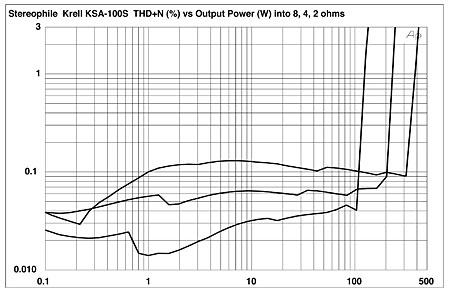
This would appear to be the Stereophile Krell KSA-100S data Joe is referencing:

99K100FIG8.jpg


If you call "clipping" the sudden knee in the distortion vs. power curve, which appeals to my physics sensitivities, then it does nearly double output power when dropping from 8 Ohms to 4 Ohms. But notice that power only increases by 50% when dropping from 4 Ohms to 2 Ohms. Joe mentioned that they couldn't test it into 2 Ohms, however, so I'm not sure where the discrepancy is there.
 
Please be so kind as to list exactly what half truths Krell (the example) is publishing. All they say is that that "this amp will produce this amount of power into these loads".

Nowhere do they mention maximum power or power at clipping into any load.

Some of you seem to be fixated on specs that are neither claimed nor published.

Furthermore, I cited a Krell amplifier that produced 20dBW at clipping into 8 and 4 Ohm loads. That is doubling down by any standard. Stereophile (John Atkinson) said they were unable to measure it into a 2 Ohm load as their test gear was inadequate.
I'm not willing to argue over semantics. I've stated my position.

All I can say is I've gotten out of several jams with former girlfriends by telling half truths and thus intentionally misleading them. Was I lying? Not by your standards. However, there was malice. There was the intention to mislead them into thinking otherwise. It would seem Krell has done the same.
 
I'll say it again, nowhere in Krell's specs does it say maximum power, at any load. All of you who are complaining and calling "foul" are fixated on maximum power at "X" load.

If I ever get into the amplifier manufacturing business all my specs will say "These are minimum performance expectations. If this amp produces more at a given load consider it a gift!"
 
Last edited:
Regarding "lying" in specs - remember that an honest spec will talk about the minimum output power that any sample of the amplifier will produce under the worst-case conditions it is designed for. It will also rate this at a particular distortion level, and certainly below the worst-case clipping point.

That way, no matter who tests it under what conditions (within its spec), the amp will actually deliver that amount of power. Since you can always turn down the volume to get less power, but you can't turn it up to get more, the maximum power is the relevant spec.

It seems to me that Krell is being conservative for one thing, and likely that it is voltage limited at 8 ohms and current limited at 4. The maximum voltage is set by the turns ratio of the transformer (together with the various losses). The maximum current is limited by the transformer losses, the transistor and resistive losses, and the current limiting if any. The two sets of limitations don't have anything to do with each other. The AC from the wall can vary quite a bit from the nominal 110V, particularly if you are running a big amp at the other end of your antiquated aluminum wiring system in your house, while the current it can deliver is limited by the breaker and then only after quite a while.

So I am not at all surprised that Krell gives a much wider margin of error for their 8 Ohm spec than their 4 ohm one. Good for them.
 
There is another issue. Power is measured at a particular distortion level and that power may be well below clipping. Also missing from all of the above posts is the inclusion of the headroom spec, which would tell you how much additional power is available.
 
Regarding "lying" in specs - remember that an honest spec will talk about the minimum output power that any sample of the amplifier will produce under the worst-case conditions it is designed for. It will also rate this at a particular distortion level, and certainly below the worst-case clipping point.

That way, no matter who tests it under what conditions (within its spec), the amp will actually deliver that amount of power. Since you can always turn down the volume to get less power, but you can't turn it up to get more, the maximum power is the relevant spec.

It seems to me that Krell is being conservative for one thing, and likely that it is voltage limited at 8 ohms and current limited at 4. The maximum voltage is set by the turns ratio of the transformer (together with the various losses). The maximum current is limited by the transformer losses, the transistor and resistive losses, and the current limiting if any. The two sets of limitations don't have anything to do with each other. The AC from the wall can vary quite a bit from the nominal 110V, particularly if you are running a big amp at the other end of your antiquated aluminum wiring system in your house, while the current it can deliver is limited by the breaker and then only after quite a while.

So I am not at all surprised that Krell gives a much wider margin of error for their 8 Ohm spec than their 4 ohm one. Good for them.

Pfffft...

They're sandbagging BS'ers.. Intentionally misleading. I truly am surprised people think it's OK provide such misleading specs. It seems quite strange, really. People bash Bose for not publishing any specs, yet here we have people essentially praising Krell for publishing misleading specs. Strange indeed.
 
Last edited:
IMO the most important power spec is one for 4 ohms, since many ordinary speakers are 4 ohm nominal, and perhaps 2.5 ohms minimum (some of those tiny cube speakers on cheap HT in a box packages are 3 ohms). I don't care if the 4 ohm rating is 2x or 1.2x the 8 ohm rating.

Since many amps and receivers are only FTC rated to 8 ohms, as a rule of thumb add about 26% (1 db) to the 8 ohm rating. Many recent amps and receivers aren't even recommended for 4 ohm speakers, in which case use them at your own risk. And some that are use a cheater switch, that either cuts power way back, or activates a bank of resistors before the speakers to keep the impedance up.

For the most part, an amp that can deliver 50 - 100 wpc @ 4 ohms will produce satisfying SPL's with all but the most difficult to drive speakers, Irregardless of the 8 ohm power rating.
 
Last edited:
IMO the most important power spec is one for 4 ohms

I agree. 4 ohm power also comes into play if the user ever runs more than one pair of 8 ohm speakers at the same time or if they ever bridge the amp.

For the most part, an amp that can deliver 50 - 100 wpc @ 4 ohms will produce satisfying SPL's with all but the most difficult to drive speakers, Irregardless of the 8 ohm power rating.

I feel that the type of music the user listens to also comes into play here. Bass-heavy content and/or liberal use of low-end EQ can use up available power amazingly quickly.
 
And I've always thought it suspicious that amplifier ratings are always nice round numbers that end in a zero. Or sometimes a five.

For the record, Krell isn't lying if they fail to mention their 300W/ch amp also does 580W/ch.

They fail to claim how well their amp also holds the carpet down, or props the door open, or keeps my boat from drifting across the lake - outrageous!
 
I'll say it again, nowhere in Krell's specs does it say maximum power, at any load. All of you who are complaining and calling "foul" are fixated on maximum power at "X" load.
For the sake of clarity.

a) for the purpose of my posts and language, the term "doubling down" means a doubling of output watts for each halving of load impedance, and absolutely no other manipulation of electrical terms. Your definition may be different, that's fine. It doesn't apply here.

b) at no point did i ever use the words "at clipping"

c) at no point have i stated a "bitch" about Krell's or hundreds of other manufacturer's methods of stating power output claims, i merely present as fact that many companies mislead by giving power specs that are inaccurate beyond the industry standard of plus or minus ten percent.

d) my main point was in shedding light on the huge normalcy bias that exists among poster's who feel empowered by the misleading interpretation of their amplifier specs that spawn the belief that "doubling down" in an amplifier is real, and exists in theirs. It likely does not.

Sorry I simply don't agree that underrating a products performance in any aspect is misleading.
FWIW, and IMO, Krell didn't claim those specs with the intention of misleading anybody, certainly not to mislead for profit. I believe it's done for the sake of simplicity, and ease of understanding for the consumer.

When shopping in the market, and we see an amplifier rated at 300, 600, and 1200 into halving impedance, many of us will immediately recognize a "high current" design, and/or an amplifier capable of driving low impedance or reactive loads. The symmetry of the numbers is also attractive to the human brain. You don't have to take my word for it, but psychology has a very firm place in advertising technique.
 
Last edited:
For the sake of clarity.

a) for the purpose of my posts and language, the term "doubling down" means a doubling of output watts for each halving of load impedance, and absolutely no other manipulation of electrical terms. Your definition may be different, that's fine. It doesn't apply here.

b) at no point did i ever use the words "at clipping"

c) at no point have i stated a "bitch" about Krell's or hundreds of other manufacturer's methods of stating power output claims, i merely present as fact that many companies mislead by giving power specs that are inaccurate beyond the industry standard of plus or minus ten percent.

d) my main point was in shedding light on the huge normalcy bias that exists among poster's who feel empowered by the misleading interpretation of their amplifier specs that spawn the belief that "doubling down" in an amplifier is real, and exists in theirs. It likely does not.

FWIW, and IMO, Krell didn't claim those specs with the intention of misleading anybody, certainly not to mislead for profit. I believe it's done for the sake of simplicity, and ease of understanding for the consumer.

When shopping in the market, and we see an amplifier rated at 300, 600, and 1200 into halving impedance, many of us will immediately recognize a "high current" design, and/or an amplifier capable of driving low impedance or reactive loads. The symmetry of the numbers is also attractive to the human brain. You don't have to take my word for it, but psychology has a very firm place in advertising technique.

I don't think we are all that far apart in our thinking.

a. I know exactly what "doubling down" (related to maximum power at 8 Ohms) really means and how unattainable it actually is. I'm a retired EE.

b. The at clipping comment was for those who seem to think that a manufacturers started wattage rating should be the maximum power possible. That I don't agree with this viewpoint is obvious. If a manufacturer chooses to use a power rating lower than the actual maximum output, who in his/her right mind will complain that it actually produces more.

c. While understating an amplifiers actual output may not be accurate IMO it is neither dishonest nor an attempt to "get over" on the buyer. I wonder if the detractors would be so upset if the phrase "Minimum expected performance was added to the specs?

d. On your point here we are in agreement. I got involved in this shooting match because some posters act like understating an amplifiers performance is akin to blasphemy and an attempt to cheat the buyer.

I still don't quite understand why anyone can be upset when a product actually delivers more than advertised. IMO the only question is, does the Krell FPB amplifier deliver its specified output? The answer being a resounding yes, what's the problem with that?
 
The part that irks me most about it is when I read people saying McIntosh, Krell, Levinson, et al, watts seem so much more powerful than Brand X watts.

Well, HELLO, when your "300 watt" amp is actually putting out effectively double that, guess what? Those "300 watts" are going to seem like more...because it is.

If this was at the race track comparing cars/engines instead of in the living room comparing amps, would sandbagging the engine horsepower by 50% be acceptable?

I can just hear it..."Dude your car is way fast, what you got under the hood?"

"Aw, just a 300hp mill."

"Man, that thing really moves for 300hp."

"Well, it actually produces 600 horsepower but the guys that put it together rate it at 300 horsepower. Amazing what 300 horsepower can do, isn't it? Every time I go up against another car running 300hp I always win. Those guys over at XYZ engines have some real magic in their horses."
 
Last edited:
For the sake of clarity.

a) for the purpose of my posts and language, the term "doubling down" means a doubling of output watts for each halving of load impedance, and absolutely no other manipulation of electrical terms. Your definition may be different, that's fine. It doesn't apply here.

b) at no point did i ever use the words "at clipping"

c) at no point have i stated a "bitch" about Krell's or hundreds of other manufacturer's methods of stating power output claims, i merely present as fact that many companies mislead by giving power specs that are inaccurate beyond the industry standard of plus or minus ten percent.

d) my main point was in shedding light on the huge normalcy bias that exists among poster's who feel empowered by the misleading interpretation of their amplifier specs that spawn the belief that "doubling down" in an amplifier is real, and exists in theirs. It likely does not.

FWIW, and IMO, Krell didn't claim those specs with the intention of misleading anybody, certainly not to mislead for profit. I believe it's done for the sake of simplicity, and ease of understanding for the consumer.

When shopping in the market, and we see an amplifier rated at 300, 600, and 1200 into halving impedance, many of us will immediately recognize a "high current" design, and/or an amplifier capable of driving low impedance or reactive loads. The symmetry of the numbers is also attractive to the human brain. You don't have to take my word for it, but psychology has a very firm place in advertising technique.

If your main point was one of education, I suggest that the next time you feel compelled to share your point of view, you start with a conversational, informative tone (as opposed to the arrogant, aggressive and disdainful one you displayed in your first post). You might also want to re-consider your use of the phrase "normalcy bias", which is not particularly applicable as the basis for what you perceive to be a lack of common understanding regarding amplifier performance specifications.
 
I get it now. You're just pissed because your car only has 300HP.:D

That's funny, but not true. They're all less. LOL.

I own two of those "double down" style amps. I don't regret buying them, but more than performance I've gained lots of insight about specsmanship, applicability of "high current", etc.
 
Last edited:
I don't think we are all that far apart in our thinking.

a. I know exactly what "doubling down" (related to maximum power at 8 Ohms) really means and how unattainable it actually is. I'm a retired EE.

b. The at clipping comment was for those who seem to think that a manufacturers started wattage rating should be the maximum power possible. That I don't agree with this viewpoint is obvious. If a manufacturer chooses to use a power rating lower than the actual maximum output, who in his/her right mind will complain that it actually produces more.

c. While understating an amplifiers actual output may not be accurate IMO it is neither dishonest nor an attempt to "get over" on the buyer. I wonder if the detractors would be so upset if the phrase "Minimum expected performance was added to the specs?

d. On your point here we are in agreement. I got involved in this shooting match because some posters act like understating an amplifiers performance is akin to blasphemy and an attempt to cheat the buyer.

I still don't quite understand why anyone can be upset when a product actually delivers more than advertised. IMO the only question is, does the Krell FPB amplifier deliver its specified output? The answer being a resounding yes, what's the problem with that?

Just curious...regarding your second point; if not the point at which clipping begins, what would you propose as the standard for defining an amp's output capabilies and comparing them one to another? Thanks.
 
Back
Top Bottom