• The move to the new server is done. There are some software and database maintenance updates in process. This has us passing the hat around to help out. We appreciate any donations. Seriously, even a dollar helps. The payment page may be found here - https://www.audiokarma.org/support.html

PrimaLuna EVO and Tube Rolling

Everybody knows there is only one way to skin a cat, especially in a subjective hobby like audio. SMH

Measurements definitely have their place, as does using your ears.

A school of audio thought I definitely subscribe to is at least 80% of the audiophile equation is the room you listen in, how well you've set up the speakers (and other gear and furniture) in it and how you have dealt with reflections and peaks/nulls in the bass. Nice thing is a lot of this is free (if the S.O. approves).

I bought a used tube amp recently. Didn't need a signal generator and scope to tell me it sounded terrible. Spent two weeks troubleshooting with the builder's assistance. It sounded just as bad the day I returned it to the seller as it did on the day purchased.
 
Last edited:
Everybody knows there is only one way to skin a cat, especially in a subjective hobby like audio. SMH

Measurements definitely have their place, as does using your ears.

A school of audio thought I definitely subscribe to is at least 80% of the audiophile equation is the room you listen in, how well you've set up the speakers in it and how you have dealt with reflections and peaks/nulls in the bass. Nice thing is a lot of this is free (if the S.O. approves).
And many ignore thier space.
 
To be 100% clear, sound quality can easily be measured and quantified. For under $1000 a person can set themselves up to measure the performance of tube amplifiers then when a change is made you can compare what you measured before the change to what you measured afterwards to see if an improvement was made.
Doing so is a lot of work.
Slapping in different tubes and then going to your favorite social media to brag about them and the euphoric sound is comparatively much easier.
Are all of these people improving the performance of their amplifiers ir just changing it?

Like I said, before you spend any money on tubes you should equip yourself to know weather you're traveling forward or in reverse. I can tell you as a matter of fact that our minds will play major tricks on us, convincing us we hear differences in the same piece of music. More often than not it's just your fallable brain, doing its best to make sense of its surroundings.
You can easily drive yourself insane trying to pin the tail on the donkey, for what?
So you can convince yourself it sounds the best in your own mind?
Why not know what's easily knowable.
There's enough mystery in life, the real performance of your tube amplifier does not need to be a mystery.
Sound quality cannot be measured let alone quantified. You can measure distortion into a resistive load. You can look at square waves, clipping behavior, power supply ripple, etc. all day and not have a good idea of how the system will sound once hooked to a pair of speakers. And of course it changes again when you use the same amp with a different set of speakers. Sure, you can rule out egregious problems with noise and crosstalk and whatnot but “sound quality” is nowhere to be found in any amp measurement. It sure would be nice if we could hook up our equipment and get a single quality number to assess “sound quality.” Instead we are given numbers like rise time, total harmonic distortion, the levels of the harmonics of the distortions, IM distortion with different pairs of frequencies, etc. If an amp with KT88 has 1.5% less harmonic distortion, 15% more power, 2% lower IM distortion as compared to the same amp with 6l6gc in it but the kt88 equipped one has 3d and 5th harmonics are 8% higher in level which one has higher sound quality? Numbers are completely made up of course but it’s an illustration of the difficulty of judging an amp by the numbers. And that’s not even taking into account the speakers you will be using. How much power do you need? How does the amp measure at different power levels? Does it maintain it’s measurements into a changing load? The questions never stop…

And yes, our ears are not objective measuring devices. But surely we can hear differences between things that measure differently. No amp is perfect and many changes aren’t all good or all bad just different. Unless a tube change makes a gross difference for the worse why can’t someone prefer the change made with rolling tubes? Why is it impossible that the change made to the amp makes it work better for that particular set of speakers that is important to that listener?

I don’t mind engineering approaches to making amps, it is a critical part of making sure they function properly. I do get frustrated when that approach stops at the test bench and ignores the interaction with the speakers. On top of that, of measured performance is the measure of the sound quality of an amp why use tubes at all? I am certain that all of the engineers that designed the tubes we like so much would be befuddled to learn we are still using them. The appeal of tube amps has something to do with how they differ from solid state, with their imperfections. Juggling those imperfections is both an engineering challenge and an aesthetic one.
 
My advice.
My long winded advice. Don't get involved. Before you spend any money on rolling tubes, you should spend a few bucks on the equipment with which to test your equipment. If you're not taking measurements, you're not making improvements. Once you own this equipment, I think you'll find that the whole topic is a bunch of hot air.
The problem can be that many folks don't understand what test equipment can—and, more importantly—cannot tell them.

Test equipment can be a minefield. Which one should you buy, how should you use it, and what does it all mean? How to maintain and test the equipment.

I was lucky. I learned a lot from old-school techs a long time ago. I'm not sure I'd rely on YouTube videos to learn test equipment. :idea:

Just a little caveat.
 
I just watched this video about tube swapping and not surprisingly, there’s quite a lot the amplifier circuitry needs to change to take advantage of the different tubes. How does PrimaLuna accomplish this in their EVO amplifiers?

This is an excellent overall video on the complexity of swapping tubes of different output wattage.

Also, the parameters of how to drive the output tube via the gain stage(s) vary with the output tube type. At least to drive it most effectively.
 
I just watched this video about tube swapping and not surprisingly, there’s quite a lot the amplifier circuitry needs to change to take advantage of the different tubes. How does PrimaLuna accomplish this in their EVO amplifiers?

Depends on the amp. Some have a bias switch that lets you choice between EL34 and KT88. Others have no switch so the user needs to adjus the bias pot inside the amp.
The newer PL amps will run the KT150s as well but they are super under biased at the KT88 position. The KT88s will give you more slam in the bass. Have found a more significant change by getting rid of the Chinese input tubes and replacing with US or EURO 12AU7s and 12AX7s. The first set of input tubes can make a big difference. The PL amps, especially the larger models offer a lot of performance for the money and are an excellent platform to upgrade.
 
To the OP, see what you started :D. I've got a PL Prologue Premium that's currently running KT150s. It's a big improvement over the stock EL34s. Is that due to the tube type or the manufacturer? I don't know. I can tell you that the KT150s may be overkill in a PL amp. I think the best fit for me were KT77s. They had the sweet midrange of the EL34s with the extended bass of the larger KT tubes with plenty of power. Just my 2 cents.
 
Depends on the amp. Some have a bias switch that lets you choice between EL34 and KT88. Others have no switch so the user needs to adjus the bias pot inside the amp.
The newer PL amps will run the KT150s as well but they are super under biased at the KT88 position. The KT88s will give you more slam in the bass. Have found a more significant change by getting rid of the Chinese input tubes and replacing with US or EURO 12AU7s and 12AX7s. The first set of input tubes can make a big difference. The PL amps, especially the larger models offer a lot of performance for the money and are an excellent platform to upgrade.
Even though Kevin Deal says the EVO 300 will work with KT150s, I was skeptical of going beyond KT88s. Besides, the KT150s are pretty expensive. I think I may heed you and others advice and start with the front end tubes.
 
To the OP, see what you started :D. I've got a PL Prologue Premium that's currently running KT150s. It's a big improvement over the stock EL34s. Is that due to the tube type or the manufacturer? I don't know. I can tell you that the KT150s may be overkill in a PL amp. I think the best fit for me were KT77s. They had the sweet midrange of the EL34s with the extended bass of the larger KT tubes with plenty of power. Just my 2 cents
I certainly didn't mean to spark a debate, or rather a healthy exchange of ideas, but I definitely valued everyone's' responses.

My wife and neighbors limit the volume out of our JBL L100s so going after more power seems pointless. ;) However, I will value greater clarity and bass if I hear it so I may try tube rolling sometime in the future. One thing most people have agreed upon though, is that I start with the front end tubes since it seems they may have the biggest impact on sound quality.
 
I certainly didn't mean to spark a debate, or rather a healthy exchange of ideas, but I definitely valued everyone's' responses.

My wife and neighbors limit the volume out of our JBL L100s so going after more power seems pointless. ;) However, I will value greater clarity and bass if I hear it so I may try tube rolling sometime in the future. One thing most people have agreed upon though, is that I start with the front end tubes since it seems they may have the biggest impact on sound quality.
An aside. Does the manufacturer say that the amp can use 6550 tubes? I like them better than most KT-88s.

Thanks!
 
If you find your system weak on bass try an equalizer. They're literally built to adjust individual frequency bands. Changing tubes may cause you to perceive more or less bass, but there's no guarantees. You can buy a used equalizer for about the same price as a single tube.
The equalizer will be able to dial up and down frequencies to your liking because that's it's purpose. Changing the frequency response of an amplifier is not the purpose of a vacuum tube. That's just not how it's ever been done on any sort of professional basis.
Swapping tubes, once again is like playing pin the tail on the donkey. No telling what differences your mind might make up and attribute to a change in tubes. Are you even going the right direction?
How would you even begin to know if you haven't bothered to measure anything?
 
An aside. Does the manufacturer say that the amp can use 6550 tubes? I like them better than most KT-88s.

Thanks!
Power Tubes: 6L6G, 6L6GC, 7581A, EL34, EL37, 6550, KT66, KT77, KT88, KT90, KT120, and KT150. I have a Dialogue Premium HP Integrated and will be installing the KT170's. Picture will follow tomorrow. I been running KT150's since I had the Amp day one.
 
Even though Kevin Deal says the EVO 300 will work with KT150s, I was skeptical of going beyond KT88s. Besides, the KT150s are pretty expensive. I think I may heed you and others advice and start with the front end tubes.
KT150s will work and will likely last for over 10-12 years since they will be so under biased and under spec'd. To really hear what the 150 sounds like a person should give them a bit more bias than a KT88. If you are using an EVO 300 to driver L100s you really don't need more power, go for the sound that you really like. There are tons and tons of 12AU7s, 5814s and 6189s on ebay from some good sellers all will work in those input slots. If you want more sparkle on top try the RCA Clear tops, or Telefunken smooth plates. If you want a warmer sound try a pair of Mullards, or RCA black plates in the those first two slots.
 
Power Tubes: 6L6G, 6L6GC, 7581A, EL34, EL37, 6550, KT66, KT77, KT88, KT90, KT120, and KT150. I have a Dialogue Premium HP Integrated and will be installing the KT170's. Picture will follow tomorrow. I been running KT150's since I had the Amp day one.
just an FYI, the KT170s physically will not fit. The glass bottles are too large for the octal socket spacing on the amp.
 
just an FYI, the KT170s physically will not fit. The glass bottles are too large for the octal socket spacing on the amp.
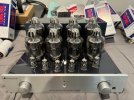
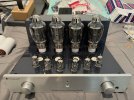
A test fit using a high quality TUBEMONGER NOVIB OCTAL NOS GE-USA OMRON-JAPAN Socket Saver© with Vibration Reduction Base. I will power the Amp on later as I am Upgrading the Mundorf MCap EVO Silver Gold Oil (two front Gain Tubes) with either Mundorf MCap Supreme Silver Oil or V-Cap ODAM. Will test the Mundorf MCap Supreme Silver Oil with 200+hrs burn in.

KT170PLb.jpegKT170PLa.jpeg
 
Back
Top Bottom