Another Radford S90 Owner
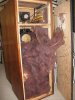
I have a pair of Studio 90s that I built from kits in 1975. They are still working, still sound great. The cabinets weigh 110 pounds each, not especially portable, and as big as a fridge. Mine are full of 16 ounces of english lambs wool (came with the kit), hand carded to uniform fluffyness and stuffed carefully into the cabinets by yours truly - a task that consumed eighteen hours, I recall. I used high density particle board (K5?), but many were built of 1/2" birch plywood. I was poor at the time, chipboard was cheap and I wasn't convinced I could hear the difference.
The tweeter is a Phillips unit, very high quality. The mid-range was always criticized as these speakers' weak point, but there is an adjustment for mid-range response on the crossover, so you can, theoretically, adjust mid-range response to our ears/room. I've never bothered. I've heard a comment about the transmission-line bass enclosure muddying the bass response. Myself, I don't think so. I have always found them to be a very natural sounding speaker. They are very efficient, it doesn't take too much power to drive them. I was positively shocked to hear them driven by a little old borrowed Sugden A21, 20 watts per channel, class A. Fantastic. Every time I've brought better equipment home, the Radfords reveal their high quality and rise to the occasion. I'm still learning how good these things can sound after 32 years of using them.
I brought home new speakers, once, that had sounded great in the shop, but when I got them home and compared them to my old Radfords, I couldn't listen to the new ones. I took them back. The only reason to replace these is because they are so big, or when they eventually die.
I'm thinking I ought to replace the XO caps, but it wouldn't be because I don't enjoy what they sound like now.
$200 is a steal for this level of sound quality. On the other hand, don't go overdriving them, because you probably won't find replacement drivers. Having said that, I know of a guy in Calgary who claims he has a few leftovers from a speaker business.
If I remember correctly, the kits cost about $550 in 1975: drivers, crossovers, a bundle of wool, and a brochure with dimensioned drawings. Couple of buddies and I bought three kits to grind the price down a bit.



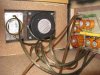
 By the number of screws that have been replaced you can tell that someone has been fiddling with them a bit. That add-on supertweeter is another clue (and I think I remember seeing some stray wires). I'd open them up and recap them and check that everything is in order. I did see some crossover diagrams for these on the net somewhere, so you should be able to compare what you have to that and put them back the way they should be.