• The move to the new server is done. There are some software and database maintenance updates in process. This has us passing the hat around to help out. We appreciate any donations. Seriously, even a dollar helps. The payment page may be found here - https://www.audiokarma.org/support.html

RCA MI-112182 Monoblock Tube Amps

Damn, hit a bit of a setback with this thing. Had it at 2/3 B+ voltage on the variac, everything looked great. Gave it full voltage to test the regulated screen supply and I hear a very loud BZZZZZZZTTTTTT. Was using a 750 watt halogen DBT to provide some current limiting for dead shorts, and it lit up bright -- not a good sign. I suspected a plate transformer internal arc-over and confirmed it using the variac -- now the insulation is damaged and it starts to arc at 60 volts on the primary. Drives my oscilloscope display crazy and smells foul.

Hammond 718 plate transformer is a drop-in replacement, albeit with somewhat reduced secondary voltage (625-0-625 as opposed to 720-0-720). However Hammond rates their secondary voltages at full load and they are 115v primary, so all said and done I think it'll be relatively close. The other option would be to go 1500 vct, but honestly for the sake of all the insulation in this thing I'd rather err on the low side.

Unfortunately I think this means I'm going to replace the plate transformers in both amps, cus now I don't trust the other one (and I want them to match).
 
What really amazes me is that RCA built anything with a 6550 tube! That is tantamount to admitting defeat to their vaunted 7027A tube (and of course, in the end it was defeated). RCA basically had to be nearly bullied into including the 6550 in their Receiving Tube Manual, and finally relented with (to the best of my knowledge) it first appearing in their 1971 RC-28 manual -- and this for an unbelievably popular tube since it first appeared in 1955. The competitive smugness between the tube manufacturers of that day was just incredible. They did the same thing with the 7591, which they copied to produce their 7868.........

This is not to say or imply, or even suggest anything I might personally have against RCA or their products. I have nothing against them at all. But the General -- being who he was -- was competitive virtually to a fault, so he would only relent if he was forced to if there was no other way out.

Very neat amps -- with their part making for a great chapter in the history of audio amplifiers.

Dave
The only RCA engineer I know with an interest in these amps liked the 6550 better. Swapping the 0C3 for 0D3 was required, but at elevated power, the 6550 screen current pulls them out of regulation. There were semi-contemporary PPP RCA amps that ran the 6550 also. Later inception than the '282 in fact.

A 5R4 offers next to no delay in conduction. B+ rise is effectively the same as SS. You'd need more heater current, an additional socket, and a pair of damper diodes to get warm up comparable to the IDH power tubes. In this case of competing with the performance of a 5R4, a pair of 6W4 would be quite adequate.

Douglas
 
On one of my MI-12188As, one of the leads from the choke cracked and started to arc to the chassis. I sleeved it with heat shrink to repair. Maybe double check where the arcing is happening, you might get lucky.
 
Yeah, unfortunately I'm pretty much certain it's internal cus I replicated it a bunch of times and don't see anything externally. Also I did check the leads pretty carefully when I re-crimped them and they are in all in fine condition. But I am gonna pull the end bells off and see if I can find where it's arcing.
 
Yeah, unfortunately I'm pretty much certain it's internal cus I replicated it a bunch of times and don't see anything externally. Also I did check the leads pretty carefully when I re-crimped them and they are in all in fine condition. But I am gonna pull the end bells off and see if I can find where it's arcing.

Yes if it arcs when it's removed from the amplifier and the end bells are off, you can probably condemn it. I guess these things are becoming ancient, but it's a shame! I had to replace the power transformers with Hammonds on some Heathkit W3s not so long ago. I made adapter plates out of 1/4" aluminum plate, so that the chassis wouldn't need to be drilled.
 
at least power transformers are not a huge issue to sub. Much less difficult than finding a specific output transformer or having one re-wound to precise specs if you don't want to re-engineer the feedback stuff.
 
I got lucky that Hammond has something even roughly approximate. The mounting holes are threaded and it's a steel chassis so I'd rather not re-drill. Also it's pretty difficult to find anything stuff above 1000ish VCT these days since choke input full wave supplies have fallen out of favor.
 
Inserts. It's a nicely done chassis and very robust. No flex whatsoever. Certainly can't say the same for Hammond's 18 gauge steel...
 
industrial gear tends to be built like they mean business. I appreciate it, even if the cosmetics leave a bit to be desired but its not everyone's preference.
 
It occurs to me that the initial arcing might have been caused by excessive capacitance. Went from 47uFs in series to a single 80uF 800v film cap. It is a choke input supply, and I'm having trouble finding max capacitance specs for the 5R4GY in choke input configuration. Don't see any for the 5U4G either. Curious if anyone has heard of these values or if there isn't really a max capacitance for choke input configurations. In any case, I'll probably switch to SS rectification on these to be safe. Would also allow me to disconnect the 5V heater winding from HV and reduce the risk of any insulation issues with the heater transformers. I think all the iron in this thing got pretty wet.

I also picked up a spare UTC CVP-3 on Ebay in case I have any OPT issues. Not super pricey iron since it's meant for PA use.
 
In hind-sight, megger testing the power transformer at the start may have indicated if there was some level of insulation leakage, which could then have been the root cause.

However there may still plausibly be two other reasons for your failed transformer imho. The 5R4 could have been arcing and that then stressed the transformer secondary insulation - in which case adding some ss diode protection in series with the 5R4 may have saved your power transformer (including any new transformer). Another aspect is perhaps to megger test the choke to at least 1kVdc from winding to core, as it could also arc and then stress the power transformer (including any new transformer).

I'd also be cautious if using the S5019, and suggest also using the modern 3x 1N4007 in series with each 5R4/S5019 anode mod.

I had a look at the 5R4 datasheet and attempted to reverse engineer the hot turn-on current rating - with discussion in https://dalmura.com.au/static/Power supply issues for tube amps.pdf - I note that the 5R4 datasheet applies a lower limit on maximum initial levels unless a 10 second heater pre-heat is used.
 
Very interesting, I will check the article out. I really do need to buy a megger/hipot tester but unfortunately don't have one yet.
 
If its choke input, the cap value won't really matter all that much. The choke itself is what determines inrush current.

You can model it in PSUD if you wanted to, need to feed it the voltage and ohm readings of the power transformer as well as the specs on the choke but it will scream at you if the inrush exceeds datasheet values.
 
Good idea. PSUDII doesn't seem to think it's an issue. Don't have the amp on hand (vacation), but I plugged in a range of values covering anything realistic and none triggered the inrush warning with an 80uf cap.

Still not exactly sure what to do about the transformer. I'd like to be able to run tube rectifiers if possible, but the replacement PT from Hammond lowers the plate voltage substantially; probably too much for a tube rectifier. I should reach out to Heyboer to quote another with the exact same dimensions and secondary.
 
On my MI-12182's I also have 80uF after the choke and I haven't noticed any arcing in the 5R4GY's. I am also running a thermistor but several times I have switched the amps off and back on again after 30 seconds or so and no problems.

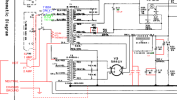
Sorry to hear about the plate transformer. I mentioned previously that I added some capacitance on the choke input to get rid of mechanical hum in the choke. The 0.57uF that I added raised the B+ voltage from 570v to about 600v. Maybe you could tailor this choke input capacitance to partially compensate for the replacement transformer's lower secondary voltage?1715869310524.png
 
Last edited:
On my MI-12182's I also have 80uF after the choke and I haven't noticed any arcing in the 5R4GY's. I am also running a thermistor but several times I have switched the amps off and back on again after 30 seconds or so and no problems.

Sorry to hear about the plate transformer. I mentioned previously that I added some capacitance on the choke input to get rid of mechanical hum in the choke. The 0.57uF that I added raised the B+ voltage from 570v to about 600v. Maybe you could tailor this choke input capacitance to partially compensate for the replacement transformer's lower secondary voltage?View attachment 3202310

Good to know that you haven't had issues with 80 uf after the choke. I have also been thinking of adding a thermistor to the plate transformer only.

Adding capacitance across the choke would be a good idea, but ultimately I decided to just order exact replacements (wound for 1420 VCT secondary) from Heyboer. Barely more expensive than the Hammonds I was going to use and it'll be nice to have things closer to original. Bit of a lead time so I'll come back to these at the end of the summer.
 
Hey, I got two this rca mi 12182a monoblocks, I’m trying to work on them but unfortunately I don’t have the schematic. Can you please help me with a copy of you still have it. Thank you
 
Google came up with this as the first search result. Not sure if the "a" version is much different but this is at least something to compare to.
 
Back
Top Bottom