• The move to the new server is done. There are some software and database maintenance updates in process. This has us passing the hat around to help out. We appreciate any donations. Seriously, even a dollar helps. The payment page may be found here - https://www.audiokarma.org/support.html

Realistic 210 reborn (AKA Acrosound UL120)

You are correct, I typed in 100v, instead of 140v. The diode was soldered with short leads to the ground buss (`1/8" rod) and a terminal strip.
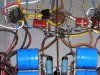
so some heat sinking took place. Diodes in the center
P1010012.JPG
 
Last edited:
Hi guys,

Dave: thanks for your comments. I did that graph some time ago manually and I remember having difficulty reading the output voltage of the amp at low frequencies.
The new plot is done digitally so clearly the amp has no roll off in the lows.

For the 12AU7 grid protection, I think I am going to experiment with the NE2 bulb.
It never thought about the capacitance of a blocked diode would have an effect, but it is certainly there.
I have to do some research to find out if that bulb has no capacitance, as 2 electrodes in gas makes a rudimentary capacitor.
 
It won't be zero, but given the fairly wide element spacing and relatively small surface area it shouldn't be significant.
 
I have to do some research to find out if that bulb has no capacitance, as 2 electrodes in gas makes a rudimentary capacitor.

FWIW, the NE-2 bulbs I bought recently from Digikey (type A2B) don't even register on my DVM. It reads as low as 1pF. Also, the driver circuit I used them in exhibits response well beyond 100 kHz, and there's no indication the bulbs have any impact. I'm fanatical about things like this, and I wouldn't have used them if I even suspected there was any audible risk.

Jack
 
FWIW, the NE-2 bulbs I bought recently from Digikey (type A2B) don't even register on my DVM. It reads as low as 1pF. Also, the driver circuit I used them in exhibits response well beyond 100 kHz, and there's no indication the bulbs have any impact. I'm fanatical about things like this, and I wouldn't have used them if I even suspected there was any audible risk.

Jack

Great to know. Thank you. I have a Sencore LC102 and will measure it when I get them, then give it a try.
I think to see them lighting up at startup is super cool.
 
Quick update:
I installed NE2 bulb on a solid state PS ULII and indeed, the bulb light on for 6 seconds upon startup.
So this solution works great. Thanks TriodeLuvr.
I used to use diodes, but I think I prefer the neon light for nostalgic and visually appealing effect :).

While I was there I wanted to check also the same on a tube rectifier ULII. I wasn't sure the online time period of the rectifier would be the same or close to the driver tubes.
The result is... no glow. So all the tubes come online pretty much together so it's an happy family startup.
All right, now I am sure.

I'll retrofit the neon bulbs on the UL120, maybe reducing the stability network caps a bit, if I feel like it as I can't hear the difference honestly.

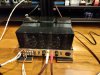
So I put back the black UL120 on the bench and set back another little black Acrosound critter, the one I always come back to, no matter what.
Gosh that tiny thing beats then all.

IMG_20220207_185257.jpg
 
Ok I installed 4 NE2 to each sections of the 12AU7 and it works beautifully.
It takes close to 8 seconds before they stop glowing.

I settled for a 56pf for the RC network.

It's a really good sounding amp, not fatiguing and super clear and detailed.

I played it quite loud and blew (quietly) both F500mA amp fuse at the CT OTs, so I upped to F750mA.
So far so good.
And this amp with EH 6CA7EH is the best combination I've tried.

I am happy how it looks and sounds.
 
That's great! My only concern might be the fuse issue. Someone correct me if I'm wrong, but 500mA isn't a small fuse for a pair of 6CA7s. I would want to double-check this amp with a 100 Mhz scope or (preferably) HF spectrum analyzer to be sure it doesn't have an intermittent oscillation.

Jack
 
I see what you mean but I doubt it is.

I've tried many fuses in other amps and for a pair of EL34, it is common to blow a 500mA. 750mA is usually what's work.

It's amazing as on the bench, you can get the to clip for a long time, and the fuse holds.
Then on real music, not even at clipping level, you blow one in 2 minutes. Funny.
 
I see what you mean but I doubt it is.

I've tried many fuses in other amps and for a pair of EL34, it is common to blow a 500mA. 750mA is usually what's work.

It's amazing as on the bench, you can get the to clip for a long time, and the fuse holds.
Then on real music, not even at clipping level, you blow one in 2 minutes. Funny.

That's called crest factor. Musical peaks can be 20dB (100 times) average level, and more, for short periods.

If the fuse was a slow-blow, it probably wouldn't blow.

Regards,
Gordon.
 
That's called crest factor. Musical peaks can be 20dB (100 times) average level, and more, for short periods.

If the fuse was a slow-blow, it probably wouldn't blow.

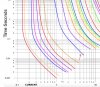
Peak power that's 20 times average music power doesn't mean it's 20 times the full output rating. How much current will a pair of EL34s draw in this amp at clipping? The chart below is from Bussman; the blue curve (red arrow) is a 500mA fast blow AGC fuse. According to this, the fuse will require more than two seconds to open, even drawing a full amp of current. One amp into a pair of EL34s represents something in excess of 400W, unless the power supply is collapsing. Even accounting for power transferred to the speakers and power lost to the output transformer, this would be extreme. Even at 500mA - more than the tubes can withstand - the portion of the chart I cut off in this crop shows the fuse requiring more than 1,000 seconds to blow. I'm not as experienced with the vagaries of EL34s as some others here, but this is why I'm skeptical.


500mA  AGC Fuse.jpg

https://www.eaton.com/content/dam/e...c-fast-acting-glass-tube-fuses-data-sheet.pdf
 
Back
Top Bottom