• The move to the new server is done. There are some software and database maintenance updates in process. This has us passing the hat around to help out. We appreciate any donations. Seriously, even a dollar helps. The payment page may be found here - https://www.audiokarma.org/support.html

Rebuilt idler wheels: can incorrect DUROMETER affect platter speed?

monkboughtlunch

Super Member
In theory, the size of the idler doesn't affect platter speed. But does durometer -- the grade of hardness of the rubber -- affect driven platter speed?

I had an ancient petrified idler wheel rebuilt, and the best speed I can dial in on a ROK idler using the pressure adjustment is 1.5% too fast. Could an incorrect durometer used in a tire rebuild account for such a speed overrun?
 
Last edited:
Register to hide this ad
Theory and reality often differ. Think of it this way: Practice molds theory. After the practical reality is achieved, theories get developed.

I can tell you the size and quality of rubber can easily both affect speed. Do you know if you can adjust the speed underneath your unit ? Many ROK tables can be speed tweaked by idler tension and some even have an adjustment...Then, there is the fact that your power line could have 124VAC available, when the motor was designed with 115 to 117VAC. Did you use a lighter than specified oil or change the bearing ? Please check for the idler tension adjustment and keep us informed. There are literally many dozens of serious ROK collectors on this forum....
 
Theory and reality often differ. Think of it this way: Practice molds theory. After the practical reality is achieved, theories get developed.

I can tell you the size and quality of rubber can easily both affect speed. Do you know if you can adjust the speed underneath your unit ? Many ROK tables can be speed tweaked by idler tension and some even have an adjustment...Then, there is the fact that your power line could have 124VAC available, when the motor was designed with 115 to 117VAC. Did you use a lighter than specified oil or change the bearing ? Please check for the idler tension adjustment and keep us informed. There are literally many dozens of serious ROK collectors on this forum....

Hi tubeactive,

Turntable is a Rek O Kut B12 GH. Hysteresis motor locks on to the mains frequency for precise rotation velocity.

I am able to achieve precise platter speed (confirmed via a KAB speed strobe AND by Turntabulator iphone App) via an aftermarket idler using an O-Ring. But the aftermarket O-Ring idler has a bronze bushing a hair too large. It was made in Italy and I think they rounded up to millimeters instead of using fractions for the bushing size that ROK apparently used back in the day.

So, I thought I would have an actual original ROK idler wheel rebuilt as the bronze bushing in the US made idler wheel has a tighter tolerance for the apparently US customary (non-metric) sized shaft than the Italian O-Ring metric-based aftermarket idler wheel. Tighter tolerance bushing means less chatter.

So, I got the authentic ROK idler wheel rebuilt and installed it.

1.) I adjusted the idler pressure throughout the full range via the hex nut under the speed selector knob. At no point through the range was I able to achieve speed better than 1.5% too fast with the rebuilt ROK rubber idler wheel.
2.) I used specified oil for idler shaft and platter bearing SAE 20 (3-in-1 blue).
3.) Power line not an issue as this has a hysteresis motor and is immune to voltage fluctuation.

So, I'm left scratching my head. The Italian aftermarket idler (which has bronze bearing, an acrylic core and a rubber O-Ring) can be dialed in for precise speed at 33, 45, 78 using the idler pressure adjustment. But the authentic ROK idler wheel which I sent off to have rebuilt drives the platter 1.5% fast (best case).

Both are roughly 2.5 inches in diameter. The o-ring is a little thinner and of course is curved whereas the ROK rebuilt idler is flat where it contacts the platter.

I'm thinking a possible significant variance is the durometer of the rebuilt authentic ROK rubber idler wheel vs the aftermarket Italian O-ring idler wheel. Could durometer variance be the root cause why one is accurate and the other is not? I'm thinking the rebuilt ROK idler is not rebuilt to factory spec, as 1.5% fast would have surely been out of tolerance as these were used for broadcast applications back in the day.

 
Last edited:
Is there a name for the Italian aftermarket idler? How to order it? And do you think it's worth it since you say speed stability is spot on? Thanks. Norm
 
It may be audiosilente, he's in Italy and does them along with several other branded companies tables.
 
If theory and practice differ, the theory is wrong or incomplete. My guess is that with equal sized shafts against a rubber wheel with the same loading, the durometer probably doesn't matter. OTOH, a small motor shaft and large platter or whatever, will deflect the rubber differently, changing the drive radius, and the speed won't transfer exactly. No idea if that's the problem.
 
Is there a name for the Italian aftermarket idler? How to order it? And do you think it's worth it since you say speed stability is spot on? Thanks. Norm

The Italian one I bought that is extremely precise (per my tests using a KAB speed strobe and Turntabulator iPhone app) is made by a company called "Torqueo Audio."

Search for the following and you should be able to find it:

"RUOTA PULEGGIA "TORQUEO AUDIO" TURNTABLE IDLER WHEEL for - REK O KUT"
 
Has anyone here modified the edge of the standard idler wheel by putting a groove in it and then just putting an O ring on it to mimic some of the aftermarket idlers out there. The torque seems expensive but on the other hand sometimes quality costs. Norm
 
The nice thing about the O-Ring idler wheel approach is that if you keep your bronze bearing oiled, the wear item is the O-Ring which can be easily and quickly replaced by hand in seconds with a new cheap O-Ring. No more sending off idler wheels and waiting weeks for $40 tire rebuilds.
 
Hi tubeactive,

Turntable is a Rek O Kut B12 GH. Hysteresis motor locks on to the mains frequency for precise rotation velocity.
well, yes and no. The mains frequency isn't a pure velocity as the motor sees it. It is a fast velocity at latch, a slow velocity at stall. over a given period it will rotate as many times as it was built to.
ie a 24pole PM synchronous will rotate 300 times in one minute. however 12.5 times a second it is faster and slower VVVVVVVVV. What is in contact with your platter is seeing that also, so there has to be some stick/slip/stick/slip. The momentum of the platter should smooth the peaks and valleys of the velocity differences to "average" a speed. your question is spot on. The one that keeps time
has a better stick/slip surface
 
The speed of the platter is determined by the diameter of the drive (I understand it is adjustable). However, the softer durometer will end up making the "effective" drive smaller as it will compress, and thus actually be at a different diameter, thus a different speed.
 
I thought the outer diameter of the idler would not affect the turntable speed but rather it is based on the motor shaft and idler shaft diameters. Am I wrong about this? When I think of an LP the outer most groove actually has to cover a greater distance in one rotation compared with the innermost groove, but both are at 33 1/3 RPMs. I. think I am getting confused? A little help please. Thanks. Norm
 
your question is spot on. The one that keeps time has a better stick/slip surface

Thanks for explaining the stick/slip phenomenon. This is quite fascinating and I was not aware of this.

Is there a standard durometer grade that is considered optimal for best stick/slip performance?

My take away is that the rubber durometer being used to rebuild ROK idler wheels today may be incorrect and lead to a speed overrun.

Does anyone here know if ROK ever published the exact specs (including durometer) for their idler wheels back in the day?
 
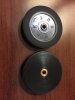
Here are comparison photos (including measurements) of a vintage ROK idler wheel rebuilt with new rubber vs Italian aftermarket O-Ring idler wheel specifically designed for a ROK B12-GH. Again, the Italian idler wheel runs dead on speedwise, and the ROK idler wheel runs about 1.5% fast.

IMG_8981.jpg

Below:
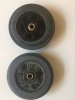
Note differences in surface reflectivity of the rebuilt ROK wheel (left) and Italian O-Ring wheel (right). The rebuilt ROK is coarser to the touch and the Italian O-Ring is smoother to the touch.

IMG_8988.jpg


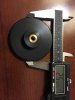
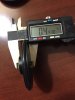
Below: The rebuilt ROK wheel is 2.4995 inches in diameter
IMG_8982.jpg

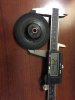
Below: The Italian O-Ring idler wheel is 2.5025 inches in diameter

IMG_8983.jpg

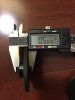
Below: rebuilt ROK idler height = 0.5015 inches

IMG_8984.jpg

Below: Italian O-Ring idler height = 0.4930 inches

IMG_8985.jpg

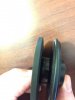
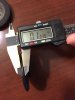
Below: rebuilt ROK thickness of contact surface = 0.1770 inches

IMG_8987.jpg

Below: Italian O-Ring thickness of contact surface = 0.1330 inches

IMG_8986.jpg
 
I would add that of all the photos I posted, this photo below best illustrates the difference in rubber surface texture between the two wheels and may align with what @marcmorin noted about optimal "stick/slip" surfaces to achieve correct speed.

The ROK instruction manual for setting correct idler pressure precisely aligns with the Italian O-Ring idler wheel's performance. For example, the ROK instruction manual states when setting pressure to slide the switch shaft 1/16" of an inch to the right after the platter starts moving. When this approach is followed with the Italian idler wheel, the speed is virtually dead spot on accurate.

Below: Rebuilt ROK idler on left and Italian O-Ring idler on the right.

IMG_8988.jpg
 
Last edited:
I thought some of you might find this interesting... Note the differences in the bushings on two of the idlers. The inner diameter on both is the same. The rubber on the one with the thicker bushing also has more of a beveled edge, making the contact surface narrower.

IMG-1664.JPG IMG-1663.JPG
 
I thought some of you might find this interesting... Note the differences in the bushings on two of the idlers. The inner diameter on both is the same. The rubber on the one with the thicker bushing also has more of a beveled edge, making the contact surface narrower.

View attachment 1247137 View attachment 1247136

Before you send them off for a rebuild, can you do a quick speed test on each and see how they each perform?
 
Before you send them off for a rebuild, can you do a quick speed test on each and see how they each perform?

They're both on their way for rebuilding, but the one with the thicker bushing ran slowly. I have a third idler wheel still at home... I'll take a look later and see if it's the other kind.
 
Further observations between the rebuilt ROK idler wheel and Italian O-Ring idler wheel. My hat goes off to the guy who designed the Italian idler wheel. In terms of speed accuracy, his wheel delivers excellent performance. I suspect the Italian wheel could be slightly improved with a more accurate bronze bushing, just a hair smaller. ROK probably used a fractional-sized bronze bushing. I believe the Italian idler wheel's bronze bushing is rounded to the nearest millimeter -- which makes sense since Europe uses the metric system for the most part.
  • 1. Bronze bearing size
    • Rebuilt ROK wheel: Zero play when I try to rock it back and forth, suggesting ROK may have used a 7/32 bearing. The B12GH **loves** the idler wheel bushing in the original ROK idler wheel. There is zero chatter at 78 RPM and it's virtually quiet at 78 RPM except for the whirring of the motor itself. Impressive.
    • Italian wheel: There is very slight play, suggesting the bearing is 5.6mm and not 7/32. No audible chatter at 33 and 45 RPM. Very slight low level chatter at 78 RPM, suggesting the bearing is a hair too large and causing a very slight audible wobble at 78 RPM.
  • 2. Speed accuracy
    • Rebuilt ROK wheel: Best possible speed after adjustment 33.80 (1.4% fast). Way outside of NAB broadcast speed specs. Very poor performance and it's perplexing as to what is causing this issue.
    • Italian wheel: Speed after adjustment 33.34 (virtually exact and well within NAB specs). Very impressive.
  • 3. Rubber material
    • Rebuilt ROK wheel: more coarse, slightly "spongier" -- can be depressed a bit more with fingers
    • Italian wheel: smoother, a bit stiffer - depresses less when pinched with fingers

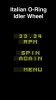
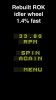
Below: Turntabulator test results (independently corroborated with a battery powered KAB speed strobe).


itaccuracy.jpg

IMG_9020 (1).jpg

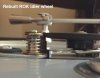
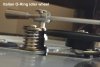
Below: Photos show where and how much surface area of each idler wheel contacts the pulley.

rebuiltrok.jpg

italianwheel.jpg
 
Last edited:
Back
Top Bottom