

You are using an out of date browser. It may not display this or other websites correctly.
You should upgrade or use an alternative browser.
You should upgrade or use an alternative browser.
Rebuilt idler wheels: can incorrect DUROMETER affect platter speed?
- Thread starter monkboughtlunch
- Start date


monkboughtlunch
Super Member
A fellow named ralphfcooke posted this interesting theory and diagram on another forum about this same topic:
=======================
By ralphfcooke:
"I suspect the difference in speed is down to the change in the effective diameter of the two wheels in use. The 'O'ring idler will indent more in contact with the smaller diameter drive wheel than the original flat edged idler for a given pressure. The same is true for the contact with the inside of the platter, but to a lesser extent owing to the larger contact area. This will effectively turn the idler into a 'speed reducing gear'; indeed ROK use this variability as the fine speed adjustment. It's the same principle as using different thickness belts to adjust the speed of a belt drive turntable.
...the pressure on the edge of the idler will affect the indentation depending on the surface area of the contact. There will be more indentation where the idler contacts the small motor spindle than there will be where it contacts the inner surface of the platter, therefore the ratio of the motor spindle to platter will not be 1:1. This will change depending on both the 'stiffness' (durometer) of the material, and the edge shape; with a circular cross section having the largest effect, and a flat contact area the smallest"

=======================
By ralphfcooke:
"I suspect the difference in speed is down to the change in the effective diameter of the two wheels in use. The 'O'ring idler will indent more in contact with the smaller diameter drive wheel than the original flat edged idler for a given pressure. The same is true for the contact with the inside of the platter, but to a lesser extent owing to the larger contact area. This will effectively turn the idler into a 'speed reducing gear'; indeed ROK use this variability as the fine speed adjustment. It's the same principle as using different thickness belts to adjust the speed of a belt drive turntable.
...the pressure on the edge of the idler will affect the indentation depending on the surface area of the contact. There will be more indentation where the idler contacts the small motor spindle than there will be where it contacts the inner surface of the platter, therefore the ratio of the motor spindle to platter will not be 1:1. This will change depending on both the 'stiffness' (durometer) of the material, and the edge shape; with a circular cross section having the largest effect, and a flat contact area the smallest"
monkboughtlunch
Super Member
So if the above theory is correct, the implication might be that the durometer grade of rubber selected and used by some wheel rebuilders today is incorrect and doesn't indent as much as the original rubber ROK used 50 years ago, thereby preventing the newly rebuilt wheel from properly acting as a "speed reducing gear" via ROK's speed adjustment system.
ROK's primitive (but functional) speed adjustment on the B12GH is based on simply increasing or decreasing pressure between the idler wheel and motor pulley -- making the idler wheel a speed reducing gear.
ROK's primitive (but functional) speed adjustment on the B12GH is based on simply increasing or decreasing pressure between the idler wheel and motor pulley -- making the idler wheel a speed reducing gear.
Last edited:
monkboughtlunch
Super Member
For those who may not be familiar with the ROK B12GH, here is how the speed is adjusted via idler pressure. Basically, a nut is loosened and a shaft is slid to either increase or decrease pressure between the idler and motor pulley/capstan.

Hello. Very interesting stuff. I would like you to look at my thread from 2015.
http://audiokarma.org/forums/index....-the-idler-wheel-matters.634920/#post-8422954
Robert.
http://audiokarma.org/forums/index....-the-idler-wheel-matters.634920/#post-8422954
Robert.
monkboughtlunch
Super Member
Hello. Very interesting stuff. I would like you to look at my thread from 2015.
http://audiokarma.org/forums/index....-the-idler-wheel-matters.634920/#post-8422954
Robert.
Hello. I agree with all you guys are saying. I was trying to point at slight different problem. In Rekokut and maybe other idler turntable using too soft wheels outside original specification will not allow for correct speed of the platter. This situation is similar to using belts with different thickness in belt drive design which changes an actual radius of spindle. There was a great thread here or on Vinyl Engine forum where it was proven using mathematical formulas. I think that Lencos and Thorens are indifferent for wheels stiffness due to design. Robert.
Thanks for posting this. You make great points.
Rek O Kut tables with an idler pressure adjustment to control speed may be much more sensitive to "incorrect" idler wheel rubber durometer/compliance than other period turntables like a Thorens TD 124 or Garrard 301.
A Garrard 301 or Thorens TD 124 uses a magnetic eddy brake to fine tune speed. I would imagine if a Garrard or Thorens idler wheel was rebuilt with an "incorrect" durometer rubber, the eddy braking speed control knobs on the Garrard or Thorens might have enough variance to still dial in an accurate speed.
In contrast, since the Rek O Kuts don't use magnetic eddy braking, there is probably a much narrower durometer "sweet spot" for the ROK idler pressure adjustment control to dial an accurate platter speed. I'm basing this on your illustration in the below post.
monkboughtlunch
Super Member
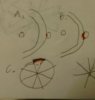

ConradH
Lunatic Member
It's not durometer alone. Think in terms of a change in radius on the wheel. If the original had a flat edge, it would act stiff even with a low durometer rubber. The o-ring has a much smaller contact patch, so deflection will be greater for the same pressure- shorter radius to the contact patch. We need an inflatable idler! Speed adjust via bicycle pump!
monkboughtlunch
Super Member
My understanding is the durometer of the rebuilt ROK wheel may be 65. Not sure yet what the durometer of the Italian O-Ring model is.