• The move to the new server is done. There are some software and database maintenance updates in process. This has us passing the hat around to help out. We appreciate any donations. Seriously, even a dollar helps. The payment page may be found here - https://www.audiokarma.org/support.html

Record cleaning fluids

Chet63

Active Member
hello,

i am using couple of commercially made record fluids, one is bought in germany conrad store, called antistatic cleaner, and the other one i bought at record store, it says on the bottle it is made of deionized water, surfactant and antistatic agent...clean them with micro fiber cloth manually...

after using both of them, i think they give me some positive results, but after each playing stylus is full of dirt...i'd like to know, is it dirt from the grooves, or both liquids leave some residue which stylus pick up? i can say, after applying those fluids i hear less static from my records, but i have doubts about longer term safety for the records and stylus as well...if they are picking up dirt from the records, i am fine with it...

i am talking about brand new records, they are usually so full of static electricity and dirt from the factory...
 
Register to hide this ad
Simplify your life.
Get a HumminGuru ultra sonic cleaner. Just add distilled water. Nothing else.
I always run a new LP through the 'Guru. Used records usually get the long wash (10 minutes).
If by some chance I received a filthy LP I'd go the manual route, then into the 'Guru.
 
If you are only using a microfiber cloth to clean the vinyl, you are only wiping the record surface at the top of the grooves. You aren't getting down into the bottom of the grooves where the needle rides. It doesn't surprise me you see dirt on the diamond. Ultra Sonic is a great choice, or get a natural fiber brush like a horsehair shaving brush or a paint pad and use that with the cleaning solution, then a rinse with distilled water. That should give you better results. A vacuum would give you an even cleaner record because it completely removes the dirt, cleaning solution and water from the grooves.
 
After applying your fluids, wiping with a microfiber cloth will more than likely result in much of the fluid being pushed down into the grooves and accomplishing nothing aside from leaving your stylus with a bunch of gunk to have to dredge out of them upon playing the record. That is why, most likely, you are seeing the crud on it after playing your record. If you really want to learn about how to clean a record properly, take some time to read the thread in the stickies called "Record Cleaning: Developing The Best Possible Methods" and then you will be far more able to make good choices about how to get cleaner records. Aside from that, as has been said by @noisefreq, get yourself a paint pad brush and wash the records in the sink and you'd be better off....take care not to get the labels wet, but otherwise it will not leave the gunk you're dealing with now. Understand that this is a very basic, low-cost method and will not get you optimal results, just better than what you are doing now.
 
I use the industrial ultrasonic cleaning solution that we use at work. Its called Mega-Clean and is blue. Safe for all pretty much all materials. I tried to find it online and it seems there is a lot of different cleaners with the same name. I know we pay about $90 a gallon for it. I use about 60ml in 6L of distilled water. I run them at 35C for about an hour. After ultrasonic cleaning, they get a rinse with distilled water to get the remaining soap off in the Spin Clean and then dried with lint free cloth. If the record is really dirty, I'll give it a mechanical clean in the Spin Clean first, using the same solution of surfactant and distilled water.

I've come to this method by reading the "How to clean your vinyl" thread here and my own experimentation. I've turned into a picky vinyl listener now. A properly cleaned record will not have any noise, and now when I hear it all I can think is how badly the poor thing needs washed.
 
Keep it simple and be vinyl clean conscious.

Being a vinyl disk user since I was a little kid and with a collection of over 7000+ disks I realized ultrasonically clean vinyl was the only way to go.
Forget dry brushes, small tubs or any other method other than the ultra sonic methods. Dry cleaning methods are always endorsed by those who have limited knowledge as they just move dust and debris around additionally increasing static-charges.

By 2009 I began my dedicated vinyl cleaning journey by purchasing a VPI 16.5 vacuum machine. It worked wonderfully compared to my early-on simple dry cleaning methods and started enjoying the benefits of clean disks. It prompted me to move on and get serious by doing the proper research. I scoured hundreds of web sites and read countless articles mostly written by the high-end world of experience. As a side note, I purchased the first 'DiscWasher'' when it came out around 1977 or so.
Early 1970's I used the "Dust-Bug" and the "Disk-Preener" and any manner of available reasonable cost methods that promised it would work. On a low budget for insane reasons in '03 I bought a Technics 1700 just to turn disks around as I tried different brushes and methods but, the end result was poor. During the same period I was upping the quality of my system so I was torn in a vintage Hi-Fi sort of way.

By 2014 I bought into using the ultra sonic vat and a spinning spindle cleaning method.
Although I did manage to clean about 3500+ records, presently I’m still enjoying my labors.
And though much of that big number of disks are good condition used disks, the ultra sonic method has yet to be equaled.

If you asked, I’d say forget about those high price cleaning models and go for the lower cost practical method of a simple tank where you can clean up to 10 or so disks at one time, though I usually clean 5 to 7 at a time depending on their condition.
I use distilled water, 1.5 to 2 oz. of 91% alcohol, and 1.5 oz. of Ilford ‘Ilfotol’ as a wetting agent. Either air dry or use a small low rpm fan in a dust free area.

In my opinion, I feel those big cost ultra sonic machines are simply money making methods for those who make them. A simple machine along with common sense diligent methods work the best and will quickly get you back to listening and, to all the personal enjoyment using clean vinyl affords.*

Understand a badly scratched or damaged disks will never improve so, strive to purchase well inspected good condition used records.
I’ve have become so pleased with my simple and quick methods and understand how important it is that of course I clean ‘new’ disks as ultrasonic cleaning also helps alleviate static charges. I always use new poly/paper inner sleeves and use new plastic covers for the outer jackets.
Additionally, I attach a post-it note indicating the condition of the disk, when purchased, if any cleaning method changed and how it was cleaned.
FM

* CAUTION: I must add that hearing properly cleaned disks caused me to purchase more costly high-end cartridges.

A few headliners in my stable are the Lyra Delos, Lyra Kleos, Ortofon Cadenza Blue, Audiotechnica ART-9, and the Benz-Micro Gull-Wing so believe me when I say the words above. Understand, I would never use a cartridge costing a few thousand dollars on a damaged or uncleaned disk, period!

Below: One of two completely vintage systems I enjoy immensely to no end. All components are restored vintage items except for the new MC phono cartridges that I use exclusively. All proper cartridge set-up parameters are strongly adhered to.

Screen Shot 2025-04-19 at 5.25.46 PM.png
92
 
Last edited:
hello,

i am using couple of commercially made record fluids, one is bought in germany conrad store, called antistatic cleaner, and the other one i bought at record store, it says on the bottle it is made of deionized water, surfactant and antistatic agent...clean them with micro fiber cloth manually...

after using both of them, i think they give me some positive results, but after each playing stylus is full of dirt...i'd like to know, is it dirt from the grooves, or both liquids leave some residue which stylus pick up? i can say, after applying those fluids i hear less static from my records, but i have doubts about longer term safety for the records and stylus as well...if they are picking up dirt from the records, i am fine with it...

i am talking about brand new records, they are usually so full of static electricity and dirt from the factory...

Do you have a rinsing procedure?
 
@Chet63, as you can see, there is a pretty strong case to be made for ultrasonic cleaning, which was why I pointed you to the thread above, but if you don't want to go to these lengths I would just reiterate that your present method is highly likely the cause of getting your stylus covered with detritus. A very simple wash in the sink using a painter's edge pad is less likely to leave you with a dirty stylus but far, far less effective as you might suspect than ultrasonic cleaning. Keep in mind that neither method, the one you are currently using OR washing as I've described, will be very effective at getting dirt out of the grooves. Washing will only remove some dirt on the surface as the bristles on such a brush have no hope of reaching into the grooves. In the end, it just depends on how involved you want to get and how sensitive you are as far as noise is concerned.....if you've heard an ultrasonically cleaned record, then you know how dead silent they can be and that is certainly a treat amigo! Carry on.....
 
two things "against" ultrasonic machine for me: money and space...

i tried washing and rinsing records, even have label protectors, but it makes things worse...it looks like i am doing it wrong, or it isn't the best way to clean records...whatever formula i am using records ended up unlistenable...

at the end of the day, simple manual cleaning is what's left for me...and ended up with something from the hi-fi history...maybe it influenced my approach too much... :)

"Ivor Tiefunbrun of Linn picking up records of the floor and playing them on the Linn Sondek to demonstrate that there was no need to clean records. The stylus would clean the grooves as it played. Then clean the stylus!"
 
Last edited:
two things "against" ultrasonic machine for me: money and space...
For me, it's time. I clean a used record just prior to my first time playing it, and having gotten used to the speed and convenience of a vacuum machine (from dirty to clean, dry, and ready to play in just a little over a minute), I can't imagine switching to anything more involved.
i tried washing and rinsing records, even have label protectors, but it makes things worse...it looks like i am doing it wrong, or it isn't the best way to clean records...whatever formula i am using records ended up unlistenable...
I mostly agree with noisefreq above (I'm not too sure of the word "completely," but I sure think it works well enough), "A vacuum would give you an even cleaner record because it completely removes the dirt, cleaning solution and water from the grooves."
at the end of the day, simple manual cleaning is what's left for me...and ended up with something from the hi-fi history...maybe it influenced my approach too much...

"Ivor Tiefunbrun of Linn picking up records of the floor and playing them on the Linn Sondek to demonstrate that there was no need to clean records. The stylus would clean the grooves as it played. Then clean the stylus!"
Ivor's method worked great for me for many years, particularly with new records. With used records, I never knew what had been done to them cleaning wise by previous owners (another of Linn's cautions was, "Most record cleaning devices do more harm than good. The dust that inevitably collects on records is not harmful: it's on the surface, not in the grooves containing the signal. Attempts to remove the dust usually force the dust down into the grooves, where it does damage."), and I've gotten some pretty incredible crud on my stylus just taking them home and playing them.

I've been using Nitty Gritty fluid and brushes for a long time, now, though currently with a KAB EV-1 instead of a Nitty Gritty machine, and it seems to work great. Once cleaned, for all subsequent playings (if I don't mishandle them and get my fingerprints on the playing surface) I just take them out of their sleeves, play them, then put them back into their sleeves. When following Ivor's method, don't forget that the mat needs cleaning, too, "The felt mat can be cleaned with masking tape. If the mat becomes really dusty, you can beat it like a carpet or rug."
 
I'm in the UK and the link (in the big red box about 1/2 way down the page) is in "American" (e.g. color (US) vs colour (UK).

Some of the products are not available in the UK but there's a very helpful table of alternatives (Go to Pg 17 on) along with links to suppliers.

Hope that helps.
 
i tried washing and rinsing records, even have label protectors, but it makes things worse...it looks like i am doing it wrong, or it isn't the best way to clean records...whatever formula i am using records ended up unlistenable...
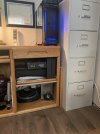
Yes, that's why I suggested that you only remove stuff from the surface of the record when doing this, but making things worse???? Hmmmmm.....yeah, I'd say there's something else that's a problem with the procedure as I've never made things worse doing it like that, which was how I started out cleaning my records but I DID, however, also vacuum them after washing so that may have helped lift some of the dirt off after it had been soaked and agitated with the painter's brush. What kind of brush were you using? If you've always been using microfiber cloths, that would be my guess where all the gunk is coming from although I guess there are some brands of those that don't shed. There are so many different theories about record cleaning, what to do, what not to do etc. etc. that it will make your head spin! My suggestion would be to re-assess your conclusions about US cleaning though......you can put together a very satisfactory system for less than $300 if you're willing to do some cobbling of pieces together. The tanks can be had for around $100 online and some even come with rotisseries (maybe not the finest quality, but usually workable). Then you need to figure out a way to dry them, and a lot of folks just get a dish rack and air-dry so there's that. As for space? My tank fits neatly on a shelf under my desk and I can pull it out whenever I want/need to clean some records. You can see it here:
IMG_6791.jpg
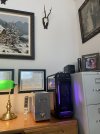
It's the silver tank with the black cord wrapped around the spigot. It stays full of the cleaning fluid so when I need it, I may add a little IPA since that probably evaporates quickest and then I'm ready to roll, just put it up on the desk surface next to the PC and ready to go.

IMG_6793 (1).jpg

However, I fully get that it's not a project everyone wants to take on and again, it just depends on how sensitive you are about what you hear......I'm one that really appreciates dead-quiet playback, which otherwise would defeat the purpose, for me, of playing vinyl at all. Others? Well, I also have a few friends who think the more crack, snap and pop and groove noise the better......seems to give them more of an "authentic record listening experience" and that's just OK by me if that's how they prefer to hear their music. Not for me, though. Lots of stuff to chew on here, amigo, and hopefully you will figure out what is causing the problems for you......carry on
 
Last edited:
Chet63, two things you might think about; if your cleaning procedure is making things worse, I believe you are not removing all the surfactant from the grooves. Like washing your hands and not rinsing them completely off, leaving them sticky. Second, relying on the diamond to plow out the crud from the grooves is going to wear out the stylus faster. I have to brush off my diamonds about every 2-3 months, if that. Record cleaning saves on styli replacement, too.
 
Last edited:
I'm quite the novice at this but a Discwasher directional brush and Audio-Technica AT634a solution are doing a good job. After brushing static is noticeable, and the Zerostat gun does a good job of removing it.

Apparently some modern "Discwasher" brushes where the package has the RCA brand are not directional any more? I got mine from eBay.

I am also planning on an ultrasonic cleaner, particularly for records bought second hand.
 
I am also planning on an ultrasonic cleaner
You will not be disappointed. Take care to get things set up properly and once again, and I know it's a long read, if you haven't read the "Record Cleaning: Developing The Best Possible Methods" thread in the sticky section of this forum, it would be a great place to start before you actually get your equipment as it may change your decisions. If you already know all of that, then nevermind.......carry on.
 
Simplify your life.
Get a HumminGuru ultra sonic cleaner. Just add distilled water. Nothing else.
I always run a new LP through the 'Guru. Used records usually get the long wash (10 minutes).
If by some chance I received a filthy LP I'd go the manual route, then into the 'Guru.
This is spot on.

With the exception of wood glue, I've tried all the methods for cleaning records. Ultrasonic is by far the best.

For a long time, I was using a setup very similar to Tima's (including the pumps/filters, dual tank setup, etc.) and followed Neil Antin's chemistry/recommendations religiously. Cleaned a lot (1000+?) records this way. Results were way better than the other methods, but it was sooo time consuming and unfun. I also couldn't shake the thought that there was more on the records I still wasn't hearing and maybe fewer clicks/pops could be achieved.

Started researching purpose built RCMs and found the Degritter best fit my requirements. As if by magic, a Mark II popped up on E-Bay at a price I couldn't resist. Being "frugal", I probably would have gone with the HumminGuru, had it been available at the time.

After re-cleaning aforementioned records and a bunch more since, here is what I found.

The convenience alone was worth the price of admission. In its simplest form, you add water, push a button, wait for the beep(s), and the record is ready to go. Some are dirtier than other and need more than one cycle. I've found that surfactant produces better results and so another cycle is needed for the rinse.

Am I hearing more and having to endure less surface noise? The answer is an unequivocal and resounding 'yes'.

Not that anyone asked, but here are a few of the lessons I've learned through painful trial and error.
  • Unless exceptionally dirty, nothing touches the record except water and surfactant
    • Never use a velour-style brush or a microfiber towel
    • "Sticky" (wash/reuse) and strand (such as the one Neil suggests) types are OK. With the sticky type, use a very light touch.
  • After each cleaning cycle, pour a bit of the water into clear glass/cup and check the debris
    • If more than a few "strands" (lint) are visible, reclean
    • If heavy concentration of particles (white specs), reclean once
      • The specs, particularly past the first clean, will predominately be vinyl
  • Replace the water between cleaning cycles
    • This and the previous point are easy with the Degritter and likely the HumminGuru, perhaps not so with the KL Audio
  • Never add heat to the water
    • Applies to general purpose RCMs
    • Degritter and AFAIK the other purpose built RCMs don't include a heat option (Degritter will stop cleaning and run the fans to cool the water if it gets above 90 (?) degrees F)
  • Incorrect cleaning procedure/solutions can permanently damage records
  • Ultrasonic cleaning does remove vinyl from the record
    • With general purpose UCMs, most of the material removed will be from the outer edge
      • Position the record so that the edge of the record is as far away from the edge of the record as possible, while keeping the grooves submerged
  • Once the record is clean, it shouldn't need to be re-cleaned unless:
    • Record player doesn't have a dust cover or it is left up when playing the record
      • Record, particularly when spinning, will build up static and attract dust
  • Avoid blowing on the record, as the fine particles in your breath will get into the grooves
  • If done properly, the stylus should not need to be cleaned
  • I only use Triton and/or Ilfotol (per Neil's recommendation) as a surfactant (less is more!)
 
Back
Top Bottom