• The move to the new server is done. There are some software and database maintenance updates in process. This has us passing the hat around to help out. We appreciate any donations. Seriously, even a dollar helps. The payment page may be found here - https://www.audiokarma.org/support.html

Record cleaning fluids

The optical microscope is a great tool to observe gross contamination on records but due to its limited resolution, it cannot detect whether any lower level of contamination is coating the sidewalls of the grooves. This requires more surface sensitive analytical techniques such as Scanning Electron Microscopy (SEM) or Photoelectron Spectroscopy (PES) as examples. The large particles observed with an optical microscope typically are responsible for the ticks and pops when playing a record. The contaminants that coat the sidewalls of the groves typically affect detail and clarity and increased background noise when playing a record.

I have analyzed numerous records after various cleaning methods that looked extremely clean with an optical microscope but had significant contamination when analyzed with more surface sensitive analytical techniques. In some of these records the top 10 to 20 nanometers contained as much as 75% primarily organic contamination. This level of contamination is below the resolution of the optical microscope but it has a significant effect on the SQ of the record.
I don't have a Electron Scanning Microscope so that is a non issue. Have you ever analyzed a record that was washed with pressurized DW? All I can say is the results using the optical scope showed much better cleanliness at that level than using an Ultrasonic Cleaner and vacuum drying. There is little doubt, the pressure washer cleans the record to the groove. There is no reason to think otherwise. If you ever pressure wash and look with an electron microscope let us know what you find.. The records sound better than they ever have. Thanks for the info.
 
Have you ever analyzed a record that was washed with pressurized DW? All I can say is the results using the optical scope showed much better cleanliness at that level than using an Ultrasonic Cleaner and vacuum drying.
I have never analyzed a record cleaned with a pressure washer. I have analyzed many records cleaned with my ultrasonic cleaner and in those cases the optical microscope always revealed a very clean surface with virtually no observable particles. In fact the ultrasonic cleaner always produced the cleanest record surface compared to any other cleaning method that I analyzed. In order to evaluate the effect of various ultrasonic cleaning parameters such as: composition of the bath solution, choice of surfactant, surfactant concentration, bath temperature, exposure time, rotation speed, rinse time, etc required using more surface sensitive analytical techniques. Except for exposure time, optical microscopy could not distinguish any significant differences by varying any of the above stated parameters even though they have an effect on SQ. The primary surface analytical technique that was used to detect differences was Photoelectron Spectroscopy (PES) and the results would typically correlate with SQ. Several other surface sensitive analytical techniques were also used to complement the PES results.

There is little doubt, the pressure washer cleans the record to the groove.
I don't see how you can make this statement without using a surface sensitive technique with enough resolution to analyze within the grooves. Without a proper surface analysis of the pressure washed record surface, the degree of contamination in the grooves is unknown.

If you ever pressure wash and look with an electron microscope let us know what you find.
I don't have any plans to pressure wash records for several reasons:
• The ultrasonic bath cleans records extremely well without any significant contamination and the SQ is great.
• The ultrasonic bath cleans records faster, typically 10 records at a time. Total time to clean, rinse and spin dry 10 records is typically less than 20 min.

Good luck with your pressure washer record cleaning method.
 
I have never analyzed a record cleaned with a pressure washer. I have analyzed many records cleaned with my ultrasonic cleaner and in those cases the optical microscope always revealed a very clean surface with virtually no observable particles. In fact the ultrasonic cleaner always produced the cleanest record surface compared to any other cleaning method that I analyzed. In order to evaluate the effect of various ultrasonic cleaning parameters such as: composition of the bath solution, choice of surfactant, surfactant concentration, bath temperature, exposure time, rotation speed, rinse time, etc required using more surface sensitive analytical techniques. Except for exposure time, optical microscopy could not distinguish any significant differences by varying any of the above stated parameters even though they have an effect on SQ. The primary surface analytical technique that was used to detect differences was Photoelectron Spectroscopy (PES) and the results would typically correlate with SQ. Several other surface sensitive analytical techniques were also used to complement the PES results.


I don't see how you can make this statement without using a surface sensitive technique with enough resolution to analyze within the grooves. Without a proper surface analysis of the pressure washed record surface, the degree of contamination in the grooves is unknown.


I don't have any plans to pressure wash records for several reasons:
• The ultrasonic bath cleans records extremely well without any significant contamination and the SQ is great.
• The ultrasonic bath cleans records faster, typically 10 records at a time. Total time to clean, rinse and spin dry 10 records is typically less than 20 min.

Good luck with your pressure washer record cleaning method.
Have you ever looked at the US cleaned record with a Electron Microscope? If so please show us the results. How could pressure washing with DW cause any contamination. In a US cleaner the dirt that comes off the record has only 3 places to go. To the bottom, suspended in the solution and floaters on top of the water. Have you ever seen a bathtub ring. That's the floaters and there is no way to keep that stuff off the record as it rotates in the dirty water. It sticks to the record like bathtub ring. but not as obvious. Using DW and filtering it as it used prevents that from happening. I suspect you use DW for rinsing. So that part must be okay.
 
Last edited:
I have never analyzed a record cleaned with a pressure washer. I have analyzed many records cleaned with my ultrasonic cleaner and in those cases the optical microscope always revealed a very clean surface with virtually no observable particles. In fact the ultrasonic cleaner always produced the cleanest record surface compared to any other cleaning method that I analyzed. In order to evaluate the effect of various ultrasonic cleaning parameters such as: composition of the bath solution, choice of surfactant, surfactant concentration, bath temperature, exposure time, rotation speed, rinse time, etc required using more surface sensitive analytical techniques. Except for exposure time, optical microscopy could not distinguish any significant differences by varying any of the above stated parameters even though they have an effect on SQ. The primary surface analytical technique that was used to detect differences was Photoelectron Spectroscopy (PES) and the results would typically correlate with SQ. Several other surface sensitive analytical techniques were also used to complement the PES results.


I don't see how you can make this statement without using a surface sensitive technique with enough resolution to analyze within the grooves. Without a proper surface analysis of the pressure washed record surface, the degree of contamination in the grooves is unknown.


I don't have any plans to pressure wash records for several reasons:
• The ultrasonic bath cleans records extremely well without any significant contamination and the SQ is great.
• The ultrasonic bath cleans records faster, typically 10 records at a time. Total time to clean, rinse and spin dry 10 records is typically less than 20 min.

Good luck with your pressure washer record cleaning method.
Don't need luck, it's science. But thanks you. I remember when US cleaning caught on, I have one and I don't believe it's the end game people say it is. For several reasons.
 
Have you ever looked at the US cleaned record with a Electron Microscope?
We have used Scanning Electron Microscopy (SEM) to analyze ultrasonic cleaned records. The SEMs were not done by me but by a colleague. I did the Photoelectron Spectroscopy (PES) analysis as well as the Thermal Desorption Mass Spectrometry (TDMS) analysis. Several of my colleagues did the Optical Microscopy, SEM and Fourier Transform Infrared (FTIR) analysis. PES is considerably more surface sensitive to contamination than SEM and is one of the best techniques to determine the level of contamination on a record surface. Only a few select SEMs were done because they are very time consuming compared to the other techniques. The SEMs were primarily used to determine whether the ultrasonic cleaning induces any damage on the record surface and to see whether there were any small particulates in the record grooves not observable with the Optical Microscope. SEM by itself cannot do quantitative or chemical analysis. However SEM combined with Energy Dispersive X-Ray Spectroscopy (SEM-EDS) can identify and quantify elemental compositions but the depth of analysis is much greater than the contaminates on the cleaned record surface. SEM-EDS was used on some samples but it was not very useful. PES was the main technique used to quantify the amount of contaminates on the record surface and the combination of PES, TDMS and FTIR was used to determine the chemical structure of the surface contaminants.

How could pressure washing with DW cause any contamination.
I never said pressure washing with DW causes contamination. The contamination that I am referring to is present in the grooves before cleaning. It is the grunge you are trying to remove.

In a US cleaner the dirt that comes off the record has only 3 places to go. To the bottom, suspended in the solution and floaters on top of the water
Yes, the removed contamination is suspended in solution, that is the one of the properties of the surfactant as long as the surfactant concentration is above the Critical Micelle Concentration (CMC). This is one of the key parameters in cleaning records. I have never had any dirt at the bottom or floating on top of my ultrasonic bath. I typically changed the bath water after each batch of 10 records. My spindle holds 10 records for each cleaning. The distilled water and surfactant were readily available in my laboratory so I always changed the bath water after each cleaning. If I did a single record or only a couple of records, I might reuse the bath water.

I suspect you use DW for rinsing
I only use distilled water in the ultrasonic bath as well as in the rinse bath. I change the rinse bath after each batch of 10 records.
 
Last edited:
We have used Scanning Electron Microscopy (SEM) to analyze ultrasonic cleaned records. The SEMs were not done by me but by a colleague. I did the Photoelectron Spectroscopy (PES) analysis as well as the Thermal Desorption Mass Spectrometry (TDMS) analysis. Several of my colleagues did the Optical Microscopy, SEM and Fourier Transform Infrared (FTIR) analysis. I have all the PES and TDMS spectra but I am not sure what FTIR spectra or SEM and optical images I might have. Except for my PES spectra, which are on a hard drive, most of this data is packed away in boxes. PES is considerably more surface sensitive to contamination than SEM and is one of the best techniques to determine the level of contamination on a record surface. Only a few select SEMs were done because they are very time consuming compared to the other techniques. The SEMs were primarily used to determine whether the ultrasonic cleaning induces any damage on the record surface and to see whether there were any small particulates in the record grooves not observable with the Optical Microscope. SEM by itself cannot do quantitative or chemical analysis. However SEM combined with Energy Dispersive X-Ray Spectroscopy (SEM-EDS) can identify and quantify elemental compositions but the depth of analysis is much greater than the contaminates on the cleaned record surface. SEM-EDS was used on some samples but it was not very useful. PES was the main technique used to quantify the amount of contaminates on the record surface and the combination of PES, TDMS and FTIR was used to determine the chemical structure of the surface contaminants.


I never said pressure washing with DW causes contamination. The contamination that I am referring to is present in the grooves before cleaning. It is the grunge you are trying to remove.


Yes, the removed contamination is suspended in solution, that is the one of the properties of the surfactant as long as the surfactant concentration is above the Critical Micelle Concentration (CMC). This is one of the key parameters in cleaning records. I have never had any dirt at the bottom or floating on top of my ultrasonic bath. I typically changed the bath water after each batch of 10 records. My spindle holds 10 records for each cleaning. The distilled water and surfactant were readily available in my laboratory so I always changed the bath water after each cleaning. If I did a single record or only a couple of records, I might reuse the bath water.


I only use distilled water in the ultrasonic bath as well as in the rinse bath. I change the rinse bath after each batch of 10 records.
You didn't answer weather you had used these methods to check how clean a record is after pressure washing. Have you ever tested this?
 
Bought a bottle of the juicy juice from Skylabs Audio. Use it with a Discwasher brush (upstairs rig)

Bought an Audio Technica brush and fluid for the downstairs rig.
 
The SEMs were primarily used to determine whether the ultrasonic cleaning induces any damage on the record surface
What was the result?
This is one of my biggest fears when it comes to ultrasonic - that it may clean a bit too well, meaning that it may also remove stuff that isn't dirt and that shouldn't be removed.
 
What was the result?
This is one of my biggest fears when it comes to ultrasonic - that it may clean a bit too well, meaning that it may also remove stuff that isn't dirt and that shouldn't be removed.

My initial experiments to evaluate several ultrasonic bath variables were done on sacrificial records that were cut into ~1 cm squares. This was done because several of the analytical techniques require this size for analysis. These 1 cm square record samples had controlled amounts of various known contaminants (oils, greases, lubricants, fingerprints and minerals from hard water) applied to them. These samples were then heated in an oven to drive off any volatile species and to promote mechanical interlocking and/or diffusion into the record surface, which would simulate aging and make them more difficult to remove. These samples were then analyzed with several different surface analytical techniques before and after various ultrasonic cleaning variables. One variable was time in the bath. For these experiments, the 1 cm square samples were suspended vertically in the ultrasonic bath for various times. So these test samples were static and not rotating on a spindle as in a typical record cleaner. Later experiments were done with the record on a spindle and rotating in the ultrasonic bath.

In a static mode, each 1 min corresponds to 3 min in a rotating mode because ~1/3 of the record is in the bath at any given time. After 1 min of static exposure ~95% of all applied contaminants were removed and after 2 min of static exposure 99% to 100% removal was observed. Longer exposure times had no positive effect but potentially a negative effect. Typically I observed some diffusion of additives to the record surface within 2 to 3 minutes exposure time in the ultrasonic bath. Within 5 minutes exposure time in the ultrasonic bath, the diffusion of additives to the record surface was much greater. Also at 5 min static exposure SEM did detect possible pit formation and some rounding of the peaks on the sidewalls of the grooves. 5 min in a static mode corresponds to 15 min in a rotating setup.

I would clarify that the effectiveness of the ultrasonic bath in a static mode is greater than in a rotating mode. I found that the speed of rotation had an effect on the cleaning efficiency. Faster speeds reduced the overall cleaning efficiency. To be on the safe side, I would limit cleaning time in a rotating bath to 9 min if one is using slower rotation speeds (1 to 4 RPM).

When I finally set up my ultrasonic cleaner, I typically had it set at about 2 RPM and a run time of about 6 to 9 mins. That corresponds to actual exposure times of ~ 2 to 3 minutes. I used 6 min for new records and 9 min for previously owned records which might have more surface contamination. I never purchased any previously owned record that had observable contamination.

I would also clarify that different ultrasonic cleaners may perform more or less aggressively compared to my cleaner and their results may be different.
 
After the year of using the vat and rotating spindle which rotated at a set speed, I felt I’d get better cleaning results at a slow speed. It simply made more sense to have more bubbles hitting each groove.
That same year the maker of my set-up offered a small black-box which could vary the rotating speeds.
Well, it improved the cleaning cycle and my end results proved it. Back when I purchased it, it was only $89. extra cost but, worth every cent.

On a motivated day, I can plow through 40+ disks a day. Again that would hinge on each disks condition.
Typically, I use about ten minutes per vat run. I’ll start early as each vat-cycle takes the allotted time plus time to allow to dry by slow-speed fan which is a few minutes only. Then inserting each newly cleaned disk in a new poly/paper sleeve and new plastic outer jacket, I also include a small note indicating date, fluid mixture amounts so I can repeat when necessary. To be honest, there’s not much of a difference by adding or subtracting either alcohol or the Ilford equivalent that I use. Also, I find the smaller sized jacket stays on the outer cover better than the 12.75 inch jackets. Additionally, I have learned that Kodaks Photo-Flo is too greasy and tend to remain on a disk, that’s why I use Ilford’s version of it.

While I’ve personally perfected my technique in vinyl cleaning, the biggest effort and stumbling issue has been vinyl storage. With so many disks and limited storage, many have ended up in vertical position on my listening room floor. I must indicate that having all of these hundreds of disks on the floor and creating a crowded situation it has also altered the actual acoustics of the listening room and as a bi-product and I’ve noticed that I do not appreciate the lessening of bass response and crowded conditions. Apparently, I didn’t think that fully out especially when in a one month period I went all out to clean as many disks as possible averaging 40 individual disks a day which led to the crowded conditions.
FM

P.S. As a plus regarding my cleaning efforts I must say that one of the quietest running in the groove cartridges is the Lyra Delos and it has added to my listening pleasure exponentially. Read the big magazine reviews as they will attest to this fact.
Below is not where I purchased my set-up but, it’s an equivalent if not the same.
P.S. II Back when I started with the US method, there were many opinions as one can usually expect but, I found the simplest methods are the best.
I also went through similar debates when I used the VPI 16.5 machine with people suggesting all kinds of esoteric special fluids, and there too I found it over blown and bordering on neurotic and with mixed results.
FM


Screen Shot 2025-09-18 at 3.47.50 PM.png
 
Last edited:
Additionally, I have learned that Kodaks Photo-Flo is too greasy and tend to remain on a disk, that’s why I use Ilford’s version of it.
Kodak Photo-Flo is a wetting agent which was developed to minimize water marks or streaks during photographic film development. It is not recommended for cleaning records. There are two versions, Photo-Flo 200 and Photo-Flo 600. They both contain the same nonionic surfactant but Photo-Flo 200 contains 30% propylene glycol and Photo-Flo 600 contains 40% ethylene glycol. Both of these glycols soften and swell PVC so they are not really compatible with vinyl records as they will penetrate the record surface and be hard to remove. This results in an oily or greasy residue.

Ilford Ilfotol is also a photographic wetting agent but it does not contain any of the glycols as in Photo-Flo. It only contains a nonionic surfactant and a preservative. So it is a better choice for cleaning records.
 
Presently retired but, was a working fotog in NYC for over 30 years so I know about ‘photo-flo’, it’s why I cautioned against its use. Though when US was becoming popular many people offered their suggestions as usual. It was the same when VPI brush and vacuum directives were hitting all the forums as everyone had their own 'special-sauce'.
However, the recommendation was only a drop or two in a 6 liter vat, but I avoided it like the plague. I never cared for it in the working photographic environment because of its greasiness be it with prints or film and never understood why Kodak was still manufacturing it. That’s why I mentioned the Ilford Ilfotol and even then, I use only 1.5 oz. per 6 liter vat.
Happy cleaning......
FM
 
Last edited:
There are times when I seek more resolution, deeper lows and higher highs along with better harmonics and any other differences to be had.
Changing to a Benz-Micro Gull-Wing while I intensely listen if there’s a actual difference.

As it goes, I’d like to think there’s an improvement but, when dealing with cartridges in this price range, sometimes the ‘listening-memory’ isn’t enough to draw a confirmed conclusion. There’s certainly a price difference from the 'ART-9'. And while I sometimes struggle to re-capture the mood I may have been in with the previously played cartridge, sometimes it alludes me. And though I attempt to consider all the specs., etc. to find a difference, sometimes I simply become consumed by the music on the platter and forget all thoughts except that it sounds terrific and I sink into the aural pleasure and that’s plenty enough.
FM
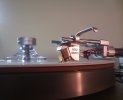
Below: Benz-Micro Gull-Wing cartridge, Orsonic head shell, S.M.E.3009 arm, AT-6101 mini-cables, Record Doctor clamp, cork mat.
sharp 15_141304 copy 4.jpg
FM


2k
 
Last edited:
Nicely stated, @frankmarsi!!! That's a real beauty by the way.....I was a hair away from pulling the trigger on a Glider a few years back but then found out that there might be a counterfeit operation of Benz-Micro cartridges going on and shied away. I wound up with a Sumiko Blackbird that I had rebuilt by Peter Lederman and it kept me happy for several years.....beautiful setup amigo!
 
I bought my Vevor US cleaner around a year ago and couldn't be happier. Probably have cleaned around 800-900 albums so far. I use distilled water with Tergikleen. Then rinse with distilled. Wipe with a microfiber. Then air dry for a few minutes. Haven't had any issues and the records sound great.
Haven't noticed any issues with fuzzies from the microfiber or grunge on the cartridge after playing so I assume the US and my technique is doing the job correctly.
 
Back
Top Bottom