

You are using an out of date browser. It may not display this or other websites correctly.
You should upgrade or use an alternative browser.
You should upgrade or use an alternative browser.
Rectilinear III crossovers
- Thread starter Jon Haring
- Start date
-
- Tags
- rectilinear iii


crdm6
Active Member
OK that makes more sense. The woofer chamber vents to chambers on either side. That does sound like the Dynaco/Scanspeak enclosures but why spread it out frequency wise? Why not just two chambers? The pictures I've seen show it totally stuffed behind the woofer which is not good for an aperiodic enclosure. But then I don't really understand the crazy crossover either.There are boards running top to bottom on the right and left of the woofer
that run to the back of the box but each ends about 1" away from the back
forming a slot to each cavity. The woofer is off center so they are not the
same size.
 Whatever works I guess.
OK OK We're hijacking the thread.
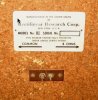
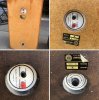
First pic: early version, no pots, factory still in Brooklyn. Second pic: Rect VI with one pot, still made in Brooklyn. As I understand, the Model VI was nearly identical to the Rect III except with a 10-inch woofer.The first IIIs had no pots
crdm6
Active Member
Here's a little history somebody wrote I found which I think is correct. Unfortunately a lot of III owners just do recaps and don't document their systems so it's hard to piece it together. Anyway...
"The 1966 version is the most difficult to find, the one reviewed by Julian Hirsch in 1967. This very first version used a Jensen woofer with an reddish accordion style woven cloth surround which was tuned to the cabinet with a two inch bass port. [I believe it was attached from the inside with 4 bolts.] The Phillips midrange had a unique whizzer cone and an accordion style surround made of paper. The four Peerless paper cone tweeters had paper dust caps and the square frame was stapled to the front baffle. There were no external adjustments unlike all the later versions. This system did not accept banana plugs, only bare 16AWG wire or a spade lug could be used. The grill badge was gold colored metal with red paint and the baffle set back was greater which allowed a thicker grill frame. At this time, there were no serial numbers on the system. [Seems like prototypes with no serial no.]
The 1968 version was very much like the first except for a single attenuator was added in a round cutout near the top rear of the cabinet which adjusted the four tweeters, the input connectors remained near the bottom. Otherwise, the second version was nearly identical to the first. [Was that the only change?]
The 1969 version still used the same brand of drivers, yet the system was altered once again. The impedance of the Dutch made midrange changed with the crossover and got a rolled edge woven cloth surround along with minor changes to the cone and dust cap. The paper cone tweeters from Holland were now glued to the front baffle in round frames plus received aluminum dust caps [Al? really?] to extend the upper range. The crossover now had two attenuators on a plastic plate located in a square cut out near the bottom of the cabinet along with the inputs. This system now accepted banana plugs along with bare 16AWG wire or a spade lug. The metal grill badge now became black plastic with gold chrome plus a gold paper serial number label could now be found on the crossover plate. This was the first version where the front baffle was moved forward by \uc0\u188 [about?] inch which required a thinner grill frame."
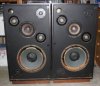
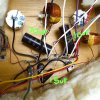
Back to me again. Attached is a photo I found of a Model 7. Obviously rough shape. I have a photo of the crossover but with just one photo it's hard to draw up a schematic. It looks like it is parallel.
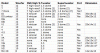
Also attached is the handy model guide. As a small manufacturer, which I understand was owned by one guy, the model lineup as time went by is somewhat shambolic. The inconsistent naming protocol doesn't help.
"The 1966 version is the most difficult to find, the one reviewed by Julian Hirsch in 1967. This very first version used a Jensen woofer with an reddish accordion style woven cloth surround which was tuned to the cabinet with a two inch bass port. [I believe it was attached from the inside with 4 bolts.] The Phillips midrange had a unique whizzer cone and an accordion style surround made of paper. The four Peerless paper cone tweeters had paper dust caps and the square frame was stapled to the front baffle. There were no external adjustments unlike all the later versions. This system did not accept banana plugs, only bare 16AWG wire or a spade lug could be used. The grill badge was gold colored metal with red paint and the baffle set back was greater which allowed a thicker grill frame. At this time, there were no serial numbers on the system. [Seems like prototypes with no serial no.]
The 1968 version was very much like the first except for a single attenuator was added in a round cutout near the top rear of the cabinet which adjusted the four tweeters, the input connectors remained near the bottom. Otherwise, the second version was nearly identical to the first. [Was that the only change?]
The 1969 version still used the same brand of drivers, yet the system was altered once again. The impedance of the Dutch made midrange changed with the crossover and got a rolled edge woven cloth surround along with minor changes to the cone and dust cap. The paper cone tweeters from Holland were now glued to the front baffle in round frames plus received aluminum dust caps [Al? really?] to extend the upper range. The crossover now had two attenuators on a plastic plate located in a square cut out near the bottom of the cabinet along with the inputs. This system now accepted banana plugs along with bare 16AWG wire or a spade lug. The metal grill badge now became black plastic with gold chrome plus a gold paper serial number label could now be found on the crossover plate. This was the first version where the front baffle was moved forward by \uc0\u188 [about?] inch which required a thinner grill frame."
Back to me again. Attached is a photo I found of a Model 7. Obviously rough shape. I have a photo of the crossover but with just one photo it's hard to draw up a schematic. It looks like it is parallel.
Also attached is the handy model guide. As a small manufacturer, which I understand was owned by one guy, the model lineup as time went by is somewhat shambolic. The inconsistent naming protocol doesn't help.

Freds.Bands
Live Music Listener
The Rectilinear Xa I bought in late spring 1968 has a series xover; maybe the III went the same way then.
The pictures show me the smaller cap is a 2.5uF and not a 5.
The crossover is mounted very compactly on a black plastic form; phenolic board was used on the first two generations with none or only one pot.
I believe these are simple pots to cut costs, not L-pads without disassembling one, but the resistors might mean they are L-pads.
The pictures show me the smaller cap is a 2.5uF and not a 5.
The crossover is mounted very compactly on a black plastic form; phenolic board was used on the first two generations with none or only one pot.
I believe these are simple pots to cut costs, not L-pads without disassembling one, but the resistors might mean they are L-pads.
Ruben Acosta
Active Member
I have two original pots but I think one isn't working right. It appears they are about 50 ohms, I don't know wattage. Any way I replaced them all and replaced crossover. So I also see two laminated coils. I think one speaker burned up some and I saved components from the other. I have some 1.0 uf mylar caps. You can put the in parallel to get value you want. The only thing original in my IIIs are the woofers. I tried changing woofers last week but sent them back. The noise I was getting was caused by old tweeter diaphragm split. They weren't used but still mounted and bass vibrations from bluray caused them to chatter.

I have Rectilinear III which were never made with pots. I would like to rebuild the crossovers and I have tears in my woofers
Which woofers do you have, I have a few spares.
Which woofers do you have, I have a few spares.
They are the originals with the accordion edges. They have the following numbers on them 3012B19R1, C12NFC8571,
 220718
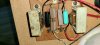
this is the crossover
They are the originals with the accordion edges. I don't see any names just a few numbers..C12NF C8571 and 220718 3012B19R1
Do they have ALNICO or ceramic magnets, and are there any bolts holding
the magnet plate on?
The two that I have both have ceramic magnets, one with bolts the other all glued.
There are no boltsDo they have ALNICO or ceramic magnets, and are there any bolts holding
the magnet plate on?
The two that I have both have ceramic magnets, one with bolts the other all glued.

aje123
Well-Known Member
Those are Jensen by the 220 number.They are the originals with the accordion edges. I don't see any names just a few numbers..C12NF C8571 and 220718 3012B19R1