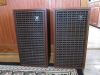
Love em or hate em, I sure love my 1967 III's......
"The design goal of the Rectilinear III was to create a reference standard with special emphasis on the widest possible dispersion of sound and unimpaired performance in unusually large rooms. By comparison, the L100 of the same era was specifically designed not to be a highly accurate speaker as it copied the flawed Altec Lansing 604 design and was a close field monitor.
As the L100 was becoming popular at the very same time as the model III, Rectilinear very politely comments on the JBL flaws in one ad without actually mentioning any names. Rectilinear directly pointed a finger at JBL by stating the new "West Coast Sound' was inaccurate with overly bright midrange and boomy bass, which was a fact. IMHO, when these two speakers are compared side by side, the model III simply outperforms the JBL L100 & 4311 in all areas plus allows for hours of non-fatiguing enjoyment.
The model III cost just under $600 a pair way back in 1966 with Duke Ellington personally endorsing them by stating The sound is so natural that I feel I'm sitting there with the band! I will include a copy of the letter he sent to Rectilinear.
The moving-coil loudspeaker was invented in 1925, yet the stereo era of hi-fi did not start until 1958, all recordings before this time were mono. By the mid-sixties there were very few dynamic speakers on the market which could accurately reproduce stereo sound without adding coloration to the playback. The Rectilinear III really stood apart at this moment in history by offering a very neutral product that did not add or subtract to the sound of original recording.
While no one will claim this system is the best speaker using today's ultramodern (expensive) standards, this vintage speaker is very enjoyable to play due to the smoothness and accuracy of sound, plus having such a strong bottom end which is often found lacking in many early speakers.
Despite being a bass reflex design cabinet, the Rectilinear III is a relatively low-efficiency system requiring a fair amount of clean amplifier power. I recommend 50 watts as the minimum, but they can be run on as little as 20 watts. Yet this comes with a caution, under powered amps will kill tweeters if pushed into clipping, so do not crank up the volume.
Critical listeners who prefer program material at high levels (loud) will most likely want to use equipment near the maximum of 100 watts per channel. Yet be forewarned the other way, do not overpower the speaker as the midrange voice coil will overheat and start to rub.
Drivers
The woofer was designed to move sufficient air while maintaining a fast transient response for solid output down to 20 Hz in the tuned enclosure. The woven cloth surround will never rot plus permits 1 inch cone excursions without running into nonlinearity issues. The woofer operates from 20 to 500 Hz and is rolled off at 6 db per octave to keep it out of the midrange where coloration could become apparent. The DCR of these woofers is 11.2 & 11.3 ohms.
The midrange driver which was made in Holland. This design provides a smooth transient response between 500 Hz and 3 kHz which is also attributed to the special European paper and an unusually light voice coil. This exceptionally neutral driver covers the musical characteristics which differentiate the vast majority of instruments and vocals. The DCR on these drivers is 3.6 & 3.8 ohms.
The four paper cone high frequency drivers made in Denmark cover the remaining range from 3 kHz all the way to 18.5 kHz. This classically simple design uses a very light cone and voice coil creating a smoothness not found in more complex designs, the thin aluminum dust cap weights only .01 of a gram. By widely spacing these four tweeters from top to bottom and around the front baffle, the upper frequency sound is dispersed over a very large area. The DCR of the 8 tweeters is 7.0, 7.1, 7.2 (x3),7.3 & 7.4 (x2)
Crossovers
The crossovers use air-gapped iron-core chokes coupled with capacitors to accurately control each driver, along with having a single attenuation control on the back panel for the four tweeters which has been cleaned and tested to assure smooth and noise-free adjustments from end to end. Typically I replace the vintage capacitors with high quality audio grade components, yet did not on this set as serious collectors prefer the OEM parts.
The OEM input posts only allowed for 16AWG wire or a spade lug.
HISTORY
The Rectilinear Research Corporation was established around 1966 in Brooklyn, New York moving to the Bronx late in 1968 where it remained until the plant was closed near the end of 1977. The model III was the first offering which was launched in 1966 and ended in 1976, almost the exact same year the popular JBL L100 also died.
Over the ten years of production, minor changes occurred to the model III as the transducers and crossovers evolved. There are four versions of the model III, yet Rectilinear did not mark these speakers aside from the company name making recognition a bit more difficult. The real amazing feat is that every version sounds nearly identical as Rectilinear put great effort into maintaining the neutral uncolored sound of the system.
The very first version of the model III won very high praise from Julian Hirsch in the December 1967 issue of Hi-Fi Stereo Review which really put the Rectilinear Research Corporation on the audiophile map. This review was the springboard for Rectilinear and became the main sales reference for the company with quotes being found in almost every advertisement. In February 1972 Julian performed a second review of the fourth version of the model III and also compares it with the first version.
The Rectilinear III is defined as a 6 driver, 4-way, base reflex system. Even though the transducers and crossover were altered over the years, the component layout on the front baffle remained consistent for the life of the speaker.
The 1966 version is the most difficult to find, the one reviewed by Julian Hirsch in 1967. This very first version used a Jensen woofer with an reddish accordion style woven cloth surround which was tuned to the cabinet with a two inch bass port. The Phillips midrange had a unique whizzer cone and an accordion style surround made of paper. The four Peerless paper cone tweeters had paper dust caps and the square frame was stapled to the front baffle. There were no external adjustments unlike all the later versions. This system did not accept banana plugs, only bare 16AWG wire or a spade lug could be used. The grill badge was gold colored metal with red paint and the baffle set back was greater which allowed a thicker grill frame. At this time, there were no serial numbers on the system.
The 1968 version was very much like the first except for a single attenuator was added in a round cutout near the top rear of the cabinet which adjusted the four tweeters, the input connectors remained near the bottom. Otherwise, the second version was nearly identical to the first.
The 1969 version still used the same brand of drivers, yet the system was altered once again. The impedance of the Dutch made midrange changed with the crossover and got a rolled edge woven cloth surround along with minor changes to the cone and dust cap. The paper cone tweeters from Holland were now glued to the front baffle in round frames plus received aluminum dust caps to extend the upper range. The crossover now had two attenuators on a plastic plate located in a square cut out near the bottom of the cabinet along with the inputs. This system now accepted banana plugs along with bare 16AWG wire or a spade lug. The metal grill badge now became black plastic with gold chrome plus a gold paper serial number label could now be found on the crossover plate. This was the first version where the front baffle was moved forward by uc0u188 inch which required a thinner grill frame.
The 1971 version was very similar to the '69 model expect for the Jensen woofer was now changed to a Chicago Telephone Supply transducer which had a smooth black butyl surround. This updated driver required the bass port to be enlarged to 3 inches plus additional crossover modifications to maintain the sound of the original system. The rest of the speaker remained unchanged aside from the baffle becoming black sometime after 1973.
By 1973 the model III had become somewhat popular, so an additional version was launched which used all the same components yet was shorter and wider with nearly the exact same cabinet volume. Many speculate the new model was released primarily to improve the WAF (wife acceptance factor) as the ads called the speaker a stunning piece of furniture.
Compared to the existing system which was almost a yard tall, the new III Lowboy could be cleverly disguised as an end table with a height of only 28 inches. The Rectilinear ads stated the standard version was the no frills model, while the fancy Lowboy came with a magnificent fretwork grille so popular in the 70's. A small bookshelf version was also released called the Mini III which was only 19 inches tall, yet this system was really not much like its big brother, it simply shared the name. The Mini did use the exact same midrange and tweeter, yet everything else was different including a departure from the bass reflex design to an acoustic suspension type.
Because Rectilinear now had two models of the III, common folk started calling the standard version the Highboy to contrast the official Lowboy name. Rectilinear never did use the Highboy nomenclature in any ad or spec sheet, yet the term did finally find its way onto the company price list by late 1976.
Technically speaking, the taller version should always be called the model III, while the shorter version is officially the III Lowboy.
The model IIIA was a late model carryover of the basic design, yet every component was changed making this a completely different speaker which never could outshine the real model III."
"The design goal of the Rectilinear III was to create a reference standard with special emphasis on the widest possible dispersion of sound and unimpaired performance in unusually large rooms. By comparison, the L100 of the same era was specifically designed not to be a highly accurate speaker as it copied the flawed Altec Lansing 604 design and was a close field monitor.
As the L100 was becoming popular at the very same time as the model III, Rectilinear very politely comments on the JBL flaws in one ad without actually mentioning any names. Rectilinear directly pointed a finger at JBL by stating the new "West Coast Sound' was inaccurate with overly bright midrange and boomy bass, which was a fact. IMHO, when these two speakers are compared side by side, the model III simply outperforms the JBL L100 & 4311 in all areas plus allows for hours of non-fatiguing enjoyment.
The model III cost just under $600 a pair way back in 1966 with Duke Ellington personally endorsing them by stating The sound is so natural that I feel I'm sitting there with the band! I will include a copy of the letter he sent to Rectilinear.
The moving-coil loudspeaker was invented in 1925, yet the stereo era of hi-fi did not start until 1958, all recordings before this time were mono. By the mid-sixties there were very few dynamic speakers on the market which could accurately reproduce stereo sound without adding coloration to the playback. The Rectilinear III really stood apart at this moment in history by offering a very neutral product that did not add or subtract to the sound of original recording.
While no one will claim this system is the best speaker using today's ultramodern (expensive) standards, this vintage speaker is very enjoyable to play due to the smoothness and accuracy of sound, plus having such a strong bottom end which is often found lacking in many early speakers.
Despite being a bass reflex design cabinet, the Rectilinear III is a relatively low-efficiency system requiring a fair amount of clean amplifier power. I recommend 50 watts as the minimum, but they can be run on as little as 20 watts. Yet this comes with a caution, under powered amps will kill tweeters if pushed into clipping, so do not crank up the volume.
Critical listeners who prefer program material at high levels (loud) will most likely want to use equipment near the maximum of 100 watts per channel. Yet be forewarned the other way, do not overpower the speaker as the midrange voice coil will overheat and start to rub.
Drivers
The woofer was designed to move sufficient air while maintaining a fast transient response for solid output down to 20 Hz in the tuned enclosure. The woven cloth surround will never rot plus permits 1 inch cone excursions without running into nonlinearity issues. The woofer operates from 20 to 500 Hz and is rolled off at 6 db per octave to keep it out of the midrange where coloration could become apparent. The DCR of these woofers is 11.2 & 11.3 ohms.
The midrange driver which was made in Holland. This design provides a smooth transient response between 500 Hz and 3 kHz which is also attributed to the special European paper and an unusually light voice coil. This exceptionally neutral driver covers the musical characteristics which differentiate the vast majority of instruments and vocals. The DCR on these drivers is 3.6 & 3.8 ohms.
The four paper cone high frequency drivers made in Denmark cover the remaining range from 3 kHz all the way to 18.5 kHz. This classically simple design uses a very light cone and voice coil creating a smoothness not found in more complex designs, the thin aluminum dust cap weights only .01 of a gram. By widely spacing these four tweeters from top to bottom and around the front baffle, the upper frequency sound is dispersed over a very large area. The DCR of the 8 tweeters is 7.0, 7.1, 7.2 (x3),7.3 & 7.4 (x2)
Crossovers
The crossovers use air-gapped iron-core chokes coupled with capacitors to accurately control each driver, along with having a single attenuation control on the back panel for the four tweeters which has been cleaned and tested to assure smooth and noise-free adjustments from end to end. Typically I replace the vintage capacitors with high quality audio grade components, yet did not on this set as serious collectors prefer the OEM parts.
The OEM input posts only allowed for 16AWG wire or a spade lug.
HISTORY
The Rectilinear Research Corporation was established around 1966 in Brooklyn, New York moving to the Bronx late in 1968 where it remained until the plant was closed near the end of 1977. The model III was the first offering which was launched in 1966 and ended in 1976, almost the exact same year the popular JBL L100 also died.
Over the ten years of production, minor changes occurred to the model III as the transducers and crossovers evolved. There are four versions of the model III, yet Rectilinear did not mark these speakers aside from the company name making recognition a bit more difficult. The real amazing feat is that every version sounds nearly identical as Rectilinear put great effort into maintaining the neutral uncolored sound of the system.
The very first version of the model III won very high praise from Julian Hirsch in the December 1967 issue of Hi-Fi Stereo Review which really put the Rectilinear Research Corporation on the audiophile map. This review was the springboard for Rectilinear and became the main sales reference for the company with quotes being found in almost every advertisement. In February 1972 Julian performed a second review of the fourth version of the model III and also compares it with the first version.
The Rectilinear III is defined as a 6 driver, 4-way, base reflex system. Even though the transducers and crossover were altered over the years, the component layout on the front baffle remained consistent for the life of the speaker.
The 1966 version is the most difficult to find, the one reviewed by Julian Hirsch in 1967. This very first version used a Jensen woofer with an reddish accordion style woven cloth surround which was tuned to the cabinet with a two inch bass port. The Phillips midrange had a unique whizzer cone and an accordion style surround made of paper. The four Peerless paper cone tweeters had paper dust caps and the square frame was stapled to the front baffle. There were no external adjustments unlike all the later versions. This system did not accept banana plugs, only bare 16AWG wire or a spade lug could be used. The grill badge was gold colored metal with red paint and the baffle set back was greater which allowed a thicker grill frame. At this time, there were no serial numbers on the system.
The 1968 version was very much like the first except for a single attenuator was added in a round cutout near the top rear of the cabinet which adjusted the four tweeters, the input connectors remained near the bottom. Otherwise, the second version was nearly identical to the first.
The 1969 version still used the same brand of drivers, yet the system was altered once again. The impedance of the Dutch made midrange changed with the crossover and got a rolled edge woven cloth surround along with minor changes to the cone and dust cap. The paper cone tweeters from Holland were now glued to the front baffle in round frames plus received aluminum dust caps to extend the upper range. The crossover now had two attenuators on a plastic plate located in a square cut out near the bottom of the cabinet along with the inputs. This system now accepted banana plugs along with bare 16AWG wire or a spade lug. The metal grill badge now became black plastic with gold chrome plus a gold paper serial number label could now be found on the crossover plate. This was the first version where the front baffle was moved forward by uc0u188 inch which required a thinner grill frame.
The 1971 version was very similar to the '69 model expect for the Jensen woofer was now changed to a Chicago Telephone Supply transducer which had a smooth black butyl surround. This updated driver required the bass port to be enlarged to 3 inches plus additional crossover modifications to maintain the sound of the original system. The rest of the speaker remained unchanged aside from the baffle becoming black sometime after 1973.
By 1973 the model III had become somewhat popular, so an additional version was launched which used all the same components yet was shorter and wider with nearly the exact same cabinet volume. Many speculate the new model was released primarily to improve the WAF (wife acceptance factor) as the ads called the speaker a stunning piece of furniture.
Compared to the existing system which was almost a yard tall, the new III Lowboy could be cleverly disguised as an end table with a height of only 28 inches. The Rectilinear ads stated the standard version was the no frills model, while the fancy Lowboy came with a magnificent fretwork grille so popular in the 70's. A small bookshelf version was also released called the Mini III which was only 19 inches tall, yet this system was really not much like its big brother, it simply shared the name. The Mini did use the exact same midrange and tweeter, yet everything else was different including a departure from the bass reflex design to an acoustic suspension type.
Because Rectilinear now had two models of the III, common folk started calling the standard version the Highboy to contrast the official Lowboy name. Rectilinear never did use the Highboy nomenclature in any ad or spec sheet, yet the term did finally find its way onto the company price list by late 1976.
Technically speaking, the taller version should always be called the model III, while the shorter version is officially the III Lowboy.
The model IIIA was a late model carryover of the basic design, yet every component was changed making this a completely different speaker which never could outshine the real model III."