

You are using an out of date browser. It may not display this or other websites correctly.
You should upgrade or use an alternative browser.
You should upgrade or use an alternative browser.


The coupling cap is a 0.22UF, the schematic isn't wrong. But I'm not a fan of those large copper foil caps using as coupling caps in a tube amp, my experience is they sound exactly as you describe using for this purpose. They work great in speakers, not so much in an amplifier. Sometimes if you burn them in for a week or two they "calm down, I've found the Mundorf Alum/oil to just sound better. Honestly, you are probably better off with what was originally in the amp. There is a reason I tell people to use these specific Mundorf caps and don't say "Just use any random 0.22UF cap you want to try."
Also, if you are good at soldering, just do the other "full mods" and use EL34 tubes. If you can solder in coupling caps, you can replace the cathode resistors etc. The only reason I posted using 6V6 tubes was for people who didn't want to open up the amp.
Also, if you are good at soldering, just do the other "full mods" and use EL34 tubes. If you can solder in coupling caps, you can replace the cathode resistors etc. The only reason I posted using 6V6 tubes was for people who didn't want to open up the amp.

Gregthib
New Member
Just to be sure - you're talking about this cap right? https://partsconnexion.com/collecti...mundorf-capacitor-0-22uf-450vdc-mcap®-evo-oilThe coupling cap is a 0.22UF, the schematic isn't wrong. But I'm not a fan of those large copper foil caps using as coupling caps in a tube amp, my experience is they sound exactly as you describe using for this purpose. They work great in speakers, not so much in an amplifier. Sometimes if you burn them in for a week or two they "calm down, I've found the Mundorf Alum/oil to just sound better. Honestly, you are probably better off with what was originally in the amp. There is a reason I tell people to use these specific Mundorf caps and don't say "Just use any random 0.22UF cap you want to try."
Also, if you are good at soldering, just do the other "full mods" and use EL34 tubes. If you can solder in coupling caps, you can replace the cathode resistors etc. The only reason I posted using 6V6 tubes was for people who didn't want to open up the amp.
Yep, you need a pair of those.Just to be sure - you're talking about this cap right? https://partsconnexion.com/collections/mundorf-evo-aluminum-oil-film-capacitors/products/mundorf-capacitor-0-22uf-450vdc-mcap®-evo-oil

Bkphoto
Super Member
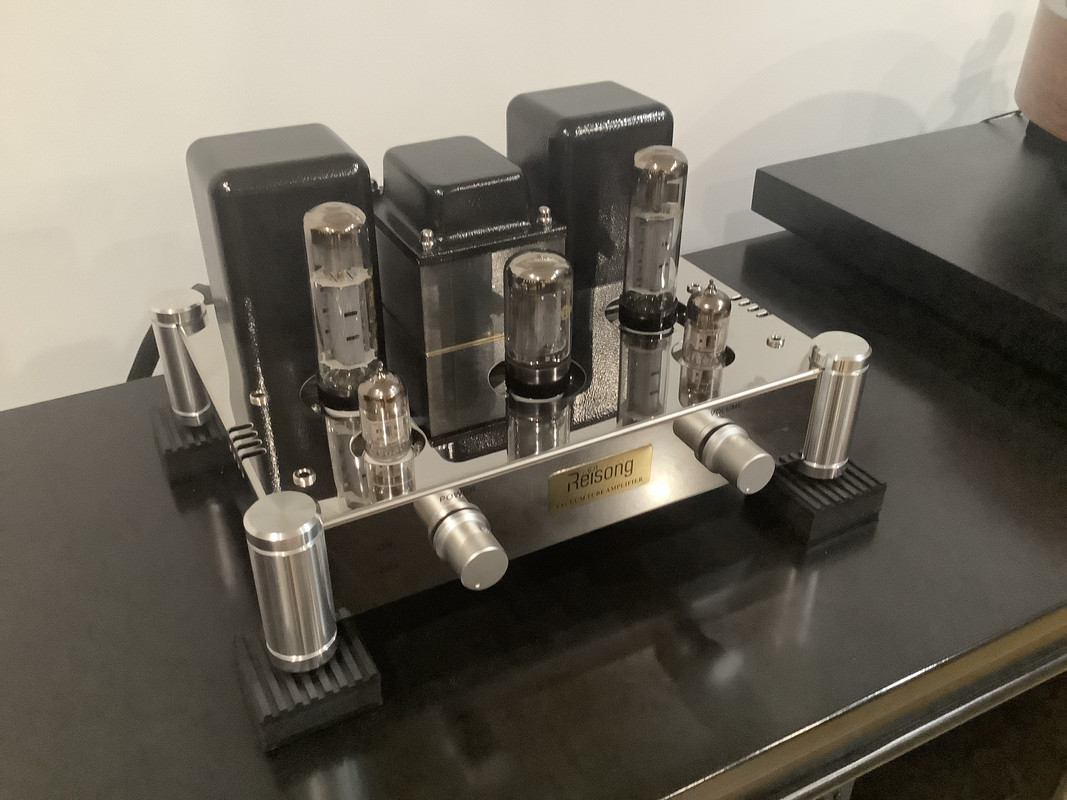
I opened it back up and everything was as it should be, but since I was in there I just went over all the joints again, why not…
Then the postman brought me my nos mullard gz34/5ar4 rectifier so I slid that in. (El34’s are nos rft short plates, 6n2p-ev voskhod, which seems to be the only upgrade for those )
Just for giggles I used the cd input instead of the aux. (no real reason)
Once again hooked up to the 4 ohm outputs. I decided against the 6v6 because my speakers are 16ohm, power is not my issue
Whenever I change anything I always play Kind of Blue…so I drop the stylus and sure enough that cymbal at the beginning sounded exactly as it should, I couldn’t believe my ears…
Dunno what to say, but it sounds great, there is a little tube noise if you are close to the speaker but it stays the same no matter volume level and it’s gone when u are about 2 ft. away, typical, not out of the ordinary by any means and plus given the price point of this amp I’d call it quiet…
I’m happily shrugging my shoulders
Last edited:
Bkphoto
Super Member
I used those in my speaker crossovers…I can also recommendJust to be sure - you're talking about this cap right? https://partsconnexion.com/collections/mundorf-evo-aluminum-oil-film-capacitors/products/mundorf-capacitor-0-22uf-450vdc-mcap®-evo-oil

Lavane
Lunatic Member
They are good caps. I'm really not sure it's worth buying the silver or gold foil in oil caps. I don't have golden ears myself and couldn't hear a difference between the aluminum and the silver and gold versions.
There have been sone that claim they can. I'm just not one of them.
IMHO the EVO aluminum in oil is a good bang for the buck cap.
There have been sone that claim they can. I'm just not one of them.
IMHO the EVO aluminum in oil is a good bang for the buck cap.
Last edited:
I've tried all 3 and honestly like the alum/oil over the others and as you said, good bang for the buck in a "boutique" cap.They are good caps. I'm really not sure it's worth buying the silver or gold foil in oil caps. I don't have golden ears myself and couldn't hear a difference between the aluminum and the silver and gold versions.
There have been sone that claim they can. I'm just not one of them.
IMHO the EVO aluminum in oil is a good bang for the buck cap.


JohnT123
Super Member
I went through all of them as well and I totally agree. I didn't hear the $$.I've tried all 3 and honestly like the alum/oil over the others and as you said, good bang for the buck in a "boutique" cap.

stephe, whats the full name of the aluminum caps ur talkin about? can you post or send me a pic?I've tried all 3 and honestly like the alum/oil over the others and as you said, good bang for the buck in a "boutique" cap.
mundorf makes a bajillion of em.

Flyingpob
New Member
A question for StepheK whom i want to thank very much : I appreciate the simple use of RCA 6V6 and Soviet 6N2P with stock schematics. Do you think i can keep these 6N2P instead of the 12AX7 for the single triode side modification as described, and keep the 6V6 i adore and giving a result so above the EL34' even JJ.

Shouldn't be a problem.A question for StepheK whom i want to thank very much : I appreciate the simple use of RCA 6V6 and Soviet 6N2P with stock schematics. Do you think i can keep these 6N2P instead of the 12AX7 for the single triode side modification as described, and keep the 6V6 i adore and giving a result so above the EL34' even JJ.
Bkphoto
Super Member
Why do some Chinese power tube amps have volume knobs…?
But it’s not actually volume, it’s an input resistor
Question for anyone,
Could that set up be adding a little noise…? I don’t see any point in it anyway, so I’m gonna bypass it…ITS NOT THE AMP IN THIS THREAD …it’s a little power amp not an integrated
But it’s not actually volume, it’s an input resistor
Question for anyone,
Could that set up be adding a little noise…? I don’t see any point in it anyway, so I’m gonna bypass it…ITS NOT THE AMP IN THIS THREAD …it’s a little power amp not an integrated

Why do some Chinese power tube amps have volume knobs…?
But it’s not actually volume, it’s an input resistor
Question for anyone,
Could that set up be adding a little noise…? I don’t see any point in it anyway, so I’m gonna bypass it…ITS NOT THE AMP IN THIS THREAD …it’s a little power amp not an integrated
So, you're saying that it is just an adjustable series resistor (two pin), not an L-pad potentiometer, with a third lead going to ground?
If so, that's not only potentially adding noise- it's CHANGING the frequency response, because of its interaction with the Miller capacitance of the input tube. The frequency response will be DIFFERENT at every setting of the variable resistor, due to a different corner frequency of the effective low-pass filter formed by that resistor and the Miller capacitance. The greater the resistance, the lower frequency that low-pass filter will act.
Hence, with a series variable resistor volume control- the amp will sound different, at every control setting- getting duller (less highs) the lower the control setting (more resistance), and brighter (more highs) as the volume goes up (less resistance). Not a recipe for "hi-fi", IME and IMHO.
Regards,
Gordon.
Everyone of these amps I have seen does reference ground with the volume pot. And it IS a volume control, any volume control is going to shunt some of the signal to ground to control on the input signal into the amp.
It's there on these type amps because the input sensitivity is high enough to reach clipping without the need for a pre-amp. I know EVERYONE wants to insert a pre-amp between the source and the amplifier, but it's not needed for these types of amp and is just putting more stuff in the signal path. And yes you can bypass it if you are controlling the signal strength applied to the grid of the driver tube in some other fashion.
