• The move to the new server is done. There are some software and database maintenance updates in process. This has us passing the hat around to help out. We appreciate any donations. Seriously, even a dollar helps. The payment page may be found here - https://www.audiokarma.org/support.html

Replacing Klipsch Midrange Diaphragms wi

BECtoo

Well-Known Member
There has been a lot of discussion on the use of the Klipsch K-53 Ti (titanium) midrange diaphragm in some earlier Klipsch speakers like the Forte 1, Forte 2, Heresy 2, Chorus, Chorus 2, KLF-20, KLF-30, Quartet and probably some others that use that style of midrange diaphragm.

This titanium midrange diaphragm was made by Klipsch and is used in the current production Heresy 3 and Cornwall 3 speakers. The driver sounds very good in isolation and in the Heresy 3/Cornwall 3 speakers and is, I would think a driver superior to the phenolic version.

Now, the question is (or should be): Does changing to this titanium diaphragm make sense for the speakers that originally had phenolic midrange diaphragms?

I have been asking myself that question for quite some time and just never seemed to have the time to get around to working on it. Well I did some of that today.

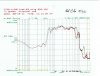
The picture attached is an FR trace of the Klipsch K-53Ti on the K-701 horn. Also on the same trace is the exact same driver and horn with just the diaphragm changed to an OEM Klipsch phenolic.

The red trace is the phenolic and the green trace is the titanium.

First thing to notice is that the curves fit with each other pretty well over most of the frequency range with a bit more output on average for the titanium. Next thing to notice is how high the frequency goes for each before the natural roll off of the diaphragm. You can see that the phenolic rolls off steeply at 6khz. So, if we bring the tweeter in at 6khz also, this makes perfect sense for the crossover in, for instance, the Forte 1, which uses this natural roll off to match up to the tweeter.

So, what happens if we use the Klipsch Titanium diaphragm in place of the phenolic without any change to the crossover? You can see that the titanium diaphragm does not roll off naturally at 6khz, but instead is actually increasing in output to 7.36khz. If we consider how the crossover summing works, we expect each of the two signals we are summing (midrange and tweeter) to be about 6db down at the summing frequency so that they sum flat at the crossover point. With the substitution of the titanium diaphragm, I think we would see a 6db or greater "hump" in the acoustic output at around 6 to 7.5khz.

Some will now probably want to know how to correct the crossover to use this titanium diaphragm and have the summing work right. That one is tough. The midrange needs a pretty steep slope bandpass for the midrange. I would have to set up the midrange and tweeter and see how they actually sum acoustically and design a bandpass filter to compensate. I have a gut feeling that this bandpass might have to be at least as steep as 3rd order to completely get the summing right. That adds a lot of parts.

A simpler approach that might work is to simply let the midrange roll off naturally at it's higher frequency and move the tweeter crossover frequency up to 7.5khz. That would not add any parts, just change the tweeter filter parts to different values.

Before closing this, I want to make sure to make one more point. I have not said changing this phenolic to a titanium and keeping the original crossover would not sound good. I have just made one small step toward identifying what might be a problem. The next step is to determine how the drivers actually sum acoustically. That is a much more difficult but would tell much more about how this works.

Bob Crites
 

Attachments

  • k53tiphenjpg.jpg
    k53tiphenjpg.jpg
    73.4 KB · Views: 670
Register to hide this ad
I'll be in the position to experiment with this soon with a x-over upgrade, I'm still running them with the stock x-over at the moment, any update on corrected values would help. Thank you for piquing our curiosity, its always welcomed Bob. :)
 
A nice writeup, as usual. I look forward to your further exploration of this question.
I note on the Klipsch products page, they specify an upper crossover frequency of 5 KHz, so they are removing the extended upper range of the Ti diaphragms. Any thoughts on their reasoning?
I also note they spec the Forte II crossover at 7 KHz, so it may accept the Ti diaphragm more smoothly than the earlier version without other component changes.
 
A nice writeup, as usual. I look forward to your further exploration of this question.
I note on the Klipsch products page, they specify an upper crossover frequency of 5 KHz, so they are removing the extended upper range of the Ti diaphragms. Any thoughts on their reasoning?
I also note they spec the Forte II crossover at 7 KHz, so it may accept the Ti diaphragm more smoothly than the earlier version without other component changes.

Since they had to limit how high the FR went on the Ti driver, they could just pick a point that gave them the best summing. Guess that turned out to be 5000hz. Perhaps needed to be that low to get away from the rising response higher up.

It think they just re-thought things between the Forte and Forte II and got it closer to right on the Forte II. No other reason for the two of those to be particularly different using the same drivers in the mid and tweet. They also inverted both the midrange and tweeter phase on the Forte II. Anyway, the problem is not just that the FR goes higher with the titanium diaphragm, the fact that the response is also rising between 6khz and 7khz may be the really hard part to work out.

But, yes, since the crossovers vary some, may work better on some than others. Problem with that is having to figure it out for each type of crossover.
 
Last edited:
Hi Bob,

Thanks for your work as always.

Things seem a little conflicting to me especially with Klipsch's spec's on line at least. I also know that that the accuracy of the information has been questionable from time to time.

Here are the spec pages on the Forte and Forte II

Forte http://www.klipsch.com/forte-floorstanding-speaker

Forte II http://www.klipsch.com/forte-ii-floorstanding-speaker


The Forte II using a polymer diaphragm and the Forte using using a phenolic.

If I gathered this right other than the shape of the horns perhaps the same mid-diaphragms.

Looking at the crossover schematics for the two

forte1crossoverschemati.jpg
ForteII1.jpg


What little I know about crossovers it would appear to me that the Forte II's tweeter network is a lower pass network than the Forte by virtue of the Forte II's 2uf caps vs the Forte's 1.5uf caps

Yet the spec pages say 6,000hz for the Forte and 7000hz for the Forte II

Without running some numbers I would think this would be the other way around.

If one were using your midrange and tweeter diaphragms then the Forte would clearly have a higher pass level.

I mention this because I really like the Titanium a lot, from my perspective it doesn't seem that a lot of people are purchasing them from Klipsch especially with their $165 price tag. But perhaps your getting a lot of inquires of them.

I used your new mid diaphragm's for about a yr before I went to the Titanium. I like your mids a lot and a close friend of mine that I use as a reference listener who is a musician and audio buff with a sharp ear liked them as well and we could clearly hear an improvement over the stock.

Clearly I hear no sharp peaks from the Ti's only great body with smoothness and extended response with a high level of resolution from my system and listening room.

Of the people I have talked with, some immediately took notice of the very high power handling characteristics of the Klipsch Ti. I noticed this as well especially under clipping conditions of my 10 watt SET amplifiers. What really stood out to me was how graciously they handled the clipping. Their ability to follow the signal is simply astonishing to me. My amplifiers use grid chokes so clipping recovery is fast, but nowhere near the recovery speed when using the Titanium. In fact I have to push my amplifiers further than I have ever before to get any strong sounding clipping.

I think moving the tweeter crossover point sounds like a good idea to me if people are having issues. I know of a few people with KLF20's that weren't crazy with the Ti mids but I see the same tweeter network components as the Forte II's interestingly.

I look forward to hearing more.

Thanks Bob

SET12
 
Last edited:
SET12, you should do the freq rolloff calculations for those xovrs to see where those xovr freqs really are. that would be interesting. Just a thought.
 
...and I appreciate you guys writing this so even i can understand...

I have wondered, since I do not have Titanium or new Mid diaphragms if going to the Titanium and it's higher point (I surmised, you confirmed) that there might be some muddiness as the Mid Squawker and Tweeter might "fight for the same territory" so to speak...


I am curious to hear from you that have done this if this is the case although I haven't heard of any real complaints when making the change in Mid diaphragms...

Thanks guys,

Bill
 
As Bob said

The next step is to determine how the drivers actually sum acoustically. That is a much more difficult but would tell much more about how this works.

A simple approach that might work is to simply let the midrange roll off naturally at it's higher frequency and move the tweeter crossover frequency up to 7.5khz. That would not add any parts, just change the tweeter filter parts to different values.


I think that with Bob's expertise and the fact that he does this everyday I would prefer to follow his lead.

As I mentioned in my above post it looks as though to me that the Forte 1 is better suited for the Titanium then the Forte II based on the smaller cap values of the Forte 1. Regardless of Klipsch's site specs for the Forte 1 and II of course the site says they used different tweeters so they could of had different impedance's and inductance values. Myself I'm using Bob's Titanium tweeters which of course he knows like the back of his hand.

SET12
 
As Bob said

The next step is to determine how the drivers actually sum acoustically. That is a much more difficult but would tell much more about how this works.

A simple approach that might work is to simply let the midrange roll off naturally at it's higher frequency and move the tweeter crossover frequency up to 7.5khz. That would not add any parts, just change the tweeter filter parts to different values.


I think that with Bob's expertise and the fact that he does this everyday I would prefer to follow his lead.

As I mentioned in my above post it looks as though to me that the Forte 1 is better suited for the Titanium then the Forte II based on the smaller cap values of the Forte 1. Regardless of Klipsch's site specs for the Forte 1 and II of course the site says they used different tweeters so they could of had different impedance's and inductance values. Myself I'm using Bob's Titanium tweeters which of course he knows like the back of his hand.

SET12

If anything the Ti Mid and Bobs Ti Tweet sound more seemless through my stock forte2's than with the phenolics, any improvement in FQ on top of this in this regard is just cherry. :)
 
If anything the Ti Mid and Bobs Ti Tweet sound more seamless through my stock forte2's than with the phenolics, any improvement in FQ on top of this in this regard is just cherry. :)

Nice to hear your satisfaction as well. We'll just have to wait till Bob is able to document more on this issue. like you said it would just be more icing on the cake :-)

There's great continuity between the two in my Forte 1's as well, going to the Titanium mid in combination with German C-Core Auto transformers and the Duelund Copper VSF coupling caps that I use made the Titanium diaphragm's sound like an upgrade worth thousands IMO.
 
Last edited:
Good info, Bob. Thanks! You too Set12 :)

I've been holding off on the Ti-mids for my Forte I (I have Bob's Ti-Tweet)

I think I would like to wait and adjust the tweeter X/O when the proper specs are found
 
I'm running Bob's Ti tweeter diaphragms in concert with K53-Ti squawkers in Heresy IIs (along with cap rebuilds from Bob) and my subjective analysis is that the Heresys (when paired with a sub) are better balanced at the frequency extremes and are generally smoother.

Bob: perhaps you could begin with the Heresy II conversion kit crossover schematic - maybe find a donor so you can reverse-engineer it? From what I understand, the difference between the H2 and H3 are:

- K107-Ti tweeter (instead of K76)
- K53-Ti squawker (instead of K53)
- K28-E woofer (instead of K24-K)
- Crossover

Granted, the K107 / K28 will have different performance characteristics than the K76 / K24 of the H2, but the primary concern sounds like the crossover between the K53 and K107 (my uneducated guess is that the differences between the K24 and K28 are primarily that of lower extension and sensitivity since the cabinet volume, etc. are unchanged between the H2 and H3, which makes this difference less important than the mid & tweeter differences). Depending on how the K107 measures in comparison to the K76, this could be relatively easy or a red-headed stepchild nightmare task.

-D
 
I'm running Bob's Ti tweeter diaphragms in concert with K53-Ti squawkers in Heresy IIs (along with cap rebuilds from Bob) and my subjective analysis is that the Heresys (when paired with a sub) are better balanced at the frequency extremes and are generally smoother.

Bob: perhaps you could begin with the Heresy II conversion kit crossover schematic - maybe find a donor so you can reverse-engineer it? From what I understand, the difference between the H2 and H3 are:

- K107-Ti tweeter (instead of K76)
- K53-Ti squawker (instead of K53)
- K28-E woofer (instead of K24-K)
- Crossover

Granted, the K107 / K28 will have different performance characteristics than the K76 / K24 of the H2, but the primary concern sounds like the crossover between the K53 and K107 (my uneducated guess is that the differences between the K24 and K28 are primarily that of lower extension and sensitivity since the cabinet volume, etc. are unchanged between the H2 and H3, which makes this difference less important than the mid & tweeter differences). Depending on how the K107 measures in comparison to the K76, this could be relatively easy or a red-headed stepchild nightmare task.

-D

You must have read my mind. I am right now putting together a couple of little test boxes to do some Heresy testing.

Bob Crites
 

Attachments

  • h123321.jpg
    h123321.jpg
    89.9 KB · Views: 250
You must have read my mind. I am right now putting together a couple of little test boxes to do some Heresy testing.

Bob Crites

Nice to know that occasionally I'm not talking out of my <redacted>. :D

If you need some beta testers once you have a design, I'd be happy to crack open my H2s and give you my (subjective) feedback!

-D
 
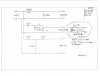
I did some more looking into this today. I was trying to work out a band pass for the midrange to limit the titanium diaphragm to about the same frequency as the phenolic to match up well with the existing tweeter filter. Anyway, after a couple of tries and getting pretty close, I happened on to a Klipsch design that seems to be just made for this exact purpose. I built it and tried it out and seems to work well. This circuit should just graft on to the midrange output on the existing crossover and do the roll off.

If someone using the titanium midrange diaphragms wants to try this out, should be a pretty simple build. The drawing attached is the Heresy II crossover and shows where the added bandpass circuit would go.

Bob Crites
 

Attachments

  • BPk53ti.jpg
    BPk53ti.jpg
    41.5 KB · Views: 563
I did some more looking into this today. I was trying to work out a band pass for the midrange to limit the titanium diaphragm to about the same frequency as the phenolic to match up well with the existing tweeter filter. Anyway, after a couple of tries and getting pretty close, I happened on to a Klipsch design that seems to be just made for this exact purpose. I built it and tried it out and seems to work well. This circuit should just graft on to the midrange output on the existing crossover and do the roll off.

If someone using the titanium midrange diaphragms wants to try this out, should be a pretty simple build. The drawing attached is the Heresy II crossover and shows where the added bandpass circuit would go.

Bob Crites


Any thoughts on values for Forte 1 and 2 ?
 
I'm a bit confused with the placement of (Bob) BECtoo's added "circuit"

I'm guessing it comes AFTER the autotransformer?

And... I'm wondering if the inverted phase design of the Fortes' mid affects Bob's circuit design ?
 
The circuit would go where I show it on the Heresy II example. That is, on the output of the crossover between the crossover and the midrange driver.

Phase will be just a guess with listening or testing to see if it is right.

Bob Crites
 
Back
Top Bottom