

You are using an out of date browser. It may not display this or other websites correctly.
You should upgrade or use an alternative browser.
You should upgrade or use an alternative browser.
Reproduction Fisher Knobs
- Thread starter ncwalz
- Start date


…Still a few more hurdles to jump before I'll know whether this project is doable…
No pressure, but this is huge! No more reliance on those who opt to cannibalize perfectly salvageable equipment. At least that’s the hope. Cheering you both on!!!

ncwalz
Mostly just a lurker
]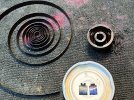
The clock-spring seems to be a good source for home-made knob spring-clips. I cut a couple and roughly fashioned them with a Dremel. It's easy to make a small bend in the repo clip with a couple of pliers, and with a bit of coaxing, it fits the three types of Fisher receiver knobs that use spring-clips. The original spring-clip is on the left.
At this point, I'm going to wait and see how the other repo knob types from my son turn out, and how they look with the brass brass caps and rings I have lying around.
The clock-spring seems to be a good source for home-made knob spring-clips. I cut a couple and roughly fashioned them with a Dremel. It's easy to make a small bend in the repo clip with a couple of pliers, and with a bit of coaxing, it fits the three types of Fisher receiver knobs that use spring-clips. The original spring-clip is on the left.
At this point, I'm going to wait and see how the other repo knob types from my son turn out, and how they look with the brass brass caps and rings I have lying around.
Last edited:
javaught81
New Member
It has surprised me nobody has attempted to 3D print these and then I finally stumbled upon this post after another dead end search for originals. I was going to try something similar myself. Definitely staying tuned to see how this turns out!

ncwalz
Mostly just a lurker
I’m hoping my son will be able to model and test print the other knob types in the next week or two. At that point we’ll see how well they work with stock brass caps rings. It they look good enough, the next step would be how to fabricate the brass bits. Since nobody is selling the brass rings, we’ll have make or have them made. And if we’re doing that, might as well do the caps too. Looking at possibly getting a mini metal lathe and fabricate the caps from solid brass rod and the rings from brass pipe. Anyways, still a ways to go on this project.

Someone said that it might be possible to print the rings in place using a brass color change. At any rate, looking forward to the end result.I’m hoping my son will be able to model and test print the other knob types in the next week or two. At that point we’ll see how well they work with stock brass caps rings. It they look good enough, the next step would be how to fabricate the brass bits. Since nobody is selling the brass rings, we’ll have make or have them made. And if we’re doing that, might as well do the caps too. Looking at possibly getting a mini metal lathe and fabricate the caps from solid brass rod and the rings from brass pipe. Anyways, still a ways to go on this project.
I agree on the paint followed up with a clear acrylic. The knob might have to re-printed to provide a surface to accept the paint however. And on the brights if I may make a suggestion: look into Marshall amp knobs. They come with a bright that is extremely passable. They sit a little proud of the knob so I cut them down to size. The filed edge is buried in the knob so you can’t tell it was modified. And the bonus: very cheap!!
Exciting!!
Exciting!!
ncwalz
Mostly just a lurker
Small update:
Both my son and I have been busy with some other projects, but today he was able to model and reproduce the lower Fisher knob.
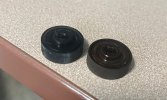
The left is the reproduction prototype in black plastic.

The prototype is close enough that a stock Fisher brass ring snaps in place.
So the next step is reproduction of the brass rings. The original stock rings appear to have been stamped from brass washers and have a flange that allows them to be snapped into the plastic knob. My son informs me that at least to start with, we should try to fashion the rings from brass pipe using a metal lathe. They should look correct from the front but won't have a flange, so we may have to modify the plastic knob slightly to accommodate the reproduction ring.
Next step is procuring a mini metal lathe and brass pipe.
Both my son and I have been busy with some other projects, but today he was able to model and reproduce the lower Fisher knob.
The left is the reproduction prototype in black plastic.
The prototype is close enough that a stock Fisher brass ring snaps in place.
So the next step is reproduction of the brass rings. The original stock rings appear to have been stamped from brass washers and have a flange that allows them to be snapped into the plastic knob. My son informs me that at least to start with, we should try to fashion the rings from brass pipe using a metal lathe. They should look correct from the front but won't have a flange, so we may have to modify the plastic knob slightly to accommodate the reproduction ring.
Next step is procuring a mini metal lathe and brass pipe.
Last edited:
Very nice, I'm certainly in need of knobs and will be keeping up with your progress.Small update:
Both my son and I have been busy with some other projects, but today he was able to model and reproduce the lower Fisher knob.
View attachment 3787798
The left is the reproduction prototype in black plastic.
View attachment 3787799
The prototype is close enough that a stock Fisher brass ring snaps in place.
So the next step is reproduction of the brass rings. The original stock rings appear to have been stamped from brass washers and have a flange that allows them to be snapped into the plastic knob. My son informs me that at least to start with, we should try to fashion the rings from brass pipe using a metal lathe. They should look correct from the front but won't have a flange, so we may have to modify the plastic knob slightly to accommodate the reproduction ring.
Next step is procuring a mini metal lathe and brass pipe.
ncwalz
Mostly just a lurker
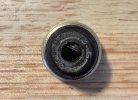
Small update: Slowly mastering the use of the small, basically kinda okay, Chinese metal lathe.
I'm able to fabricate the metal rings now from brass pipe. I'll use a Dremel with a polishing tool from now on to polish the front bevel while the brass pipe is still in the chuck and then part the ring from the pipe.
Parting has been the biggest challenge with this small lathe. But now that fabricating the brass ring of the knob is doable, I think I can move forward since the rings were not previously available anywhere else.
Fabricating the brass caps with this lathe may or may not be possible; we'll see, but since the these caps are still available, or can be fabricated by other means, this is not a deal-breaker.
Last edited:
ncwalz
Mostly just a lurker
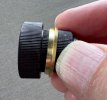
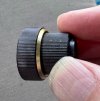
A bit of polishing on the chuck and a bit of steel wool after parting the ring. Not perfect, but maybe close enough.
I really only have to measure the inner and outer diameter of ring. My son ground a high speed steel cutting tool that has the correct angle of the bevel.
One pleasant discovery: If I'm careful about correctly reproducing the inner diameter of the ring, the parting tool leaves a flange on my reproduction ring that is very close to the flange of the original stock ring and fits nicely into the groove of the plastic knob. It's not a friction fit like the original, but three tiny dabs of glue to the holes in the plastic underneath should hold it in place.
Last edited:
Taking preorders?? 
Really nice work!!
Really nice work!!
ncwalz
Mostly just a lurker
I think it gets easier with some experience and practice. I can machine a length of brass pipe to the correct outer and inner diameter sufficient for about five rings. Then it's just two tool changes: first to bevel and second to part the ring from the pipe: about five or six minutes at present.
Next step is obtaining an Anycubic Photon Mono 4 3D printer of my own. My son has made the reproduction plastic prototypes with his printer up to this point.
Should be able to print a complete set of receiver knobs at one go, so they should all match exactly in colour.
Next step is obtaining an Anycubic Photon Mono 4 3D printer of my own. My son has made the reproduction plastic prototypes with his printer up to this point.
Should be able to print a complete set of receiver knobs at one go, so they should all match exactly in colour.