• The move to the new server is done. There are some software and database maintenance updates in process. This has us passing the hat around to help out. We appreciate any donations. Seriously, even a dollar helps. The payment page may be found here - https://www.audiokarma.org/support.html

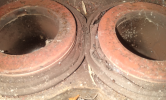
Rotor damage.

So, , , let's list the respondents here that I totally agree with :thumbsup:

whoaru99

usedto

gadget73

And krautmaster

....... That rotor is telling all one needs to see here. Those brakes were driven WAY past the point of having been needed to be replaced. That kind of gouging comes from metal on metal contact and having been abused to that point is no fault of the rotor itself, the fault here belongs with whomever delayed the needed repairs. Yep, the "deferred maintenance" plan has just rose up and bit another in the rear, , , hopefully he'll have learned a valuable lesson here ;)
 
Caliper piston lockup in the bore does happen an it's less noticeable when it occurs in the rear.

The early 2000's Ford 3/4 to 1 ton vehicles are a good example of brake issues. There numerous thoughts and evidence on root cause.

Phenolic piston fluid contamination or poor piston material
Internally collapsed flex lines
Master cylinder contamination. ABS contamination as well?
Rotten pad retainer hardware
Rotten piston dust seals=contamination
Contaminated or sticky slides

I've seen a few of examples of the above in person. The simple things that I can do for these is inspect the pad hardware, seals, slides. Change the fluid with a correct, high-temp, synthetic fluid on schedule.
 
Last edited:
Caliper piston lockup in the bore does happen an it's less noticeable when it occurs in the rear.

The early 2000's Ford 3/4 to 1 ton vehicles are a good example of brake issues. There numerous thoughts and evidence on root cause.

Phenolic piston fluid contamination or poor piston material
Internally collapsed flex lines
Master cylinder contamination. ABS contamination as well?
Rotten pad retainer hardware
Rotten piston dust seals=contamination
Contaminated or sticky slides

I've seen a few of examples of the above in person. The simple things that I can do for these is inspect the pad hardware, seals, slides. Change the fluid with a correct, high-temp, synthetic fluid on schedule.
Way back in 1991 when my wife and I got back from Desert Storm her old Honda Civic would not move- the brakes were locked up and the engine didn't make enough power to budge. I had it towed to the auto hobby shop on base (Little Rock AFB) and found that the metal brackets that hold the brakes line in place had rusted so much that they had squeezed the rubber brake lines closed... new rubber hoses and brackets fixed that issue. About three months later the engine grenaded (chucked a rod out the side of the block) on the highway while she was driving home on her last day in the USAF. That little POS went right to the crusher !
 
I replaced the original 1991 front calipers on my Mark 7 last year at 240k. They were just starting to drag. Pistons were scored and the seals were going mushy. Reman calipers were 15 bucks with no core charge, Pistons were like 25 and the seal kit was another 5. It got reman parts.
 
yeah I know. A month before I did the Mark VII calipers, I replaced the exact same ones on my 84 Continental that I had replaced when I got the car in 2018 as a preventative measure because I know how much those calipers tend to stick after sitting a while. 6 years and about 30k miles on those, parked each winter. No rust, fluid had been flushed, seals looked OK but there were scratches and cracks in the phenolic pistons.


I expect the parts used on the remans are not up to OE quality but not much to be done for that. I've got both sets sitting in a box as cores that I can rebuild if needed. I also honestly don't know if the remans get new pistons. For all I know they just clean them off if they aren't destroyed, throw new seals in and put them in a box. There is surely a reason that they cost half what the parts to do the job costs.
 
Just as a follow-up. The other three rotors were fine. Very worn but no cracks. No excessive scaring of the pads.

It's kind of scary. I try to use OEM brake parts. But you just never know these days.
The nearest bearing, seals, line have been super hot. I would check for axial and radial play before putting it all back together.

The OEM themselves can't always be trusted on their recall or legacy support sources.
 
The nearest bearing, seals, line have been super hot. I would check for axial and radial play before putting it all back together.

The OEM themselves can't always be trusted on their recall or legacy support sources.
He said he replaced everything. The caliper was split in two.

The odd thing is that the failure occurred just after startup in the morning. So, he was driving a ticking time bomb for a while.
 
Back in the day I had rotors turned. Now I just get them at Amazon (i.e. Chinese made). I've been doing that for over a decade and I have four cars. Never had a problem with any of them.
 
Back in the day I had rotors turned. Now I just get them at Amazon (i.e. Chinese made). I've been doing that for over a decade and I have four cars. Never had a problem with any of them.
May the Force be with you!

63927922-7197-4a52-99e8-bef5da86220e.gif
 
Dang, too late! He already bought new rotors. Maybe, next time — I'll email him!

:thumbsup: ;)
Interesting story - on our honeymoon in 1998 we circumnavigated the western US on a 3,500 mile road trip. On one of the "mountains" in the moab, the radiator on our Reliant split down the seam on one side. It was a gap about 1/8" wide and about three inches long. We were able to "mostly" coast into the town of Moab because for some reason we had a few empty milk jugs and a stream next to the road, and we were able to keep it "full" of water.

When we got to town , I got a pair of scissors, a can of coke, and some jb-weld. We drank the coke, I then cut it into a large rectangle and creased it into an L shape. I then slathered the JB weld on the radiator and the aluminum can and pressed it into place. We then let it cure for a whopping three hours.

It got us to mt Shasta a couple of days later. I fixed it again and that got us to our home, Seattle, where I bought a new radiator and installed it.

It was sure easy to fix cars back in the day.
 
The caliper was split in two.
There could be something in the drive line that caused a radial load. My only other thought so far is that there was a casting defect in the caliper. Casting defects that pass Q.A. and machining processes are becoming more common.
 
There could be something in the drive line that caused a radial load. My only other thought so far is that there was a casting defect in the caliper. Casting defects that pass Q.A. and machining processes are becoming more common.
He said it looked like the disc cracked and suddenly shoved the pads apart, causing the calipers to split open. There was such a loud BANG that he thought the engine had thrown a rod or something.

The pads were found several feet away from the car.
 
Some of the stick axles have c clip retainers that can break or the axle can shear. Nothing stopping it from walking into the caliper. They also had aftermarket clip eliminators that were mostly leaking garbage. I've not seen any disk brake carnage from this, but the theory is there.
 
Back
Top Bottom