• The move to the new server is done. There are some software and database maintenance updates in process. This has us passing the hat around to help out. We appreciate any donations. Seriously, even a dollar helps. The payment page may be found here - https://www.audiokarma.org/support.html

Rubber rejuvenation

Catmanboo

Analog guy, meet digital world - HELP!!
Subscriber
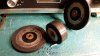
I dug my old Teac A-2060 out of long-term storage, looking to return to service. Naturally, I dug into it to assess feasability of doing so. Capstan was stuck to the idler wheel, resulting in a nasty groove in the wheel, in addition to 2 of the 4 transport drive wheels inside being rock-hard. I recall years ago, one could find rubber rejuvenation fluid, most used for typewriter rollers. Curious to see if there's any help for this thing. Ideas & advice welcomed. Happy new year, all!:beerchug:
 
Register to hide this ad
Holy crap, that was fast,you mustve been watching me type! Appreciate that tip, here's the evidence. ..
 

Attachments

  • 20190101_113647.jpg
    20190101_113647.jpg
    66.9 KB · Views: 86
Many years ago, we would just swab them with some Bletchley’s Bleach Wite. Came up like brand new. But we were just looking to squeeze more hours out of them before replacing them with fresh rubber.

The formula may have changed, so I would do your homework before attempting this in 2019.

You can’t really hold back nature if the rubber is vulnerable to it.
 
thanks for your quick responses, mine not so much! Going to try the fluid treatment for the wheels, but not going to expect miracles, as they're rock-hard. the pinch roller may get some spot-treatment of gasoline on the groove to (hopefully)swell that groove back out. Barring that, may put it on my metal lathe & attempt a regrind. Cheers & happy new year!:bigok:
 
Yeah, you can yourself make that product. It is 70% toluene and 30% methyl salicylate (oil of wintergreen). Xylene is sometimes used instead of toluene because it slower evaporates, roughly 30% slower.

The solvent (toluene or xylene) temporarily swells the rubber bonds allowing the methyl salicylate to migrate in. After soaking overnight the rubber part is saturated with methyl salicylate and removed from the solution. The toluene then evaporates and the methyl salicylate is left behind as a plasticizer. This is old, old technology; for a century, maybe more, methyl salicylate has been used as a plasticizer for rubber. The big advantage is that it works, is relatively non-toxic (it was added to candy and root beer, maybe still is, as a flavoring) and doesn't have an objectionable odor or taste.

The solution will be similar to paint thinner, so do not do any soaking indoors. Leave it in a coffee can outside overnight, away from the house. Stuff is flammable, whether it is commercial or homebrew. Also, no huffing the toluene! Not sayin', just sayin'.

NB: I have a can of toluene around, anyway, as brush cleaner and cleaning, so it's not like I had to buy it. The methyl salicylate is inexpensive.

Just sucked more of the magic out of the world.
 
Going to try the fluid treatment for the wheels, but not going to expect miracles, as they're rock-hard. the pinch roller may get some spot-treatment of gasoline on the groove to (hopefully)swell that groove back out.

Before you use benzene, try the toluene plus methyl salicylate trick.

That will relax the rubber, allowing it to return to its original shape, removing the dent.
 
Many years ago, we would just swab them with some Bletchley’s Bleach Wite. Came up like brand new.

Bleach is very alkaline and will gradually destroy the rubber. I don't understand why it would make the rubber flexible. All it would do is chew up the surface, increasing friction much like abrading it.

Plus having chlorine migrate in to the rubber will cause problems for the electronics as it migrates out. Chlorine is death to electronics, and it is the gift which keeps on giving. Yeah, small amounts, but still.
 
Caveats being that it doesn't restore shape, so if you have a roller with a notch in it, it's beyond help. Rubber renue is good at taking the glaze off of hardened idlers and rollers, and making them grip again. It's always worth a try. It will probably work on those idlers, but the pinch roller is junk, needs a rebuild.

Try letting it longer sit. The longer the rubber is immersed in the solution the more pliable it becomes.
 
Bleach is very alkaline and will gradually destroy the rubber. I don't understand why it would make the rubber flexible. All it would do is chew up the surface, increasing friction much like abrading it.

Plus having chlorine migrate in to the rubber will cause problems for the electronics as it migrates out. Chlorine is death to electronics, and it is the gift which keeps on giving. Yeah, small amounts, but still.

There is no bleach or chlorine in this product.

But it was an interesting response.
 
There is no bleach or chlorine in this product.

A search for "Bletchley’s Bleach Wite" turns up absolutely nothing.

Why would a product which contained no hypochlorite bleach state "Bleach" in the name?

Peroxide? That isn't going to soften rubber. Might remove an organic glaze on the surface, but not especially well.

In any event, I explained how the rejuvenation works and the proper chemistry to use.
 
[Mod Edit]

That product in its original version was merely a highly dilute trisodium phosphate solution. Diluted further, and you could use it as a food additive. Generally safe, but I don’t recommend drinking it. I have no idea what is in the later phosphate-free formula, except that users complain that it is ineffective.

And softening any hardened rubber (to allow plasticizer migration or otherwise) is almost always chemically destructive. There is no ‘proper chemistry’ to fully rejuvenate a cured synthetic rubber, which is what these capstan rollers, belts, and any idler wheels were fitted with. The best the OP can hope for is restoring some marginal surface friction by topical means until he can source replacements.

At least a water based treatment won’t risk attacking his tape media and capstan bearings (many of which used impregnated lubricants) as some of the other proposed treatments can if not 100% removed after application, or as they leech out later.
 
Last edited by a moderator:
Try letting it longer sit. The longer the rubber is immersed in the solution the more pliable it becomes.

I've tried this with idlers which I thought were too far gone, without any real success. The shape just never comes back to the point where it won't create wow and flutter issues due to a flat spot or notch. Basically, whoever left the deck with the pinch roller engaged before storage is to blame. Thankfully there's ways to get the idler rebuilt, without a lot of cost.

Where rubber renue has huge value, is just taking the surface glaze off of idlers which are not too far gone. I recently used it to mildly renew the idler in a Garrard 301, and it came back amazingly well. I basically just hold a soaked Q tip against the surface of the rotating idler, until the idler stops shedding black residue unto the Q-tip. Then I use a clean q tip to remove any remaining chemical which hasn't evaporated.

In the case of idlers in good condition, but with a surface glaze, I've had good luck with rubber renue helping them to last for years. Where it works poorly, is deformed idlers, or crappy designs like where a VCR tries to put way too much torque through an undersized idler, and relies on a small surface area to transmit a lot of force. In those cases it will be at best a temporary fix.

 
I've tried this with idlers which I thought were too far gone, without any real success. The shape just never comes back to the point where it won't create wow and flutter issues due to a flat spot or notch. Basically, whoever left the deck with the pinch roller engaged before storage is to blame. Thankfully there's ways to get the idler rebuilt, without a lot of cost.

Where rubber renue has huge value, is just taking the surface glaze off of idlers which are not too far gone. I recently used it to mildly renew the idler in a Garrard 301, and it came back amazingly well. I basically just hold a soaked Q tip against the surface of the rotating idler, until the idler stops shedding black residue unto the Q-tip. Then I use a clean q tip to remove any remaining chemical which hasn't evaporated.

In the case of idlers in good condition, but with a surface glaze, I've had good luck with rubber renue helping them to last for years. Where it works poorly, is deformed idlers, or crappy designs like where a VCR tries to put way too much torque through an undersized idler, and relies on a small surface area to transmit a lot of force. In those cases it will be at best a temporary fix.

Agreed, if soaked too long the rubber will eventually deform, you really need to keep an eye on it and not let it sit too long.
 
Where rubber renue has huge value, is just taking the surface glaze off of idlers which are not too far gone. I recently used it to mildly renew the idler in a Garrard 301, and it came back amazingly well.

That's been my experience, along with rubber gaskets in old tools used to prevent ingress of sawdust, so not really structural. My friends who rebuilt cars and motorcycles used it on vintage sleeves and boots to good effect, as well.
 
Retrovert is correct. In fact, the MG Chemicals Rubber Renue product is same: 70-90% Xylene, 10-30% Methyl Salicyate. The Techspray rejuvenator appears to be mostly d-limonene, a natural solvent/degreaser. While you may get a little more life with these products, I've never seen old rubber successfully "rejuvenated", just replaced. If you are just cleaning or "de-glazing" , solvents work wonders.
 
thanks for your quick responses, mine not so much! Going to try the fluid treatment for the wheels, but not going to expect miracles, as they're rock-hard. the pinch roller may get some spot-treatment of gasoline on the groove to (hopefully)swell that groove back out. Barring that, may put it on my metal lathe & attempt a regrind. Cheers & happy new year!:bigok:
Have access to any liquid nitrogen? I remember reading about machining rubber rollers after freezing them in liquid nitrogen; keeps the material from deforming under tool pressure.
 
Retrovert is correct.

Thanks!

In fact, the MG Chemicals Rubber Renue product is same: 70-90% Xylene, 10-30% Methyl Salicyate. The Techspray rejuvenator appears to be mostly d-limonene, a natural solvent/degreaser.

Limonene (‎C10H16) is a structurally similar to xylene (C8H10), both of which are less volatile than toluene (C7H8), by about a third.

Limonene is normally sold as a "geen" alternative to petroleum solvents because it can be claimed it is "100% Natural". Which is true, but petroleum is also "natural" since it comes out of the ground in nature. Castor beans contain 100% natural ricin, and puffer-fish toxin is 100% natural too, and I wouldn't go near either of them.

I have for years used CitraSolve, which is limonene from citrus, as a cleaner and degreaser. See:
www.citrasolv.com/


I don't know that it works at all as a rubber rejuvenator. Years ago after reading about the purported value for this purpose I tried it on a laserprinter platen to clean off the hard oxidized surface and soften the pickup rollers. It never softened the rubber and the surface was only slightly improved, not to the point of restoring function. I instead bought a new platen and rollers which worked far better and my printer jams ceased.
 
Back
Top Bottom