• The move to the new server is done. There are some software and database maintenance updates in process. This has us passing the hat around to help out. We appreciate any donations. Seriously, even a dollar helps. The payment page may be found here - https://www.audiokarma.org/support.html

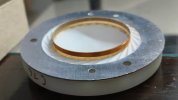
Russian paper diaphrams for Altec horns

Now the pleated surround would allow a 515B to go a little deeper, right, but not as deep as a 416? You have a Hollywood, so it has a paper hinge?
My Altec 515 has Gold label and old grey painting. Cone number is 20409, looks like original cone. It has all paper cone with old style paperhinge (no doping), like in Altec 604C pictures I posted few days ago. I can not see the nominal impedance of the label, as it has been deteoriated. It gives 7.7 ohms dcr reading, quite low? if nominal is 16ohms?

I have no 515B in hand to compare, but I would like to. I quess, that stronger magnet of 515B would give more accurate bass response than 416? I really like the 416, but hard to decide whether to buy another 416 or to try find 515B´s for a try.
 
I have no 515B in hand to compare, but I would like to. I quess, that stronger magnet of 515B would give more accurate bass response than 416? I really like the 416, but hard to decide whether to buy another 416 or to try find 515B´s for a try.

I used both 515Bs and 416s in 825 cabinets. The 416 made deeper bass but the 515 made better midrange. Either woofer was satisfactory. My opinions and experience, not the word from Sinai.
 
Hollywood 515 has a nominal impedance of 20 ohms, I believe. Cone number sounds right. I vote for finding another 416, 515 and a pair of 515Bs, compare them all and report back. Sell what you don't want at a profit. 515s and 515Bs are ridiculous right now. The most loved home Altec Model 19 has 416s, so there's that. Always seems to be a give and take, depends on what your ears like. A friend tells me the phenolic spider of a 515 makes it the most pleasant, stating there is distortion in a 515B not present in a 515. Of course you sacrifice low frequency extension due to the paper hinge. Where's @bowtie427ss , he should have valuable input on this.
 
There's not much i can add that hasn't already been stated.

515B was optimized to be a horn driver. That doesn't mean necessarily that horn driver is it's only application. But, that's what it was engineered/optimized for.

Hollywood 515 has a nominal impedance of 20 ohms
They changed their convention for measurement along the way, probably more than once. You'll find they measure ~the same as a 16 ohm labeled 515.

The most loved home Altec Model 19 has 416s, so there's that
It certainly enjoyed being the flagship model of their consumer products line and the pinnacle of the iconic 2-way Lansing monitor's evolution, the only thing they marketed more aggressively was their car audio products. But, 19's are hardly the last word in LF extension. The real innovation in the 19 was it's dual resonant cabinet that allowed the 416 to play smoothly up to 1.2khz, a frequency that most 15 inch woofers have no business approaching.

If you want to get all the way down to the bottom, Altec(actually Altec Pro) made one solution, the 3182/8182 system. Coveted by those who know, and rare as hen's teeth in today's market.

 
If you want to get all the way down to the bottom, Altec(actually Altec Pro) made one solution, the 3182/8182 system. Coveted by those who know, and rare as hen's teeth in today's market.
I have a pair of 3182, just need to build the 8182 cabinets. Too many house projects are getting in the way! argh
 
Received the diaphragms yesterday and installed one of them. The very initial impression is- it sounds a bit smoother compared to the aluminum but more open and natural.
Thank you for telling. Have you already installed both of them? I would be interested to hear the current comments how they sound in your system. My copper coil paper diaphragms will arrive soon.
 
Thank you for telling. Have you already installed both of them? I would be interested to hear the current comments how they sound in your system. My copper coil paper diaphragms will arrive soon.
Hello Juha,

Yes I did install the other one too, and have been listening to them, overall these diaphragms helps more blending of the HF with the overall sound, and sounds more coherent, with the compromise of little bit of zing or sheen on the HF, and sound a bit warmer in comparison to the AL.
Since I am using a mastering lab's clone, Which crosses the compression driver a bit higher, I think if these are crossed a bit lower they will sound better.

Currently I am making a replica of 612 cabinets, once that is finished I will experiment with lower XO point.

IMG-20231111-WA0000.jpg
My 612 build in progress.

-sann
 
Would you agree with my interpretation as being more silky?
Yes, they do, and I am noticing that they are opening up and attaining more 'silky' highs.

And, I won't shy away from admitting that I feel they could be a wonderful alternative to the conventional aluminium diaphragms, at a lower cost and better customer response from the builder/seller.

Would love to hear what other's feel after installing them.
 
Would love to hear what other's feel after installing them.
Thank you Sann for your impressions.

I got my russian paper diaphragms with copper coils also for my Altec 604. They look little different compared to yours as Alex replaced the brass lugs with copper (I asked to do so). I thought that I got wrong parts, as the loading caps could not be used. Here is reply from Alex: "I did this on purpose, my diaphragms should only be used without the loading cap for best sound. You can use an aluminum cover and place a sound absorber in it"

Alex was right. I compared the original aluminum diaphragm with and without loading cap and without the loading cap the sound was far more breathing and natural as I tested 604´s without box (dipole) in my studio with vocal, snare drum, fretless bass and acoustic guitar . I found same results and other good info here https://greatplainsaudio.com/altec-lansing-compression-driver-rear-loading-caps/ With my earlier tests I found also that the aluminum dustcap (even with loading cap installed) degrades sound also. So no dustcap installed, open back for diaphragm.

Next I compared with same setup russian paper diaphragm copper voicecoil against original "1954 (604C) aluminum diaphragm with edgewound aluminum voicecoil" and "70´s? (604E) aluminum diaphragm with copper voicecoil" (Aluminum voicecoil was about 3db louder, so had to attenuate it, but both copper voicecoils were about the same level, no attenuation needed in my minimalist crossover with only 1.8uf for hf, lf fullrange). The paper diaphragm sounded with all instruments and vocal so natural/breathing/inspiring/lively. With aluminums there was all the time feel that something is wrong, annoying metallic artifact, boring/compressed/dead as compared to paper. And I changed the diaphragms many times, allways clearly the same results

To the end of testing session I removed the "bug filter", fine metal mesh from the throat with sharp knife. Hf souded even better. That would have been clear without testing, as I have had same results on earlier speaker projects - no cover to speaker is best for me allways.

Installed one 604C with russian paper diaphragm (no loading cap, no bug filter) to my controlroom main speakers and compared to original aluminum voicecoil diaphragm 604C (with loading cap and bug filter). With pink noise/spectrum analyzer the hf with paper diaphragm needed no attenuation, as it is about 3db lower sensitivity than aluminium vc, great! The frequency response was quite similar on both, but paper diaphragm started rolling down about 1/3 octave earlier at about 8khz vs. 10khz with aluminum.

Then took some vinyls rolling. Paper/copper vc sounded so more NATURAL and lively, so big on mono with much depth/separation/micro dynamics and I could hear much better the room ambience (important part of recorded sound) and reverbs more clearly. Instruments and vocals jumped clearly more out of the speaker filling the room like "you are there". The aluminum vc. sounded dull/small/metallic as in my earlier instrument and voc tests and even though it has little more highs, it does not make dead man alive.

There is no way back for me from paper diaphragms. Alex has done good job! I was hooked instantly. Just wait to get another speaker rock´n rolling.

 
A nice review, and I don't doubt your findings.
What about if you live in Spider central Like me on the Lakeside?
those bug screens are there for a Reason.
I do agree on removing the loading caps, for Low powered home audio use only.
 
Thank you @Juha, for such a detailed review. It's really exciting to hear about your impressions.

I also had to remove the loading caps while installing the paper diaphragms. Though I still used the metal back cover with the felt damping inside.

With just 1.8uf cap on the HF, aren't you crossing them quite high above ~4.5khz?

Regards
San
 
What about if you live in Spider central Like me on the Lakeside?
those bug screens are there for a Reason.
Just hope that the spiders loves the music we play :) Sorry for them not to hear it fullrange, if they choose hf throat as their home.

It is quite easy to check the horn throat with light and even blow the compressed air from backside (diaphragm out first) if there is too big family of spiders or... I think that they are small problem soundvice compared to dense mesh in the middle of the throat and they will go there anyway, if they are music lovers...
 
With just 1.8uf cap on the HF, aren't you crossing them quite high above ~4.5khz?
I found old "handcomputer" print of 604E below of which you can hopefully see my minimalist ideology of crossover design. I have earlier tried N1500 and N1600 originals and same layouts with improved components, but liked more the simplicity...

1700292446803.png

Lf goes full range, no coils needed as frequency response dives deep down from 2.5k. My latest 604C´s dive from 1.6k and there is less overlap with hf - the 2-2.5k sum peaks only little, even though lf and hf are just in phase at 2 khz overlap region.

With hf gain is reduced only with capacitor, no resistors (to compress and mush the sound, my opinion). The phase shift (crossing point=problem point of hf) occurs quite high (about 8kHz). Capacitor attenuation does not reduce the highs from 10kHz - up (see picture) , like resistors do (according to my logic, please correct me, if I am wrong). With 604C and russian paper diaphragm 1.8uf is quite near optimum for me.

Only little acoustic damping used to lf to get 2khz crossing peak down + sub speakers as I told in earlier posts.
 
With 604C and russian paper diaphragm 1.8uf is quite near optimum for me.
Your crossover consists of 1 electrical component?

Edit: That is what the French guys do with the 415 and 076.

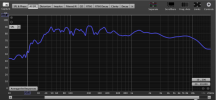
Edit II: This is my 605Bs, Paper diaphragms, Mastering Labs crossover. 10 feet away. I don't have all my support beams insulated yet, among other things.

605B Mastering Labs.png

605B Spectrogram.png
 
Last edited:
I just replaced the capacitors in the Mastering Labs crossovers for a positive impact. You might look into doing it. I need to figure out how to get the black stuff out of my N1600s without destroying them, so I can replace the capacitors in those. Didn't use anything fancy, just off the shelf from Parts Express. The old capacitors measured good.
 
Last edited:
I just replaced the capacitors in the Mastering Labs crossovers for a positive improvement. You might look into doing it. I need to figure out how to get the black stuff out of my N1600s without destroying them, so I can replace the capacitors in those. Didn't use anything fancy, just off the shelf from Parts Express. The old capacitors measured good.
Which capacitors you have put in now?
I think the originals were polyester film.
I am using K75-10 in my ML clone.
 
Back
Top Bottom