

You are using an out of date browser. It may not display this or other websites correctly.
You should upgrade or use an alternative browser.
You should upgrade or use an alternative browser.


smurfer77
Super Member
Thanks for the wonderful topic.
I'm having a hard time to adjust DC offset on my Alpha 607 MOS Premium... one channel is ~70mV and the other close to 0mV.
I did not find the service manual for this specific model so I used the one for the 607MR. Terminals and adjustment points are all in the same position so I followed the instructions to get to DC Offset, tried to adjust both jVR5L and jVR5R but it does not effect my DC offset readings, my probe shows exactly the same results no matter I try to adjust these two adjustment points... Of course I'm doing something wrong and now the situation is even worst
Someone said here TO NOT ground COLD and HOT terminals for DC offset readings as they are all alive BUT this is exactly what Sansui SM is suggesting to do... See picture below for reference. Am I reading it wrongly or the Japanese/English translation is wrong ? It says: Connection HOT OUT Speaker terminal and COLD OUT Speaker terminal
Another intriguing point: It says on "Remarks" Input Selector "CD" - OK very obvious - and then Input Terminal "Short"What does it mean ? That I have to short circuit the respective CD input RCA connector while I measure DC Offset ?
DC Offset pre-amp
View attachment 1766737
Take a look at this too:
On the "DC Offset Main Amp" instructions, "Step 2" - "Cold Side" - it says "connect probes between COLD OUT Speaker terminal and... COLD OUT Speaker terminal"This is not correct...
DC Offset Main Amp
View attachment 1766741
Guys, I'm in need of some help here and any light is welcome. Can you help me on how to adjust this integrate? BIAs, Offsets and their values, please keep in mind this is also a MOSFET sansui.
Thank you,
Sartore

Maybe you have some confusion. Nowhere on those pics does it mention grounding the hot or cold terminals. It does mention measuring by connecting between hot and gnd terminals, but there is high impedance (provided by the voltmeter) between the connection and this does not 'connect'/short them effectively. This is how voltage measurement is done, unlike current measurement which provides little to no impedance. Best to understand the difference well before working on live amps.

I agree this is very confusing - note also that the title of this is "Direct Current Off Set Voltage of Main Amplifiers Adjustment". Obviously they mean 'DC' (nothing to do with 'current' as such) - despite the fact that this is a Voltage measurement. Very confusing for people who might read this too literally, especially in the light of the other mistakes and typo's.DC Offset Main Amp

In 'Step 2' - 'Connection' - obviously there is a misprint there, but TBH I am not sure what is correct, I can only assume the second " Cold Out " should say "GND" ? - not at all sure about this.
Sorry I can't be more help at present - I'll do some investigation, see what I can find - and update here if I find some clarification.

Last edited:

SARTORE
Member
Maybe you have some confusion. Nowhere on those pics does it mention grounding the hot or cold terminals. It does mention measuring by connecting between hot and gnd terminals, but there is high impedance (provided by the voltmeter) between the connection and this does not 'connect'/short them effectively. This is how voltage measurement is done, unlike current measurement which provides little to no impedance. Best to understand the difference well before working on live amps.
Thanks for the feedback but I have to disagree. It is confusing and the translation was poorly done maybe because these units were intended to Japanese domestic market only. Why the heck put the word "speaker" between Hot/Cold and terminal ??? I believe that your experience in the electronics world is enough to guide you thru any process without a service manual but not everybody shares the same level of knowledge...

My objective is to learn how to measure and adjust and not complain about the SMs - you all know that service manuals are not 100% correct, sometimes.
Bumpalump patiently shed some light in my dark ignorance - I PMed him and took my questions out of this post

Hopefully Hyperion will come up with some good thoughts too.
Thanks again.
Sartore

JOMARK911
Super Member
So to reduce confusion. Take a look at the 911dg manual , and it's ways of adjusting and do the same. They both are a-xbalanced amps and the methodology is the same.
DC offset , hot to cold and hot to gnd. Two sets . If I remember correctly. probes set at the speaker terminals for the hot to cold measurement , and hot and grnd for the second measurement.
Bias , two sets again per channel , probes better be set on the test points on the board.
DC offset , hot to cold and hot to gnd. Two sets . If I remember correctly. probes set at the speaker terminals for the hot to cold measurement , and hot and grnd for the second measurement.
Bias , two sets again per channel , probes better be set on the test points on the board.
Last edited:

JOMARK911
Super Member
Yes you're right John. Hot amp is non inverting , cold amp is inverting.
But I believe this the general "fashion" for the inverting amp to be on "cold" side for all manufacturers. It's just that they don't call it cold, but rather refer to it as - , and + for the non inverting amp.
But I believe this the general "fashion" for the inverting amp to be on "cold" side for all manufacturers. It's just that they don't call it cold, but rather refer to it as - , and + for the non inverting amp.
smurfer77
Super Member
Thanks for the feedback but I have to disagree. It is confusing and the translation was poorly done maybe because these units were intended to Japanese domestic market only. Why the heck put the word "speaker" between Hot/Cold and terminal ??? I believe that your experience in the electronics world is enough to guide you thru any process without a service manual but not everybody shares the same level of knowledge...
My objective is to learn how to measure and adjust and not complain about the SMs - you all know that service manuals are not 100% correct, sometimes.
Bumpalump patiently shed some light in my dark ignorance - I PMed him and took my questions out of this post
Hopefully Hyperion will come up with some good thoughts too.
Thanks again.
Sartore
you wrote "Someone said here TO NOT ground COLD and HOT terminals for DC offset readings as they are all alive BUT this is exactly what Sansui SM is suggesting to do... See picture below for reference. Am I reading it wrongly or the Japanese/English translation is wrong ? It says: Connection HOT OUT Speaker terminal and COLD OUT Speaker terminal"
Let me explain further by a few statements that might be more constructive than my last comment. Some points you may know, so forgive me, but hopefully some of them will sort our the issue. I have a feeling the very first point is where the confusion arose.
- sansui SM here does not say to "connect hot and cold", implying shorting. it says under "connection" column to "put a high impedance probe between them". It does not say to actually connect directly. The "connection" column in the table says where to connect via a measurement probe, rather than directly connect with a wire and nothing else; this is very different. next point explains.
- connecting A to B via a voltage measuring device does not 'ground' A or B (connecting then via a plain wire of wire would not even do that, unless either A or B is already at groud). Connecting via voltage measurement probes does not 'connect' (A) or (B) effectively as there is a large resistor between A and B in this measurement device. So even if B is at ground, A is not being grounded by this voltage measurement. (this is not the same for current measurement, which led to my slightly obnoxious comment that you should learn some basics).
- in a non-bridged amplifier the negative terminal is typically at ground potential (voltage), only only positive terminal has an active potential.
- in a bridged amplifier (which is what the alpha series amps are), the negative terminal is now called 'cold'. It is not at ground potential. It has just as much voltage from ground as the hot terminal, equal in voltage amplitude and opposite in phase (so when hot is at say +10V, cold is at -10V, the different seen by the speaker being a 20V...and this is how bridged amps get more power out of small amps)
- i.e. neither hot nor cold are at ground so even connecting them directly wouldn't ground anything (more explanation as to why and also why you might want to ground a speaker terminal in a non-bridged amp)
- when measuring output of amps we might connect ground of measuring equipment to negative speaker output terminal, for a few reasons (such as hooking up to an oscilloscope). This is usually okay because negative terminal typically sits at ground potential. Why people say this is not ok with bridged amps is because as mentioned above the cold terminal is not at ground...there is an amplifier inside trying to swing voltage either side of ground, just like at the other speaker terminal.
I've written before that I don't like the hot and cold terminology, preferring inverting and non-inverting instead. Cold, in some fields, does imply passive/ground, so I do find that misleading but in audio it's fairly commonplace terminology.
The only thing truly wrong in those pages is the second 'cold' which should read ground. However, the use of "speaker" is ok. They wrote "hot (speaker) terminal" and "cold (speaker) terminal" because these probe points are at the speaker terminals, whether you touch your DVM probe to the appropriate pins on the driver board, or the speaker terminals themselves matters not (they are directly connected). I agree though, the translation is not great.... I'm used to dealing with japanese translations... maybe that helps. And don't be upset by being confused by bridged amplifiers, I was too until i studied them. Good luck.

Alfanijs
Always learning
To Alfanjis
I too would be interested in a comparison of the B-2102MV and the 907 Limited. The B-2102MV was the amplifier end of the AU X1111MV and these two MOS FET amplifiers are separated by about 6 years and, IIRC, were the last two of Sansui’s MOS FET integrateds. ...
Marc
Hi Marc,
You are absolutely correct however this may take a while. My 907 LTD was damaged in transport and I definitely want to do a full health check before powering her up. Will be challenging to get this done still this year - but I promise to keep you posted!
And yes, the AU-X1111 MOS V was the integrated version of the separate B-2102 MOS V power amp. It was the final incarnation of the famous AU-X1 series.
There was no new preamp released around 1988 as far as I know. However in my opinion the closest candidate for a separate, matching preamp would be... the C-2101/2 preamp! The schematics are very similar and I am convinced that the C-2101 fundamentally is a very good design. (C-2301 V would be nice too of course, but is over 10x as expensive and fully balanced... truly high-end.)
The major flaw of the C-2101 is its budget component selection; it was brought to market in the early-mid 80's during the cost-cutting, downhill period of Sansui. I have 2 and out of the factory they tend to sound ok-ish, with sparkling highs but a tendency to harshness and sibilance; nothing special and certainly not superior to the CA-F1. But after upgrading and modding my C-2101 is sounding extremely well indeed. So good that I paired it to my B-2102 MOS V and stopped looking for an alternative preamp!
I must admit that I never had the chance to do an A-B comparison of the AU-X1111 MOS V and the C-2101/B-2102 MOS V combo - or my modded C-2101 versus a C-2301 V (drool...) - though I would really love to!
Anybody have an opinion?
How the B-2102MV sounds, however, might be significantly influenced by which preamplifier you are using to drive it.
Fully agree. It would be fair to compare the power amp sections only, using the same preamp for both. And as mentioned above, this would probably be my C-2101 feeding the balanced inputs.
Cheers, Nijs

Hi Nijs.
Two points. I think that the X1111MV is more in the “adventurous” spirit of the X1 rather than a direct descendant. Also, if I recall correctly, the 2102MV can be run with a direct input, say from a cd player or tuner but not a turntable, without the need for a preamp.
Marc
Two points. I think that the X1111MV is more in the “adventurous” spirit of the X1 rather than a direct descendant. Also, if I recall correctly, the 2102MV can be run with a direct input, say from a cd player or tuner but not a turntable, without the need for a preamp.
Marc
Alfanijs
Always learning
Hi Marc,I think that the X1111MV is more in the “adventurous” spirit of the X1 rather than a direct descendant.
Yes of course, the circuit topologies are very different. The AU-X's were basically power amps with an input selector and control amps, with a good phono section but no tone controls. Indeed, the family description "adventurous" would fit nicely.
Also, if I recall correctly, the 2102MV can be run with a direct input, say from a cd player or tuner but not a turntable, without the need for a preamp.
You are correct about the direct input options for the B-2102/3 MOS V. They have a selector switch on the front panel for Balanced and Single-ended inputs, both fixed (1/1) and variable (1/2) level. The input potentiometers for left and right channels, also on the front, are mechanically coupled via a clever friction mechanism, so they can be adjusted together as well as individually to set balance.
.JPG)
However, input impedances are relatively low at 10k, much lower than those of most preamps (typically 47k for SE inputs). Interestingly, the power amp direct section of the integrated amps is even lower, only half of that, 5k. My understanding is that this would reduce the CMRR and make the system more sensitive to source impedance and interconnect cable differences.
I do not have a CD player with balanced out so I only tried the SE inputs directly to the power amp. It did work but I could not say that it sounded any better on my system than with a good preamp in. And since I need the phono inputs and also like a large volume knob, as well as having the option of using tone controls (sorry to all audio puritans!), the preamp stays.
I did add impedance balanced output on my preamp and used a balanced connection between them. My feeling is that this cleaned up the sound a bit and I now like the system with preamp better than without, but this may be related to psychoacoustics as I did no blind testing. If anything, differences are small.
Nijs
Alfanijs
Always learning
Hi Marc and all others interested in a comparison between the 2102 MOS V and the Alpha 907 LTD. I am happy to share my first listening impressions. (My LTD was damaged in transport; I finally managed to restore it to a working state. But that is something for another thread.)
The moment I hooked up the a907LTD I was literally speechless. It really does sound sublime, exceeding my already high expectations after reading what others have said about it. They are right! How is it possible that a non-black amplifier can sound so fantastic? The LTD has incredible detail and space, there is a certain 'airiness' to the music, with a bass that is deep yet controlled. I wanted to keep listening all night (actually I almost did
  )
)
The diffference with my 2102 MOS V was obvious but I find it hard to describe in words. The 2102 sounded relatively flat and bass-heavy, almost booming compared to the LTD.
Actually the difference was much larger than I expected since there are so many similarities between both amps. One thing I noticed was that the LTD got really warm, much hotter than the 2102 which always remained lukewarm at most. So I decided to check the bias settings for both, using the info from this thread (thanks again Mr. T and @smurfer77 !). 907 LTD was a bit on the high side, but close to specs. The 2102 measured a neat 8.8-9 mV per bank. ... But wait a minute! 8.8 mV?!? that is the setting for the LAPT amps! It should be around 27 mV for a MOSFET! How could this happen? I bought the 2102 from a reputable shop, serviced. So they must have taken the wrong values. And I did not check it on arrival, trusting that it would be OK. Clearly not! Another learning moment for me...
While inside the 2102 MOSV I noticed that the dreaded glue was attacking some key components. So I took the opportunity to take out the power amp boards, clean everything up and apply fresh thermal paste to the output FETs. Solder was mostly still looking OK, touched up a few connections and replaced C5 with a Silmic II.
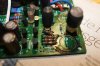
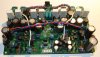
After proper adjustment my 2102 now gets a little warmer but still not very hot. It sounds better (as it should with 3 times the bias current!), closer to the 907 but still different. I did not listen long however as there is still a problem with the 907 - this remained very hot, with clear differences between sides. The Left channel at the front in particular got really hot. Too hot for comfort so I took her to the bench again to investigate further. Will keep you posted.
Bottom line: check your bias settings before doing a listening comparison!
The moment I hooked up the a907LTD I was literally speechless. It really does sound sublime, exceeding my already high expectations after reading what others have said about it. They are right! How is it possible that a non-black amplifier can sound so fantastic?
The LTD has incredible detail and space, there is a certain 'airiness' to the music, with a bass that is deep yet controlled. I wanted to keep listening all night (actually I almost did )The diffference with my 2102 MOS V was obvious but I find it hard to describe in words. The 2102 sounded relatively flat and bass-heavy, almost booming compared to the LTD.
Actually the difference was much larger than I expected since there are so many similarities between both amps. One thing I noticed was that the LTD got really warm, much hotter than the 2102 which always remained lukewarm at most. So I decided to check the bias settings for both, using the info from this thread (thanks again Mr. T and @smurfer77 !). 907 LTD was a bit on the high side, but close to specs. The 2102 measured a neat 8.8-9 mV per bank. ... But wait a minute! 8.8 mV?!? that is the setting for the LAPT amps! It should be around 27 mV for a MOSFET! How could this happen? I bought the 2102 from a reputable shop, serviced. So they must have taken the wrong values. And I did not check it on arrival, trusting that it would be OK. Clearly not! Another learning moment for me...
While inside the 2102 MOSV I noticed that the dreaded glue was attacking some key components. So I took the opportunity to take out the power amp boards, clean everything up and apply fresh thermal paste to the output FETs. Solder was mostly still looking OK, touched up a few connections and replaced C5 with a Silmic II.
After proper adjustment my 2102 now gets a little warmer but still not very hot. It sounds better (as it should with 3 times the bias current!), closer to the 907 but still different. I did not listen long however as there is still a problem with the 907 - this remained very hot, with clear differences between sides. The Left channel at the front in particular got really hot. Too hot for comfort so I took her to the bench again to investigate further. Will keep you posted.
Bottom line: check your bias settings before doing a listening comparison!
Last edited:
smurfer77
Super Member
Hi Marc and all others interested in a comparison between the 2102 MOS V and the Alpha 907 LTD. I am happy to share my first listening impressions. (My LTD was damaged in transport; I finally managed to restore it to a working state. But that is something for another thread.)
The moment I hooked up the a907LTD I was literally speechless. It really does sound sublime, exceeding my already high expectations after reading what others have said about it. They are right! How is it possible that a non-black amplifier can sound so fantastic?
The diffference with my 2102 MOS V was obvious but I find it hard to describe in words. The 2102 sounded relatively flat and bass-heavy, almost booming compared to the LTD.
Actually the difference was much larger than I expected since there are so many similarities between both amps. One thing I noticed was that the LTD got really warm, much hotter than the 2102 which always remained lukewarm at most. So I decided to check the bias settings for both, using the info from this thread (thanks again Mr. T and @smurfer77 !). 907 LTD was a bit on the high side, but close to specs. The 2102 measured a neat 8.8-9 mV per bank. ... But wait a minute! 8.8 mV?!? that is the setting for the LAPT amps! It should be around 27 mV for a MOSFET! How could this happen? I bought the 2102 from a reputable shop, serviced. So they must have taken the wrong values. And I did not check it on arrival, trusting that it would be OK. Clearly not! Another learning moment for me...
While inside the 2102 MOSV I noticed that the dreaded glue was attacking some key components. So I took the opportunity to take out the power amp boards, clean everything up and apply fresh thermal paste to the output FETs. Solder was mostly still looking OK, touched up a few connections and replaced C5 with a Silmic II.
View attachment 1856076 View attachment 1856077 View attachment 1856078
After proper adjustment my 2102 now gets a little warmer but still not very hot. It sounds better (as it should with 3 times the bias current!), closer to the 907 but still different. I did not listen long however as there is still a problem with the 907 - this remained very hot, with clear differences between sides. The Left channel at the front in particular got really hot. Too hot for comfort so I took her to the bench again to investigate further. Will keep you posted.
Bottom line: check your bias settings before doing a listening comparison!
Not trying to be a smart a*%; did you did comparison under matched volume (using pink noise, not sine wave (the later can result in different average volume across all frequencies)), do it blind with aid of a helper, and use an amp selector switch box for instantaneous switching?
smurfer77
Super Member
Hi smurfer77.
Just curious as to how you are leaning. When adequately blinded do you think that you could detect a difference between these?
Marc
Before I did the amp switchbox and the pink noise volume matching it was easy to tell all amps apart
. Now i moved to a more rigorous comparison format, things became a lot trickier. I can tell apart almost all amps, but some a so similar it's not worth talking about. Some are still very different. I haven't compared the amps mentioned in the above post, but I have compared the 907LTD to the somewhat related (to the 2102 MOS) AU-X111MOS Vintage. The AU-X111MOS Vintage is to my ears a more neutral amp, like the AU-X11, whereas the 907LTD has that hint of syrup like my old 777A. Just my opinions.
Thanks smurfer77
I have a switchbox but haven’t measured volume comparisons, just volume adjustment by ear although I can use the Audio-Technica iPhone app to do this. I have these amps hooked up, X1111 MV, 907LTD, and a B2102 MV. I am using a C2105 with the B2102 MV (I haven’t looked to see if I can use the B2102 MV without a preamp, I think that I can). I think that the C2105/B2102 MV combination sounds better than the AU X1111 MV and likely eventually get rid of the X1111 MV. I am not sure I can distinguish between the combo and the LTD. In general (72 y/o ears) I have a hard time distinguishing between the alphas and MV amplifiers but the alphas definitely sound different than the preceding amplifiers. Some day my X1 will be restored and I can compare it. My guess is that, even to me, it will sound different than the later alphas. Take care.
Marc
I have a switchbox but haven’t measured volume comparisons, just volume adjustment by ear although I can use the Audio-Technica iPhone app to do this. I have these amps hooked up, X1111 MV, 907LTD, and a B2102 MV. I am using a C2105 with the B2102 MV (I haven’t looked to see if I can use the B2102 MV without a preamp, I think that I can). I think that the C2105/B2102 MV combination sounds better than the AU X1111 MV and likely eventually get rid of the X1111 MV. I am not sure I can distinguish between the combo and the LTD. In general (72 y/o ears) I have a hard time distinguishing between the alphas and MV amplifiers but the alphas definitely sound different than the preceding amplifiers. Some day my X1 will be restored and I can compare it. My guess is that, even to me, it will sound different than the later alphas. Take care.
Marc
AU-Alpha907DR: 8.8mV 0.22Ohm, 40mA (schematic only, no SM)
Parts of the 907DR manual here: https://audiokarma.org/forums/index.php?threads/sansui-au-alpha-707dr.727376/#post-10873700
I am lacking the schematic in a high resolution scan. The one on hifiengine is nice, but it is hard to decipher few partnames even when increasing the size on the PDF a lot...
So, I did some comparisons today but they were neither blinded nor given the time they deserved. My musics choices were also limited by time. I am being blessed (seriously) by having my 32 y/o son and his fiancee move in with us (corona virus related unemployment, post Ph.D. with limited interview prospects nor interest in interviewing all over the place in these times) at the end of the month and we are trying to get ready and make space for them and their stuff. The bottom line is it all sounds good to me.
My speakers are Yamaha NS 1000 monitors. I have the music in aiff format on a hard drive hooked up to an airport extreme and use FileBrowser to pick selections which are sent over WiFi to my airport express with its optical output going to a DAC and then to a switchbox which distributes the analog output to, among other things,
1. an AU X1111 MOS Vintage.
2. a C-2105 Vintage feeding a B-2102 MOS
Vintage (presumably the X1111 MV amplifier with
a more modern and presumably better preamp.
3. an AU 907 Limited.
4. just for laughs an alpha 907 MR (the only non-
MOS FET of the group.
I used the Audio-Technica iPhone app (on two separate iPhones to both generate pink noise (sent via Airplay to Airport Express) and as an SPL meter to adjust the amps volumes to about 55 dBl at 1000 Hz. FileBrowser and my music library are accessed by iPhone using Airplay to send the tracks to the Airport Express.
I did not have anyone to push the buttons for me on the switchbox so I was not blinded.
Bottom line, for whatever it is worth, all amps sounded superb and this is just one of the reasons that audio memory is limited. I doubt that my impressions would be reproducible if blinded but my preferences were:
907 Limited>C-2105/B-2102MV>X1111MV>907MR.
I didn’t have time to go through much music. Even with “only” four amplifiers this gets tiresome and the first one you choose to listen to with a new musical choice, often sounds better than the ones that follow. A blinded comparison using just two amplifiers would have been a better way to do this. I might try again later.
My music preferences are classical, bluegrass, and classic rock. Today I sampled the Queen of the Night aria (der Holle Rache etc.) from Mozart’s Magic Flute (voice and orchestra), Spanish Harlem (Rebecca Pidgeon, from Chesky Ultimate Demonstration Disc), Selections from Beethoven’s Violin Concerto (Bernstien/Hahn for the sound of violin and orchestra) and Stravinsky’s Firebird Suite (one of several with Stravinsky conducting for dynamic range, bass and other stringed instruments, cymbals, harp), Bach's Partita #2 Ciaccona played on mandolin by Avi Avital (tone/dynamics of mandolin sound reproduction), and finally the second movement of Bach’s Concerto in F minor for Harpsichord (Billy Pilgrim marching through the snow in the movie Slaughterhouse Five, for continuo and harpsichord tone reproduction).
On the whole this was an exhausting and I don’t really feel that I accomplished much other than to determine, once again, that I have too many Sansui amplifiers and that my listening ability/skills leave much to be desired but that I could start thinning the herd and be quite happy.
Marc
My speakers are Yamaha NS 1000 monitors. I have the music in aiff format on a hard drive hooked up to an airport extreme and use FileBrowser to pick selections which are sent over WiFi to my airport express with its optical output going to a DAC and then to a switchbox which distributes the analog output to, among other things,
1. an AU X1111 MOS Vintage.
2. a C-2105 Vintage feeding a B-2102 MOS
Vintage (presumably the X1111 MV amplifier with
a more modern and presumably better preamp.
3. an AU 907 Limited.
4. just for laughs an alpha 907 MR (the only non-
MOS FET of the group.
I used the Audio-Technica iPhone app (on two separate iPhones to both generate pink noise (sent via Airplay to Airport Express) and as an SPL meter to adjust the amps volumes to about 55 dBl at 1000 Hz. FileBrowser and my music library are accessed by iPhone using Airplay to send the tracks to the Airport Express.
I did not have anyone to push the buttons for me on the switchbox so I was not blinded.
Bottom line, for whatever it is worth, all amps sounded superb and this is just one of the reasons that audio memory is limited. I doubt that my impressions would be reproducible if blinded but my preferences were:
907 Limited>C-2105/B-2102MV>X1111MV>907MR.
I didn’t have time to go through much music. Even with “only” four amplifiers this gets tiresome and the first one you choose to listen to with a new musical choice, often sounds better than the ones that follow. A blinded comparison using just two amplifiers would have been a better way to do this. I might try again later.
My music preferences are classical, bluegrass, and classic rock. Today I sampled the Queen of the Night aria (der Holle Rache etc.) from Mozart’s Magic Flute (voice and orchestra), Spanish Harlem (Rebecca Pidgeon, from Chesky Ultimate Demonstration Disc), Selections from Beethoven’s Violin Concerto (Bernstien/Hahn for the sound of violin and orchestra) and Stravinsky’s Firebird Suite (one of several with Stravinsky conducting for dynamic range, bass and other stringed instruments, cymbals, harp), Bach's Partita #2 Ciaccona played on mandolin by Avi Avital (tone/dynamics of mandolin sound reproduction), and finally the second movement of Bach’s Concerto in F minor for Harpsichord (Billy Pilgrim marching through the snow in the movie Slaughterhouse Five, for continuo and harpsichord tone reproduction).
On the whole this was an exhausting and I don’t really feel that I accomplished much other than to determine, once again, that I have too many Sansui amplifiers and that my listening ability/skills leave much to be desired but that I could start thinning the herd and be quite happy.
Marc
Alfanijs
Always learning
Not trying to be a smart a*%; did you did comparison under matched volume (using pink noise, not sine wave (the later can result in different average volume across all frequencies)), do it blind with aid of a helper, and use an amp selector switch box for instantaneous switching?
No I did not, hope I did not raise such high expectations! I have a lot of respect for people like you and Marc as this is a lot of effort and takes up a huge amount of time.
However I will not be using this method.
Don't get me wrong: as an engineer, I do agree that this would be the most objective way to perform a comparison. But practical limitations (lack of space in my room, no switching equipment, being alone,...) and most importantly time considerations make me follow a different, less scientific approach. I simply put new equipment in my system and listen to it over a longer period of time, up to several weeks, playing all kinds of music from multiple sources, allowing my impression to grow over time; I may switch back a few times. Sometimes I sit back and listen really carefully to music that I know well.
Now these amps are so good, they are very close and I am sure I will not be able to tell them apart blindly. However I think I can recognize a certain character, which I may like more or less. In the end, listening preferences remain highly subjective anyway...
Bottom line, for whatever it is worth, all amps sounded superb and this is just one of the reasons that audio memory is limited. I doubt that my impressions would be reproducible if blinded but my preferences were:
907 Limited>C-2105/B-2102MV>X1111MV>907MR.
Not having listened for a long time to the 907 LTD yet, my current impression is that like Marc, I place the 907 LTD slightly above the B-2102 MOSV (both run from my modded C-2101 via the balanced inputs). If anything, the 2102 reminds me a bit more of the "old" Sansui sound, it puts a little more focus on the bass regions compared to the 907 LTD, which I find very neutral sounding with all kinds of music. The 2102 sounds particularly great with for instance live concerts or jazz recordings.
I have no X1111 but did compare them to my BA-F1 (which I used to like a lot)... these machines are in another leage altogether. Not sure if it is related to the MOS outputs, but the level of detail, spacing and bass tightness is so much better. So like the AU-919 and the CA-F1 before, the BA-F1 has to give up its place in the living room... sadly...
Interesting detail for psychoacoustics: My visual ranking is exactly opposite: I like the looks of the BA-F1, black understated design with the cool power meters, then follows the 2102 which is a bit boring but still black (so it must sound good
). Then a long time nothing optically - I still am no fan of the rounded looks and gold color of the 907 LTD. But it does sound best to my ears!Happy listening, Nijs
Last edited: