• The move to the new server is done. There are some software and database maintenance updates in process. This has us passing the hat around to help out. We appreciate any donations. Seriously, even a dollar helps. The payment page may be found here - https://www.audiokarma.org/support.html

Sansui AU-6900 Woes .......

camgilbert

Member
Hello all,

Long story short, I inherited a Sansui AU 6900 in a broken state, missing output transistors (3 of NPN's had been removed)

Funny thing, this was to be my first major restore project, its the unit I started with and while I was waiting for parts and troubleshooting, I went on to other projects which went very well all working, caps replaced and so on. Good stuff.

  • So i get the 3 missing transistors (I used NTE-88s) install them, low and behold the unit powered on but the protection relay would not click in.

  • Read a few threads and replaced the caps on the 2596 board and bingo, the relay clicked in.

  • Output was distorted. Especially on one channel.

  • Read a few more threads and decided to replace all output transistors with Semi's (NPN and PNP)

  • Power it up and both channels level but still some distortion.

  • Then disaster hits, I decide to do some re-assembly just to organize things, turn it on and a cap that I replaced just pops.

  • I replace it, turn the unit on and both 7A fuses blow in a flash of colourama!!!

  • Frustrated, I put all of the original transistors back in and sure enough, both 7A fuses blow again.

So, do I move past this and call it an experiment gone wrong (not really my style) and use the face plate to serve peanuts to my friends?

or maybe i throw myself to the mercy of the Sansui experts and see what comes up.

I leave myself in your capable hands!

Thanks in advance.

Cam
 
Register to hide this ad
The cap that blew up was probably put in backwards. Sometimes the silk screen on the pcb is wrong. When you replace caps, always look at how the original was in there before you remove it and mark the board with a Sharpie if it is wrong.
When there are blown output transistors, always test the driver transistors and bias transistor and pot.
 
Thanks to all.

The interesting part about CAP was that it worked fine in my initial tests until "the incident" happened.

Regarding the output transistors (Since I have two sets and put them both in) how do I know if any of them are blown?

Also, why if they working working initially (see initial thread) would both sets start blowing the 7A fuses?

Thanks

Cam
 
Search this site for how to test transistors. Caps put in backwards do not always blow immediately. One side of the cap is going to connect to ground, the other side connects to either a positive or negative supply. Look at the schematic and see which side of the cap connects to ground, the + or - side. Then measure with your meter between ground and each pad that the cap connects to, to see which one is ground. Then see if the silk screen is correct.
 
It happens to all of us. I was racking my brains for why an Akai amp wasnt working and putting a power cap in backwards was the reason why that cap burst. Its generally a good indicator.

I think you need to slow down a bit with this - try to identify faults before doing work like recapping.

Build and use a DBT. Otherwise you will keep burning thru the fuses and destroying more parts.

You will find opinion on this site doesnt favour NTE parts - generally they are rebadged other parts and they are a bit like a box of Forrest Gump chocolates. Selecting good equivalents like Onsemi, Fairchild etc and getting these form Mouser, RS, Digikey is a much better idea.
 
The AU-6900 is a good Guinea Pig for a learning experience. Follow the advice given so far and the good folks here can help you through it. When you have a couple minutes, please post the serial number for the database. Click on the link in my signature block.

- Pete
 
Again, thanks to all for your support so far!

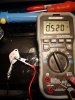
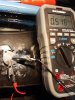
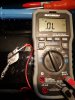
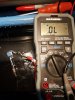
So i tested all of the output transistors. (As a reminder, I ordered the brand new 8 x On Semi/PNP/NPN and installed them all at one time)
You can see my test results below:
12 failed with basically the same meter reading (1) in red. (including the 8 new On Semi)

4 appeared to be ok showing the meter reading in (2) green.

Look, I get it. I'm an IT guy. Things happen that we cant explain. But we tend to look at things logically. We always use change management! We always asked what changed before troubleshooting.

But this, I dunno, as a refresh:

  1. Put in the NTE 88s, unit turned on, distorted output, one channel low.
  2. Ordered the On Semi, installed all 8, unit turned on and both channels same level with some distortion.
  3. Re-assembled unit, turned on and C612 cap explodes, 2 x 7A fuses blow.
  4. Replaced cap (insured correct polarity) and 2 x 7A fuses blow.
  5. Re-installed the original 8 transistors and 2 x 7A fuses blow.
  6. Desperation and consideration of peanut tray set in!
  7. Guidance from you fine folks
  8. Testing of TR's below.
Please be honest and let me know if I should switch to breeding cats!


20170823_230247.jpg 20170823_230606.jpg 20170823_230618.jpg
 
Ok, to put it in a different way, your server wasn't booting, so you changed an obviously failed hard disk, and when it still didn't boot up, you changed it again, even though there was nothing wrong with it - not realising that you had a failed array controller battery and a failed DIMM.

What I mean is that vintage amplifiers don't have internal health monitoring and warning LED's (apart from the protection light) like servers do, so you won't get any indication of where the fault is unless you understand electronics fault finding and how electronic devices work, 'shotgunning' components often gets you into more trouble.
 
Last edited:
Build and use a DBT. Otherwise you will keep burning thru the fuses and destroying more parts.

OK this bit here - you need to do this and not power the unit on except thru this. Very easy to make and will save you a lot of trouble.

If you are getting ambiguous/unclear readings on trannies its best to completely remove them from circuit to test them. The new ones will not be testing as duds, you should use them as a reference for what a good reading looks like on a meter.

If I was in your position I would pull all outputs, test them, be clear about which ones are good - install those. Then power the amp up thru a dbt to see if the bulb glows brightly. If it does - you still have a major short somewhere. If it doesnt - then try to set bias and DC offset as per the service manual. If there is still audible distortion or you are reading funny voltage readings somewhere then look for more faulty component/s.
 
I cannot tell from the pics and the use of nte outputs however are you sure you have those outputs installed correctly paying attention to which are npn and which are pnp transistors? Should be two of each type per side in the correct locations. If installed incorrectly yes instant kaboom will occur. Others should chime in with the output layout as I am very time limited this morning. Can be a challange reading Sansui schematics as they are drawn from the trace side rather than the top down side of the board in question. Often have to reference the actual circuit drawing to sort this out rather than the board diagram.

-Lee
 
Thanks again.

Lots of good information above and I understand that the components leading up to the OT's can be problematic.

I think the information I need to know here is what it takes to "kill" an output transistor.

The 8 on Semi's I ordered and installed once, were tested out of the amp and show that low reading from pics above.

Are they really dead? Am I testing incorrectly?

I will build a DBT shortly, but do I need to purchase 4 more TR's to move on to that test?

Thanks

Cam
 
Except what you need for the DBT, don't buy anything else until you do the tests and know what you need.

- Pete
 
Thanks again to all. DBT built and working (Great because I was down to my two 7A fuses!)

As you can see the 6900 is fully shorting in its glory!!

Any thoughts on next steps?

Would the 4 x bad output transistors (alleged) cause a full short like this?

Cheers

Cam

20170827_150526.jpg
 
New information (thanks to DBT)

When I remove the leads from the power board to the main caps (shown below) the unit powers up properly.

Thoughts,

Cam

20170827_151512.jpg
 
After removing the transistors, effectively I'm getting the results show below.

Note: the small transistor I get no readings on it whatsoever.

Am I measuring incorrectly?


20170827_173134.jpg 20170827_173525.jpg 20170827_173156.jpg 20170827_173848.jpg
 
Removing the caps from the equation - could be a shorted cap? Im not sure how common that is...leave checking that till last.

Your tests on the outputs - are you getting the same readings for all the outputs? If so, this looks OK.

Are the smaller trannies you are testing the pre-drivers? If so, its more common for these to blow if an output has blown.

In the event of a dead short like this I would be placing priority on checking the outputs, pre-drivers, then bridge rectifiers, then looking for a shorted or reversed powersupply cap.
 
So I'm groggy and on the ropes ....................

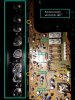
  1. I have taken out, tested and replaced all output TR's highlighted by the green box. (Including the smaller ones)
  2. I did appear to find two of the large TR's as bad (1 x PNP and 1 x NPN)
  3. I replaced those resistors shown with green boxes.
  4. I have replaced every electrolytic capacitor on the board.
  5. I tested the TR's highlighted in orange and they both seemed fine.
  6. I tested the resistors highlighted in orange and they were fine.

When i hook up the Orange and Brown leads from the Main Caps I still have a DEAD SHORT.

When I remove those leads the unit powers on.

Along with my patience wearing thin it appears that the board itself is problematic as some solder points are peeling slightly after I remove a component and then replace or put back in. (I test each connection so nothing that would impact this issue yet.)

Therefor it would be nice to hit a homerun with the next test or at least a triple down the first base line ..... :)

Thoughts?


20170905_223905.jpg
 
Back
Top Bottom