• The move to the new server is done. There are some software and database maintenance updates in process. This has us passing the hat around to help out. We appreciate any donations. Seriously, even a dollar helps. The payment page may be found here - https://www.audiokarma.org/support.html

Sansui AU-6900 Woes .......

Good people - Your were right. After getting all the obvious parts that i could get locally, this amp has refused to talk to me. It blew both the 7A fuses as i watched . I replaced the 4 fused Resistors- R31,R32,R41,R42, C606,C607, R612 and R613. I could not get IC01 and IC02. So as mentioned in this forum , i will have the amp on the work bench for a while. But the question i have is - why would the 2 7A blow again?
 
Your previous meter readings on the output transistors showed one channel shorted I believe? Remove the suspect devices and test them using your meters diode function. There are many internet guides on how to test these..
 
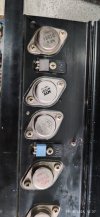
Good People - I have made progress but not completed. I noted that 2 output transistors needed to be replaced. I got NTE as seen here. Interestingly, the amp powers on okay and no fuses have blown. I have left the amp on power for 10 minutes with Speakers A+B engaged but no speakers connected. I can feel some slight heat emitting from theNTE.jpg amp ( still open) and equally some wormth from the left transistors. The voltage on the 4 ceramic resistors reads 27.8, 28.9 , 29.6 and 30.4 mV on one side, and 23.9, 24.1, 25.1 and 24.9 mV on the other side. I measured with the black meter probe on the chassis. Is this right? How do i reset the Bias ? How about the DC off set ? Can i comfortably now connect my Turntable and speakers ?
 
Do you have the service manual?? All the instructions for your questions are listed in the manual.
What are you getting for DC voltage at your speaker terminals? That is the offset voltage..
 
Do you have the service manual?? All the instructions for your questions are listed in the manual.
What are you getting for DC voltage at your speaker terminals? That is the offset voltage..
I I have the service manual. Let me check tomorrow ( it's 10.30 pm here in EA Africa. So I sleep) But tomorrow, I hope all will be well. Thank you for the advise on the offset. I will also check the reference voltage in the manual.
 
No heatsink compound? - you know the white stuff :idea:
Hi John,

The limited number of the X900 and X700 units I have worked on have original fitment of clear silicon grease as the heatsink compound. This silicon grease compound was used on other late 60s/early 70’s sansui gear (AU-222 I have on the bench at the moment has the clear grease).
Cheers
John
 
Hi John,

The limited number of the X900 and X700 units I have worked on have original fitment of clear silicon grease as the heatsink compound. This silicon grease compound was used on other late 60s/early 70’s sansui gear (AU-222 I have on the bench at the moment has the clear grease).
Cheers
John
Yes, I have seen one or two of those, an AU-7900 was one I remember, but in the picture it looks dry suggesting no compound at all to me. And the poster said he had replaced some output transistors, so I would have expected to see some signs of this. ;) :dunno:
 
Thank you all for your guidance.
I adjusted the bias from 0mV to 17.9mV for the Right Side and 38mV to 18.1mV for the Left side . Soon after that i connected my gear and sad to note that no sound was produced from speaker ( A & B) even inputting from any source input. What is the next thing i should do?
Also measured the speakers output terminals with a meter and all started at about 100mV and increased continously to over 300mV on each of the four speaker outlets. Is this expected?
 
Thank you all for your guidance.
I adjusted the bias from 0mV to 17.9mV for the Right Side and 38mV to 18.1mV for the Left side . Soon after that i connected my gear and sad to note that no sound was produced from speaker ( A & B) even inputting from any source input. What is the next thing i should do?
Also measured the speakers output terminals with a meter and all started at about 100mV and increased continously to over 300mV on each of the four speaker outlets. Is this expected?
The DC at the speakers should ideally be less then 50mv and stable..
A good start to narrow down your issue would be to use the preout ,/ main in jacks on the rear. Determine which section of the unit has problems. Connect a preamp or even a phone into the main in jacks ( if using a phone / iPod, keep the volume quite low) see if you can produce any sound. If you can get sound from the unit this way, then you will concentrate on the preamplifier section of the unit.
 
Thank you @The Fuxtor ,I actually forgot to mention that i plugged my phone into the Main port ( Pre-Amp area ) and there was not sound reproduced. So based on your approach, the indication is that the amp still has a problem. I guess i have to diagnose again
 
Are you still blowing F601 and F602? I ask because I want to understand this series of amps as well, and I am no technician. You said they were 7 amp fuses. I am looking at the schematic and note the international version with switchable power source shows that F601 and F602 are 6 amp fuses. 7 amp fuses were used on the solely domestic Japanese version. I believe Kenya is on 230 /50 power so I am taking a long shot by asking if yours is configured incorrectly for type G power. Of course you would probably know the history of your unit and that it has spent all of its life so far in your area, or whether it was recently imported from Asia for example.

The experienced techs may roll their eyes at this question, but I just want to make sure this issue is not a factor.
 
The experienced techs may roll their eyes at this question, but I just want to make sure this issue is not a factor.
Not me, but that's a fair enough question, you tend to see higher amperage fuses on the lower voltage versions, so 100V i.e. JDM models will have the highest current fuses, the USA at 120V will be a little less and Kenya or the UK for example, at 230V, will have the lowest rating fuses. The reason? - because to power this device it has a predictable power consumption, this is the product of V x A - which must come to the same or a very similar number no matter where in the World it is used. It is this that governs the fuse ratings - according to local electrical safety requirements. ;)
 
Back
Top Bottom