• The move to the new server is done. There are some software and database maintenance updates in process. This has us passing the hat around to help out. We appreciate any donations. Seriously, even a dollar helps. The payment page may be found here - https://www.audiokarma.org/support.html

Sansui eight trouble

In the following discussion, when I refer to a node in the circuit of 2 components, that's the place where they are connected together.
On the F-1235 board, Short the node of R7019, R7021, and C7009 to ground. Does the noise stop on one channel? If not, short the node of C7027, R7055, and R7057 to ground. Does the noise stop?
 
In the following discussion, when I refer to a node in the circuit of 2 components, that's the place where they are connected together.
On the F-1235 board, Short the node of R7019, R7021, and C7009 to ground. Does the noise stop on one channel? If not, short the node of C7027, R7055, and R7057 to ground. Does the noise stop?

Hmmm, no change in either case. This thing sure is stubborn.
 
This means that everything to the west of C7027 is ok. Next short the node of C7039, and R7071 to ground. Is the noise gone?
 
Classic half-split troubleshooting!

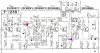
In the diagram below, Doc asked OP to short the following points in order to ground.
Red, Purple, Green, then Yellow.

He picked points in the circuit with low DC potential, where shorting it to ground would not short out transistor biasing, just the audio signal.
The RED point eliminated the first two transistors, TR7001 and TR7003.
The PURPLE point eliminated the next two transistors, TR7005 and TR7007.
The GREEN point isolated TR7009 and all the Low/High filter caps/network.
The YELLOW point isolated just TR7009.

Anyone can do this method with just a schematic, the knowledge to read it, and a piece of wire.

Great job Dr*Audio!!

In the Air Force, they taught us the first step in troubleshooting is a thorough visual inspection, and the next step was half split troubleshooting.
 

Attachments

  • Sansui Eight Tone Board final.jpg
    Sansui Eight Tone Board final.jpg
    93.2 KB · Views: 37
Now short the node of C7037 and R7063 to ground. Noise still gone? If not, replace TR7009.

No, the noise is still there.

TR7009 was replaced already, I replaced all the tranisitors on the pre-amp way back when. I had read that they were known to be problematic.

I picked this unit up from another AK'r that had the unit recapped. The noise was there but he couldn't remember if there was a noise before. I double checked the re-cap work and changed a couple caps.
 
No, the noise is still there.

TR7009 was replaced already, I replaced all the tranisitors on the pre-amp way back when. I had read that they were known to be problematic.

I picked this unit up from another AK'r that had the unit recapped. The noise was there but he couldn't remember if there was a noise before. I double checked the re-cap work and changed a couple caps.

The problem is is around TR7009. Check the basing on TR7009, verify that you used the correct transistor and that the basing is correct. In fact, what transistor did you use and where did you get it?
 
I replaced with KSC1845 from Mouser.

I'll double check the biasing.

Basing, not biasing. The KSC1845 should be ECB looking from the writing side with leads facing down. The original transistor may not be the same basing, some are EBC.
 
I confirmed the basing of the KSC1845 is ECB, same as the original. The flat side of the transistor should face the edge of the board for TR7009. TR7010 is mounted in the reverse direction, flat side away from the edge of the board.
 
I confirmed the basing of the KSC1845 is ECB, same as the original. The flat side of the transistor should face the edge of the board for TR7009. TR7010 is mounted in the reverse direction, flat side away from the edge of the board.

yup, ECB, installed properly. Noise.

I mis-interpretted the data sheet on the originals (now, not back during replacement) and thought they were wrong. I turned them and the noise was gone. But so was the emitter voltage and amplification, so it was filtering (I guess).

So, I pulled them again, broke out some fresh ones. Noise. I replaced C7039 and C7040 and bumped them to 1uf 100v (since I didn't do the recap and thought "maybe" they are cheezy). Nope. Noise.
 
One more test:
can you measure the DC voltage on each pin of TR7009, then compare with the other channel (TR7010) ?
 
One more test:
can you measure the DC voltage on each pin of TR7009, then compare with the other channel (TR7010) ?

DC on TR7009 V TR7010

E 6.8v 7.6v
C 20.3v 20.4v
B 7.2v 7.9v

Schematic shows that there is supposed to be around 11-12v on the E and B. ?
 
DC on TR7009 V TR7010

E 6.8v 7.6v
C 20.3v 20.4v
B 7.2v 7.9v

Schematic shows that there is supposed to be around 11-12v on the E and B. ?

The voltages are low on E and B. Remove C7037 and see if the noise goes away and measure the voltages again.
 
The voltages are low on E and B. Remove C7037 and see if the noise goes away and measure the voltages again.

Puller C7037 and C7038 and rechecked voltages.

DC on TR7009 V TR7010

E 11.8v 11.9v
C 20v 20v
B 12.3v 12.5v


Those look a lot better.
 
Puller C7037 and C7038 and rechecked voltages.

DC on TR7009 V TR7010

E 11.8v 11.9v
C 20v 20v
B 12.3v 12.5v


Those look a lot better.

And is the noise gone?

in any case, replace C7037 and C7038 with non - polarized caps. If you can fit a polyester film cap in there, use that. If not, use non polar electrolytics.
 
And is the noise gone?

in any case, replace C7037 and C7038 with non - polarized caps. If you can fit a polyester film cap in there, use that. If not, use non polar electrolytics.

Noise is gone. :banana:
picture.php


I just happened to have some Bennic Metalized Polypropylene that I guess I never got around to installing on some other project, http://www.mcmelectronics.com/product/50-4545. There is room. :banana:

picture.php

I'll tidy it up a bit, this was a trial install.

Things seem great. Noise gone and so are the pops on the filters ON/OFF. :banana:

The wild part is that I "guessed" at those caps, way back when. http://www.audiokarma.org/forums/showthread.php?t=371489
You can see I didn't get any attention at that time. Wrong forum? I tend to surf the whole site, but I see it helps to target certain groups.

From what I could find, the solid aluminum caps are never suspects. I found info in AK from reputable posters that says those don't get bad so leave them alone. AND for BOTH to be bad. What a puzzle!

You guys have been great! I can't thank you enough. I gave up a few times on this thing and took it off the bench. Karma all around.

AND, I got this old scope out and checked the tubes and learned how to use it. :banana:

Now, if I can learn that "Classic Half-Split Troubleshooting" trick. (In computer science, we call it Binary Search or Divide and Conquer).

OK, now to check the amp adjustments. With the noise in there, it seemed impossible to check those. AND, to find all the case parts...jeez this has been apart a LONG time.

 
(Bows gracefully) You're welcome! This is one of my favorite receivers and I'm glad to help get another one working. In my experience, ANY electrolytic cap can go bad. Also tantalums.
 
Back
Top Bottom