• The move to the new server is done. There are some software and database maintenance updates in process. This has us passing the hat around to help out. We appreciate any donations. Seriously, even a dollar helps. The payment page may be found here - https://www.audiokarma.org/support.html

SCA-35 Project

I usually cut the back off with a drill but there's a certain technique to it.
High speed low pressure and the element of surprise work to your advantage.
If you rely on pressure and torque you'll spin the rivet. Sometimes even in the most skilled hands the rivet spins.
Usually a small punch will beat the rivet out from the crimp side once drilling has weakened it sufficiently
 
I was thinking about the EFB mod right now - I'm wondering from reading Gillespie's article / story about this amplifier - Is he comparing stats with the higher wattage and performance to decades old filter cans in his particular SCA-35's? I'm a bit bothered by this glaring fact. For example, what's to say putting in German authenticaps wouldn't provide the exact same performance? I have looked over the circuit and recognize it has some improved biasing features and power handling.

But - SCA-35 stock with can caps that have been replaced or just the old amps he tested?

1745130211655.png
 
I was thinking about the EFB mod right now - I'm wondering from reading Gillespie's article / story about this amplifier - Is he comparing stats with the higher wattage and performance to decades old filter cans in his particular SCA-35's? I'm a bit bothered by this glaring fact. For example, what's to say putting in German authenticaps wouldn't provide the exact same performance? I have looked over the circuit and recognize it has some improved biasing features and power handling.

But - SCA-35 stock with can caps that have been replaced or just the old amps he tested?

View attachment 3485666
Build 2 power supplies and generate some data :)
 
Last edited:
Knowing Dave, he would have verified the power supply caps and such were in good operational condition.

The basics of the biasing system in stock form will do this though. The cathode voltage shifts considerably no matter who's caps and what value are installed. I can verify this from my own tests in amps with and without EFB that got no other changes made.
 
I was thinking about the EFB mod right now - I'm wondering from reading Gillespie's article / story about this amplifier - Is he comparing stats with the higher wattage and performance to decades old filter cans in his particular SCA-35's? I'm a bit bothered by this glaring fact. For example, what's to say putting in German authenticaps wouldn't provide the exact same performance? I have looked over the circuit and recognize it has some improved biasing features and power handling.

But - SCA-35 stock with can caps that have been replaced or just the old amps he tested?
I don't know the answer to that, but fixed grid bias can make more power and is easier on the output tubes than self bias. If I was attempting to improve the stock design, I would explore the possibility of adding a small bias supply to this amp.

Jack
 
I usually cut the back off with a drill but there's a certain technique to it.
High speed low pressure and the element of surprise work to your advantage.
If you rely on pressure and torque you'll spin the rivet. Sometimes even in the most skilled hands the rivet spins.
Usually a small punch will beat the rivet out from the crimp side once drilling has weakened it sufficiently
I've used an old pair of snips to pry up the underside of the rivet. Once weakened bunching them out was easy.
 
If you have a Dremel with a sanding disc and enough room you can also just sand through the rivet. The brass goes away pretty quick with 100 or so grit paper. Once the flange is basically gone a quick tap with a small punch will pop it right out.
 
If you have a Dremel with a sanding disc and enough room you can also just sand through the rivet. The brass goes away pretty quick with 100 or so grit paper. Once the flange is basically gone a quick tap with a small punch will pop it right out.
Seems like I'm never lucky enough to come across brass rivets, or even aluminum. All I see are steel.
 
Thank you all for providing some really fantastic advice so far. I installed a CL-90 thermistor and a 3 prong-plug today, as well as a few capacitor replacements. Then enjoyed some listening for a bit, the amplifier sounds very sweet. Which brings me to my next question - the hum pots on the back.

According to TNT-Audio,

"Rare hum controls are provided for each channel. The hum controls can be set at the lowest hum level for low level inputs (for example phono). This position gives the highest S/N ratio which is perfect for low level inputs. For high level inputs the hum controls can be set a higher hum levels."

Should I be adjusting these pots? I generally use the Spare input for my audio source on both the PAS and SCA-35. I assume the Spare is a good choice as aux, but should I be adjusting the hum pots to their lowest resistance?
 
Thank you all for providing some really fantastic advice so far. I installed a CL-90 thermistor and a 3 prong-plug today, as well as a few capacitor replacements. Then enjoyed some listening for a bit, the amplifier sounds very sweet. Which brings me to my next question - the hum pots on the back.

According to TNT-Audio,

"Rare hum controls are provided for each channel. The hum controls can be set at the lowest hum level for low level inputs (for example phono). This position gives the highest S/N ratio which is perfect for low level inputs. For high level inputs the hum controls can be set a higher hum levels."

Should I be adjusting these pots? I generally use the Spare input for my audio source on both the PAS and SCA-35. I assume the Spare is a good choice as aux, but should I be adjusting the hum pots to their lowest resistance?
The hum pots is used to find minumum hum in the speakers.
 
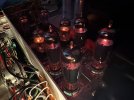
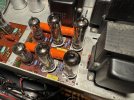
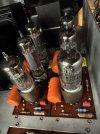
Progress update - started replacing resistors on the driver boards. Using Vishay 1% 1/2-1 Watt high-voltage rated components depending on the schematic requirements. I just received all of the components, I'm going with Cornell Dubilier orange caps for coupling caps on this amplifier, and silver micas to replace board ceramics. I had some 0.02 mfd safety caps for the power switch spark cap / ac filter and installed, extremely overkill but I enjoy it. The tubes I'm using on this build are JAN nos matched Sylvania EL84's, they sound great.

I thought the amp performed well with original resistors, despite the fact that some key resistors in the circuit (including the 120k) were above 50% out of spec. I am really impressed with how well designed these circuits were to the point that components can be on the point of useless and it still produces excellent sound. Upon replacing the components I just thought the amp sounded fantastic, and I thought that before. I did however notice that its three transformers were noticeably cooler to the touch.
 

Attachments

  • image0.jpeg
    image0.jpeg
    136.9 KB · Views: 52
  • image2.jpeg
    image2.jpeg
    141.8 KB · Views: 49
  • image3.jpeg
    image3.jpeg
    126.9 KB · Views: 50
  • image4.jpeg
    image4.jpeg
    119.7 KB · Views: 51
  • image5.jpeg
    image5.jpeg
    158.1 KB · Views: 49
Last edited:
Just make sure the thermistor isn't too close to the wiring on the output jacks. Those things get pretty toasty.


tube gear is pretty tolerant of sloppy component values, especially with a decent level of feedback. It covers up a lot of sins, but they do tend to sound better when things are actually where they belong.
 
Just make sure the thermistor isn't too close to the wiring on the output jacks. Those things get pretty toasty.


tube gear is pretty tolerant of sloppy component values, especially with a decent level of feedback. It covers up a lot of sins, but they do tend to sound better when things are actually where they belong.
Thanks gadget, per your advice I felt it (safely) while in operation and it's damn hot. I adjusted it a bit so it will vent upwards and away from the wires.
 
Today's update - the change in audio quality was staggering after replacing the cheap caps with orange drops and MPT's. Whereas changing out resistors didn't make much of a difference in aural character, these coupling caps changed it from sounding very nice to giving you goosebumps. I tried a few different type capacitors in my previous Mark 3 build and I settled upon Cornell Dubilier orange drops, and I can say they are as good as I've been able to find and very faithfully pass the AC signal through.
 

Attachments

  • IMG_5491.jpg
    IMG_5491.jpg
    74.7 KB · Views: 39
  • IMG_5494.jpg
    IMG_5494.jpg
    108.3 KB · Views: 39
  • IMG_5495.jpg
    IMG_5495.jpg
    159 KB · Views: 39
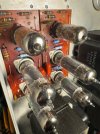
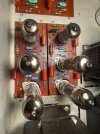
Update - driver boards completed, messed around with some nos 6GH8A's with an adapter and was not disappointed. Using my emissions tube tester I compared the state of my 7199 collection to a lot of RCA 6GH8A's that I was able to get very cheaply, well the 6GH8A's tested like 100% while the 7199's were all a bit worn out but still in the good position (but closer to the ?). The tester was kept configured for the 7199, and I tested the 6GH8A's with adapter as if they were 7199. I know I was considering rewiring the sockets for these type tubes, but I bought an ST-70 that came with these very nice gold plated adapters and they work beautifully. The 6GH8A's with adapter are audibly indistinguishable from my best testing RCA and Sylvania 7199's, can't tell a difference and neither can my scope.

The orange caps I used are overkill 800v rated 0.1 mf coupling. All resistors are Vishay and individually selected based upon their role in the circuit, most are 1% tolerance, high voltage / pulse rated. The lower voltage 0.1 mf ceramic cap was replaced with a 100v wima I had on hand. 12pF cap was replaced with 1kV USSR components I had left over from the Mark 3 builds I've been doing. They're fantastic.

I LCR test all components that I remove, and all I put in. Around half of the original resistors on the driver boards were like 30%+ out of spec, some were really bad. It's really impressive that the circuit still worked. The other half of the resistors tested very accurately, I'll save them for guitar pedals and other fun projects.

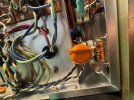
Up next I'll be replacing the capacitor cans as in my listening room I was able to perceive a low hum, these original cans are done. I'll replace the solid state rectifier section at the same time as they're all interlinked.

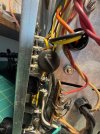
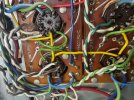
Finally, when selected the phono section has a very audible 60 cycle hum with nothing connected. I have tried adjusting the hum pots. So I'll be focusing on that board and its wiring, I can see that someone tried to modify the wiring of the phono section with ground shielded speaker wiring and I'm guessing that's the issue, it's so bad.



Attachments

  • IMG_5512.jpg
    IMG_5512.jpg
    106.3 KB · Views: 24
Last edited:
Hum at an unused input i consider uninteresting. The interesting is if the input hum's when using ground plugs or the intended source.
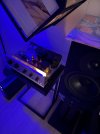
Thanks for that Peter. I'll be rebuilding the phono board towards the end and will test out a turntable. I've enjoyed a good many SCA-35's but never used the phono input so this is new territory for me. I know that it's a solid / acceptable board but does not perform as well as a PAS or other external preamp. I'm setting this amp up in a listening room where I'll have minimum equipment, just a turntable, Audioengine B1 streamer, and some Dynaudio Emit 20's.
 
Last edited:
I've never seen any discussion on Packaged Electronic Circuits, the proto IC's that are in various Dynaco amps. They contain capacitors and resistors that I assume set values for the tone controls. Should they be replaced? I always wondered about these but never have seen any focus on them. You can find NOS with PN 555003. Safe to assume that the capacitors inside are some sort of ceramic type build? I ordered some to investigate. Maybe I can pull some values from them and we can experiment with wiring up discrete components instead.

View attachment 3473007
If you need 555002, talk to Peter. I installed one w/o issues.
 
Back
Top Bottom