

You are using an out of date browser. It may not display this or other websites correctly.
You should upgrade or use an alternative browser.
You should upgrade or use an alternative browser.
Scott 299B Restore
- Thread starter Dave451
- Start date

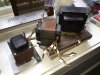
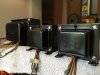

Got the transformers back in today--quite a job, but successful. Powered up after triple-checking everything and voltages were good. Sound check excellent! Here are some pictures of how the chassis looks with the newly-painted transformers. I then cleaned up the faceplate and knobs and put everything back together for semi-final checkout before moving this one to the "listening room." Sounds great even with the 'grab bag' of tubes in it. More pictures of the semi-final product. Can't wait to hook it up to my Klipsch KG 4's.
Attachments
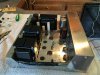
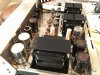
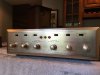
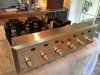
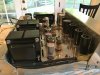
Thanks much, guys. I put on four feet and brought her up for some serious listening--sounds awesome into my modified KG 4's! The two Pyramid 'black beauties' are still in it, but I'll either replace them in the final version (new caps on the way) or try and bypass them as Dave G suggested to see what that does for the low end (which is already quite good). I'm going to try the replacement Sovetk EL84M's again when they show up as well--real good luck with them on another 299B. Amp is entirely hum free; even the phono section. Absolute, dead quiet at full volume on line input into the Klipsch. Phono still a bit 'rushy'--prob need to roll tubes a little, but that can come later. This one will give my Fisher X-200 a run for it's money, I think.
Going to re-cap the cross overs in the Scott X-100 speakers now and start work on the 350B tuner (separate thread for the tuner and will start one on the speakers). The speakers are late 60's vintage and are interesting and apparently not well known. Might be an "all Scott" system when complete!
Going to re-cap the cross overs in the Scott X-100 speakers now and start work on the 350B tuner (separate thread for the tuner and will start one on the speakers). The speakers are late 60's vintage and are interesting and apparently not well known. Might be an "all Scott" system when complete!

Dandy
Addicted Member
Nice work Dave,she sure looks pretty! Regarding the Pyramid coupling caps,they rank right up there with the Ceracaps and the Astrons.In other words,they're s**t!
The only thing I hate more than these brands of caps are my tax bills
Normally, I'd just say 'Amen'. But when I replaced the tone control Ceracaps in my 222C, I did imagine that it lost a little of the holographic magic. (Speaking entirely scientifically, of course!)

arts
Addicted Member
Normally, I'd just say 'Amen'. But when I replaced the tone control Ceracaps in my 222C, I did imagine that it lost a little of the holographic magic. (Speaking entirely scientifically, of course!)
Normally,I wouldn't dare risk agreeing with a statement like that. We both just might get votes in the ''village idiot'' category for this one,but I have also experienced this situation,where, after replacing defective components or just ''upgrading'' an older unit,the magic was lost.I will now,like any good former Infantryman,dive for cover!!
Well, the beauty of Dave G's suggestion is that I can jumper them and see what happens--it's easily reversible. I agree on the front-end caps (tone control, etc). I'm not planning to change any of those at risk of the amp's sound, which I'm very happy with. That's the main reason the referenced Pyramids are still in there. The front end caps are all Ceracaps or Pyramids. I guess I'm heading for cover, too!

Brycecb750
Active Member
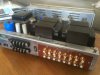
Great work! Looks awesome! I have wondered about bypassing those little LF filter coupling caps. I do a full recap on my Scott's (299c, LK48, LK72, 200) with hovland musicaps, .022 caps, Mepco gold 270k plate resistors in the phono pre. Then all westcap pio's or K40-y's throughout the rest, even in the tone section with little film 47 p caps too. Of course all the power supply caps and selenium rectifier. All of them sound pretty insane at this point and I really couldn't be happier with them. This is just what I personal like and found to be the best for my taste after years of different combos and trying things one at a time.
Bass performance on these is always impressive as I'm sure you are all aware, I wonder if getting rid of the super subsonic stuff so the power amp and speakers do have to waste power trying to reproduce it is part of this. I work in a recording studio and engineers are always working on subsonic bass management, cutting off the super low stuff like below 20 or 40 hz so the amps and woofer don't have to waste power trying to reproduce it. Would love to hear if anyone's bypassed those caps in Scott amps.
I also put in new RCA input jacks and better speaker up terminals and a phono ground screw, I'm always annoyed at the stock ones. I know I'm "destroying" a piece of hifi history is some people's eyes, but I use these amps to enjoy music, if I ever sell one, someone that feels the same will buy it and not someone looking for a musium piece.
Keep up the good work and make that Scott sing!!
Bass performance on these is always impressive as I'm sure you are all aware, I wonder if getting rid of the super subsonic stuff so the power amp and speakers do have to waste power trying to reproduce it is part of this. I work in a recording studio and engineers are always working on subsonic bass management, cutting off the super low stuff like below 20 or 40 hz so the amps and woofer don't have to waste power trying to reproduce it. Would love to hear if anyone's bypassed those caps in Scott amps.
I also put in new RCA input jacks and better speaker up terminals and a phono ground screw, I'm always annoyed at the stock ones. I know I'm "destroying" a piece of hifi history is some people's eyes, but I use these amps to enjoy music, if I ever sell one, someone that feels the same will buy it and not someone looking for a musium piece.
Keep up the good work and make that Scott sing!!
Attachments
Last edited:
Bryce, beautiful work, man! I do like what you did with the RCAs--I just soldier on with older cables that will fit the close-together originals, but I am tempted to go your route, as some of my better cables won't fit!
You mentioned the 0.0012 caps, so here is an UPDATE. I continued to think the 299B sounded great, but maybe just a little dull compared to the 299B I restored before and compared to my Fisher X-200. So, I decided to change out the aforementioned Pyramid couplers and 2) recheck the bias on the EL84M's that I'd had trouble biasing and the various voltages.
Well Dandy said the Pyramid's didn't age well and Art said he put them right up (down?) there with Ceracaps and Astron's for poor quality. You guys were both right. The two caps measured at .0018 to .0019 uf (that didn't tell the whole story, either) and I replaced them with metallized polypro, fired her up and the difference in the sound was immediately obvious. Much more detail and better highs; no trace of any 'dullness!' The lesson is that all the audio passes through these two, and if they're not up to snuff it affects everything after! (The prior 299B actually had disc ceramics instead--I'll probably deal with them when it's time for a check up for that one). I thought about just bypassing them, as Dave G had suggested but decided to try a replacement first. We'll see how that plays vis a vis low frequency response, but I'll probably just leave it like this since it sounds so good. I may bypass them on the other 299B and compare.
Bias and voltages all good (re-biased the EL84M's to 49 mA per pair). 19+ WRMS per channel.
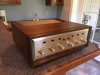
I also bought a custom wood case for the 299B and it now sits proudly on the shelf in my study with my 350B tuner. Picture below.
Dave
You mentioned the 0.0012 caps, so here is an UPDATE. I continued to think the 299B sounded great, but maybe just a little dull compared to the 299B I restored before and compared to my Fisher X-200. So, I decided to change out the aforementioned Pyramid couplers and 2) recheck the bias on the EL84M's that I'd had trouble biasing and the various voltages.
Well Dandy said the Pyramid's didn't age well and Art said he put them right up (down?) there with Ceracaps and Astron's for poor quality. You guys were both right. The two caps measured at .0018 to .0019 uf (that didn't tell the whole story, either) and I replaced them with metallized polypro, fired her up and the difference in the sound was immediately obvious. Much more detail and better highs; no trace of any 'dullness!' The lesson is that all the audio passes through these two, and if they're not up to snuff it affects everything after! (The prior 299B actually had disc ceramics instead--I'll probably deal with them when it's time for a check up for that one). I thought about just bypassing them, as Dave G had suggested but decided to try a replacement first. We'll see how that plays vis a vis low frequency response, but I'll probably just leave it like this since it sounds so good. I may bypass them on the other 299B and compare.
Bias and voltages all good (re-biased the EL84M's to 49 mA per pair). 19+ WRMS per channel.
I also bought a custom wood case for the 299B and it now sits proudly on the shelf in my study with my 350B tuner. Picture below.
Dave
Attachments

Super job Dave!! That is one sharp look Scott! A couple of comments to add to the conversation:
1. Regarding the subsonic filter: Fisher, Scott, and others used these filters to prevent needless power loss to changer rumble and/or TT wow and flutter issues. If vinyl is still part of your audio experience, then -- based on the quality of vinyl playback equipment you have, and how it is installed -- you can either leave them installed or bypass them based on what is most appropriate for your needs. The filter can also help with some FM tuners that don't appropriately control the LF "thump" as a station carrier is tuned in and out when tuning along the band. A properly designed tuner however will not display this type of socially unacceptable behavior. Modern high quality line level digital sources employ automatic muting during user input commands, eliminating the need for the filter on these sources. And of course, it is these sources where removal of the filter will have the greatest effect, since it is the modern digital sources that contain such enhanced LF energy, relative to that of vinyl sources.
2. In changing out tone control caps, it is almost a guarantee that the new caps will cause the controls to operate at a slightly different position to produce the same response as before -- particularly with the bass control, and particularly so if they are of the active design type, as the Scott's are. Therefore, the magic may still be there, but at a new address.
Just some stuff to bandy about in the conversation. Great job on the Scott!
Dave
1. Regarding the subsonic filter: Fisher, Scott, and others used these filters to prevent needless power loss to changer rumble and/or TT wow and flutter issues. If vinyl is still part of your audio experience, then -- based on the quality of vinyl playback equipment you have, and how it is installed -- you can either leave them installed or bypass them based on what is most appropriate for your needs. The filter can also help with some FM tuners that don't appropriately control the LF "thump" as a station carrier is tuned in and out when tuning along the band. A properly designed tuner however will not display this type of socially unacceptable behavior. Modern high quality line level digital sources employ automatic muting during user input commands, eliminating the need for the filter on these sources. And of course, it is these sources where removal of the filter will have the greatest effect, since it is the modern digital sources that contain such enhanced LF energy, relative to that of vinyl sources.
2. In changing out tone control caps, it is almost a guarantee that the new caps will cause the controls to operate at a slightly different position to produce the same response as before -- particularly with the bass control, and particularly so if they are of the active design type, as the Scott's are. Therefore, the magic may still be there, but at a new address.
Just some stuff to bandy about in the conversation. Great job on the Scott!
Dave
Dandy
Addicted Member

Thanks much, Dave. Interesting about the low filter. The first 299B I mentioned I gave to my daughter and son-in-law, along with my turntable and my whole vinyl collection. It's the one with the ceramic caps in this location, so they may be doing some good. I don't think they're using the 'rumble filter', though, in the interest of better bass. I'll have to check.
By the way, the 0;.0012 caps I'm talking about are directly in the audio path into the grids of the first AF amplifier stage (12AX7). The "rumble filter" control switches in another 0.0033 uF cap.
My sources are now CD's, iPhone/iPod (yes, I still have one) on-line streaming, SAT radio, and FM radio. So, all digital source but for good old analog FM (unless they're playing CD's I guess--I do still hear the faint rumble of turntables every now and then, though). As far as the magic is concerned, it is still definitely there, but I'll have to listen more to see if it's moved around any!. This 299B is one of my keepers (hence the fancy case), so I can play around with it a bit as we go forward and can try life without these caps as well.
The only LF source of the type you're mentioning that I notice is a college FM station. Good sound, but fairly loud and frequent low frequency microphone pops when the announcer is talking. Don't know if the filter is helping that or not and need to compare with my X-200. As I recall your description of the (K)X-200, this permanent LF filter was removed.
By the way, if you don't mind, would you help me a little more with the difference between active and passive tone controls and how they are manifested in the circuitry. I had thought the tone controls in both the X-200 and 299B were passive, but apparently not.
Dave
By the way, the 0;.0012 caps I'm talking about are directly in the audio path into the grids of the first AF amplifier stage (12AX7). The "rumble filter" control switches in another 0.0033 uF cap.
My sources are now CD's, iPhone/iPod (yes, I still have one) on-line streaming, SAT radio, and FM radio. So, all digital source but for good old analog FM (unless they're playing CD's I guess--I do still hear the faint rumble of turntables every now and then, though). As far as the magic is concerned, it is still definitely there, but I'll have to listen more to see if it's moved around any!. This 299B is one of my keepers (hence the fancy case), so I can play around with it a bit as we go forward and can try life without these caps as well.
The only LF source of the type you're mentioning that I notice is a college FM station. Good sound, but fairly loud and frequent low frequency microphone pops when the announcer is talking. Don't know if the filter is helping that or not and need to compare with my X-200. As I recall your description of the (K)X-200, this permanent LF filter was removed.
By the way, if you don't mind, would you help me a little more with the difference between active and passive tone controls and how they are manifested in the circuitry. I had thought the tone controls in both the X-200 and 299B were passive, but apparently not.
Dave
Correct -- it is the .0012 uF caps I'm talking about, that make up a "permanent" LF filter. The .0033uF cap can be switched in and out of the circuit at will by the LF Filter Sw.
The announcer "pop" you refer to is a station problem, not a tuner problem. The thump I'm referring to is due to tuning a carrier in and out of resonance with the tuner.
Fisher did in fact remove the permanent LF filter in the (K)X-200 units, but kept them in all the receivers. They can be removed in the 400 series, but must remain in the 500C and 800C due to the large DC shift created when the Automatic FM Stereo Switching circuits of those models triggers in and out.
There is nothing mysterious in identifying active and passive tone controls. The Fisher unit you cite uses passive tone controls, while the Scott uses an active tone control design. The differences include:
1. Passive Tone Controls -- as the name implies -- use no power to operate, and are nothing but a frequency sensitive "losser" circuit inserted in series with the signal. When set for flat performance, they will typically produce about a 15 db (or so) loss of signal evenly (hopefully) across the audio bandwidth. When the controls are turned towards cut, the signal is reduced even more (frequency appropriate), and when boosted, there is simply less loss than at a flat setting, so the appropriate frequencies are then boosted. However, even with the controls at full boost, there is ALWAYS a signal loss through passive tone controls.
2. Active Tone Controls -- as the name implies -- require a stage of amplification to work with. The controls are connected so as to control the amount of frequency sensitive NFB applied around the stage of amplification they work with, such that at a flat setting, the gain of the tone control circuit operates at unity across the audio spectrum. As the controls are turned towards cut, the frequency appropriate NFB is increased, therefore reducing the output signal from the stage. As the controls are turned towards boost, the appropriate NFB is reduced, increasing the output signal from the stage. In the boost position, active tone controls ALWAYS provide a degree of amplification, relative to the signal applied to the tone control circuit.
I hope this helps!
Dave
The announcer "pop" you refer to is a station problem, not a tuner problem. The thump I'm referring to is due to tuning a carrier in and out of resonance with the tuner.
Fisher did in fact remove the permanent LF filter in the (K)X-200 units, but kept them in all the receivers. They can be removed in the 400 series, but must remain in the 500C and 800C due to the large DC shift created when the Automatic FM Stereo Switching circuits of those models triggers in and out.
There is nothing mysterious in identifying active and passive tone controls. The Fisher unit you cite uses passive tone controls, while the Scott uses an active tone control design. The differences include:
1. Passive Tone Controls -- as the name implies -- use no power to operate, and are nothing but a frequency sensitive "losser" circuit inserted in series with the signal. When set for flat performance, they will typically produce about a 15 db (or so) loss of signal evenly (hopefully) across the audio bandwidth. When the controls are turned towards cut, the signal is reduced even more (frequency appropriate), and when boosted, there is simply less loss than at a flat setting, so the appropriate frequencies are then boosted. However, even with the controls at full boost, there is ALWAYS a signal loss through passive tone controls.
2. Active Tone Controls -- as the name implies -- require a stage of amplification to work with. The controls are connected so as to control the amount of frequency sensitive NFB applied around the stage of amplification they work with, such that at a flat setting, the gain of the tone control circuit operates at unity across the audio spectrum. As the controls are turned towards cut, the frequency appropriate NFB is increased, therefore reducing the output signal from the stage. As the controls are turned towards boost, the appropriate NFB is reduced, increasing the output signal from the stage. In the boost position, active tone controls ALWAYS provide a degree of amplification, relative to the signal applied to the tone control circuit.
I hope this helps!
Dave